 Add to Chrome
 Add to Firefox
 Add to Edge
SalsaAgent: A multimodal embodied language model for interactive dance generation
May 28, 2026
Interaction between humanoids involves bidirectional and nonverbal reactivity, coordination and synchrony. Toward socially aware robots and interactive virtual agents, we present SalsaAgent, a language model that generates expressive, full-body salsa dance motions in reaction to a human leader and against a contextual music backdrop. We formulate interaction as nonverbal motion token passing, extending the vocabulary of a large language model (LLM) to process discrete motion tokens, pairwise relation tokens, and audio. Our contributions include new tokens for full-body and motion relations, LLM fine-tuning using automatically derived text descriptions of skeleton dynamics for token grounding, and a two-stage token-to-diffusion pipeline. Subjective and objective evaluations demonstrate the effectiveness of our approach in terms of motion quality, music and partner coordination, and consistent two-person spatial behavior, with significant improvements over baselines.

MotionScript: Natural Language Descriptions for Expressive 3D Human Motions
Dec 19, 2023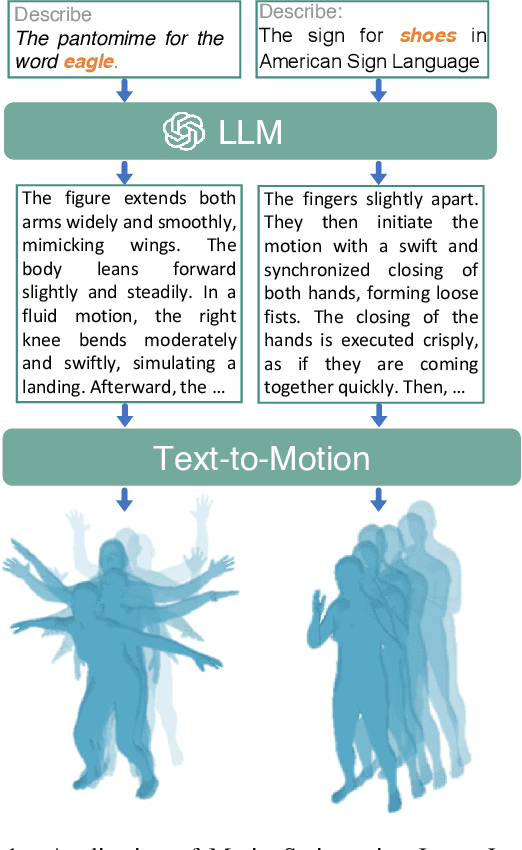

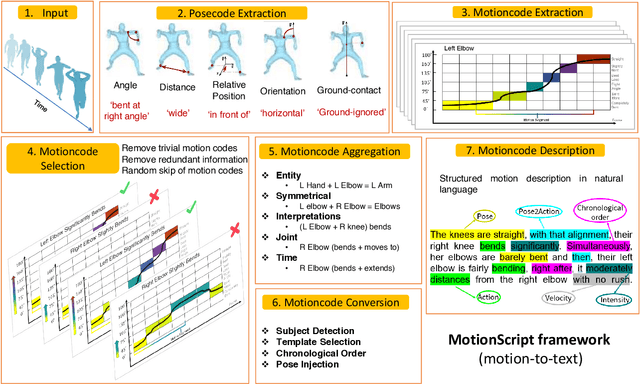
This paper proposes MotionScript, a motion-to-text conversion algorithm and natural language representation for human body motions. MotionScript aims to describe movements in greater detail and with more accuracy than previous natural language approaches. Many motion datasets describe relatively objective and simple actions with little variation on the way they are expressed (e.g. sitting, walking, dribbling a ball). But for expressive actions that contain a diversity of movements in the class (e.g. being sad, dancing), or for actions outside the domain of standard motion capture datasets (e.g. stylistic walking, sign-language), more specific and granular natural language descriptions are needed. Our proposed MotionScript descriptions differ from existing natural language representations in that it provides direct descriptions in natural language instead of simple action labels or high-level human captions. To the best of our knowledge, this is the first attempt at translating 3D motions to natural language descriptions without requiring training data. Our experiments show that when MotionScript representations are used in a text-to-motion neural task, body movements are more accurately reconstructed, and large language models can be used to generate unseen complex motions.