 Add to Chrome
 Add to Firefox
 Add to Edge
Diffusion-Based Electromagnetic Inverse Design of Scattering Structured Media
Nov 07, 2025
We present a conditional diffusion model for electromagnetic inverse design that generates structured media geometries directly from target differential scattering cross-section profiles, bypassing expensive iterative optimization. Our 1D U-Net architecture with Feature-wise Linear Modulation learns to map desired angular scattering patterns to 2x2 dielectric sphere structure, naturally handling the non-uniqueness of inverse problems by sampling diverse valid designs. Trained on 11,000 simulated metasurfaces, the model achieves median MPE below 19% on unseen targets (best: 1.39%), outperforming CMA-ES evolutionary optimization while reducing design time from hours to seconds. These results demonstrate that employing diffusion models is promising for advancing electromagnetic inverse design research, potentially enabling rapid exploration of complex metasurface architectures and accelerating the development of next-generation photonic and wireless communication systems. The code is publicly available at https://github.com/mikzuker/inverse_design_metasurface_generation.

Drone Carry-on Weight and Wind Flow Assessment via Micro-Doppler Analysis
Oct 26, 2025Remote monitoring of drones has become a global objective due to emerging applications in national security and managing aerial delivery traffic. Despite their relatively small size, drones can carry significant payloads, which require monitoring, especially in cases of unauthorized transportation of dangerous goods. A drone's flight dynamics heavily depend on outdoor wind conditions and the carry-on weight, which affect the tilt angle of a drone's body and the rotation velocity of the blades. A surveillance radar can capture both effects, provided a sufficient signal-to-noise ratio for the received echoes and an adjusted postprocessing detection algorithm. Here, we conduct a systematic study to demonstrate that micro-Doppler analysis enables the disentanglement of the impacts of wind and weight on a hovering drone. The physics behind the effect is related to the flight controller, as the way the drone counteracts weight and wind differs. When the payload is balanced, it imposes an additional load symmetrically on all four rotors, causing them to rotate faster, thereby generating a blade-related micro-Doppler shift at a higher frequency. However, the impact of the wind is different. The wind attempts to displace the drone, and to counteract this, the drone tilts to the side. As a result, the forward and rear rotors rotate at different velocities to maintain the tilt angle of the drone body relative to the airflow direction. This causes the splitting in the micro-Doppler spectra. By performing a set of experiments in a controlled environment, specifically, an anechoic chamber for electromagnetic isolation and a wind tunnel for imposing deterministic wind conditions, we demonstrate that both wind and payload details can be extracted using a simple deterministic algorithm based on branching in the micro-Doppler spectra.
Partially Coherent Radar Unties Range Resolution from Bandwidth Limitations
Jun 28, 2021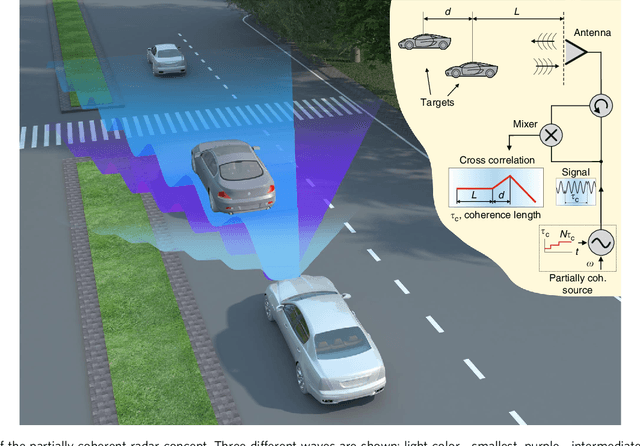
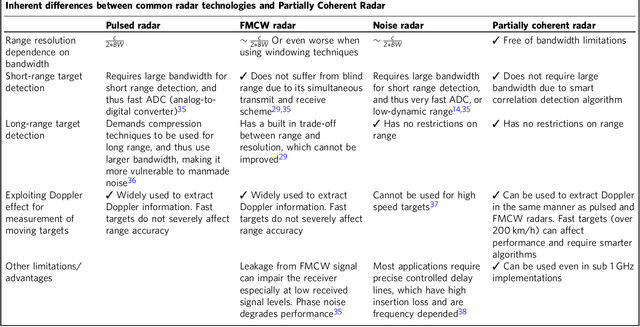
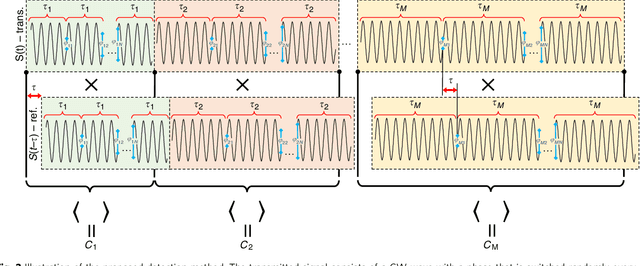
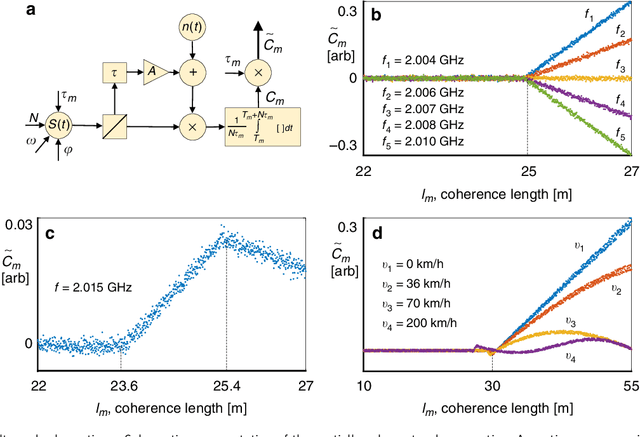
It is widely believed that range resolution, the ability to distinguish between two closely situated targets, depends inversely on the bandwidth of the transmitted radar signal. Here we demonstrate a different type of ranging system, which possesses superior range resolution that is almost completely free of bandwidth limitations. By sweeping over the coherence length of the transmitted signal, the partially coherent radar experimentally demonstrates an improvement of over an order of magnitude in resolving targets, compared to standard coherent radars with the same bandwidth.. A theoretical framework is developed to show that the resolution could be further improved without a bound, revealing a tradeoff between bandwidth and sweep time. This concept offers solutions to problems which require high range resolution and accuracy but available bandwidth is limited, as is the case for the autonomous car industry, optical imaging, and astronomy to name just few.
Broadband Radar Invisibility with Time-Dependent Metasurfaces
Apr 20, 2021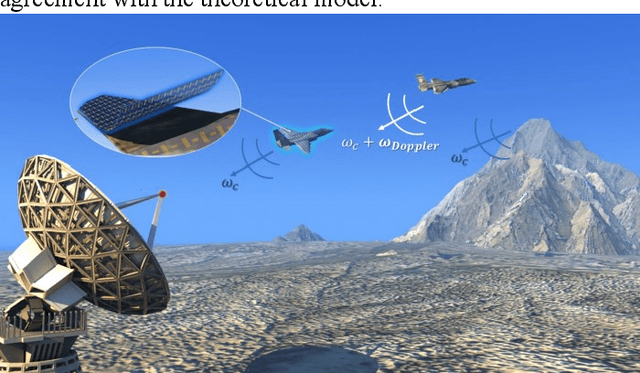
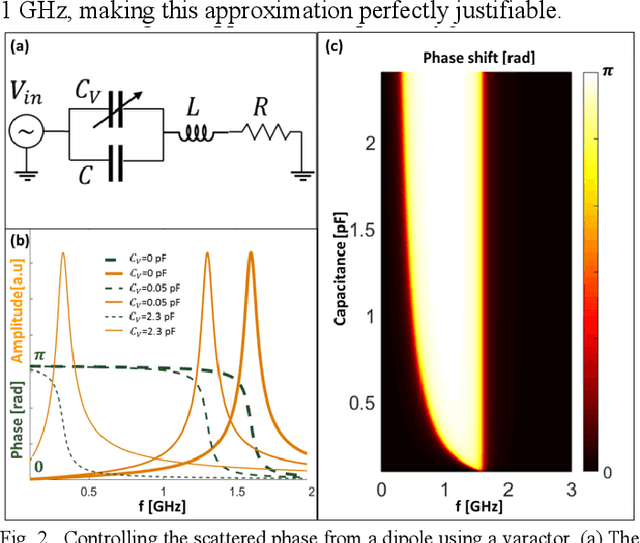
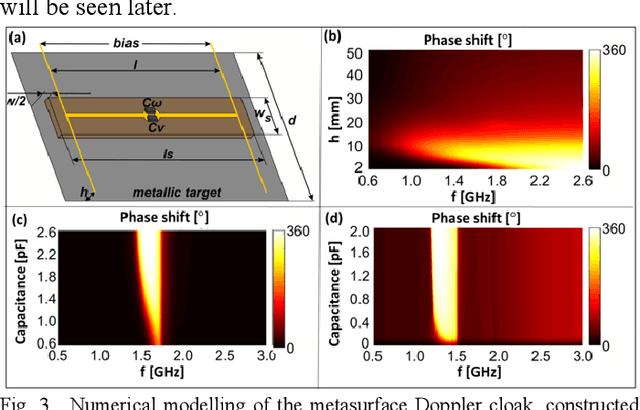
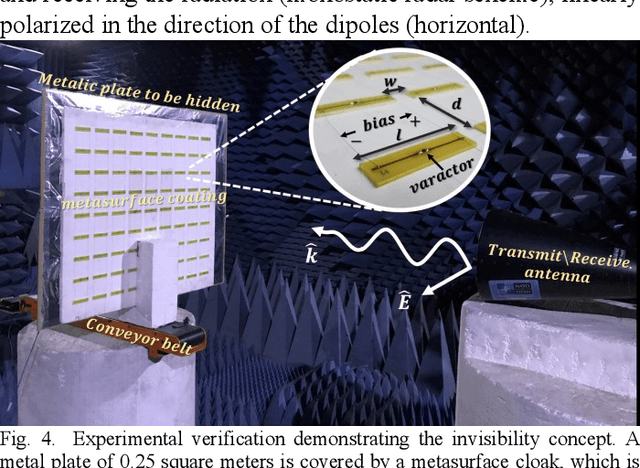
Concealing objects from interrogation has been a primary objective since the integration of radars into surveillance systems. Metamaterial-based invisibility cloaking, which was considered a promising solution, did not yet succeed in delivering reliable performance against real radar systems, mainly due to its narrow operational bandwidth. Here we propose an approach, which addresses the issue from a signal-processing standpoint and, as a result, is capable of coping with the vast majority of unclassified radar systems by exploiting vulnerabilities in their design. In particular, we demonstrate complete concealment of a 0.25 square meter moving metal plate from an investigating radar system, operating in a broad frequency range approaching 20% bandwidth around the carrier of 1.5GHz. The key element of the radar countermeasure is a temporally modulated coating. This auxiliary structure is designed to dynamically and controllably adjust the reflected phase of the impinging radar signal, which acquires a user-defined Doppler shift. A special case of interest is imposing a frequency shift that compensates for the real Doppler signatures originating from the motion of the target. In this case the radar will consider the target static, even though it is moving. As a result, the reflected echo will be discarded by the clutter removal filter, which is an inherent part of any modern radar system that is designed to operate in real conditions. This signal-processing loophole allows rendering the target invisible to the radar even though it scatters electromagnetic radiation. This application claims the benefit of patent number 273995, filed on April 16 2020.