 Add to Chrome
 Add to Firefox
 Add to Edge
Training data generation for context-dependent rubric-based short answer grading
Mar 31, 2026
Every four years, the PISA test is administered by the OECD to test the knowledge of teenage students worldwide and allow for comparisons of educational systems. However, having to avoid language differences and annotator bias makes the grading of student answers challenging. For these reasons, it would be interesting to consider methods of automatic student answer grading. To train some of these methods, which require machine learning, or to compute parameters or select hyperparameters for those that do not, a large amount of domain-specific data is needed. In this work, we explore a small number of methods for creating a large-scale training dataset using only a relatively small confidential dataset as a reference, leveraging a set of very simple derived text formats to preserve confidentiality. Using the proposed methods, we successfully created three surrogate datasets that are, at the very least, superficially more similar to the reference dataset than a straightforward result of prompt-based generation. Early experiments suggest one of these approaches might also lead to improved training of automatic answer grading models.

Overview of the Sensemaking Task at the ELOQUENT 2025 Lab: LLMs as Teachers, Students and Evaluators
Jul 16, 2025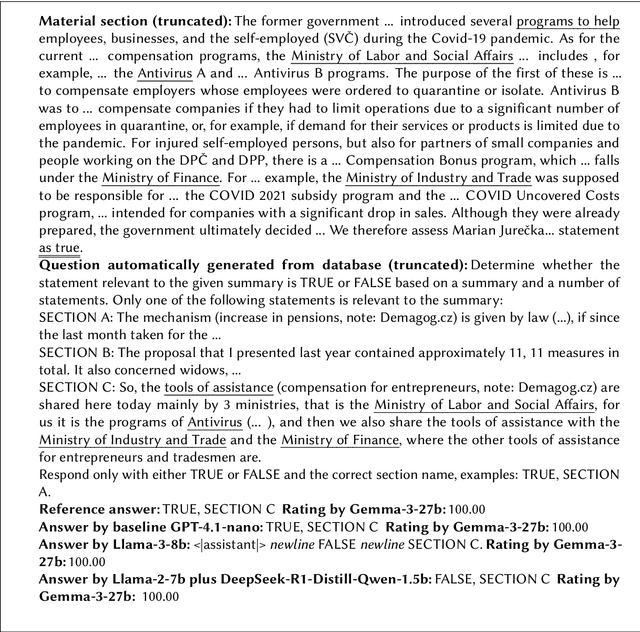
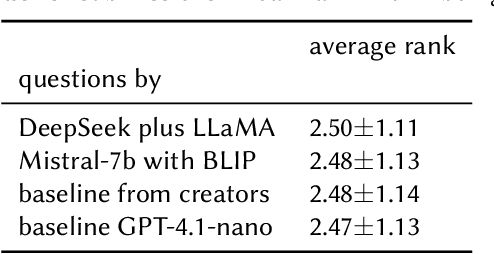
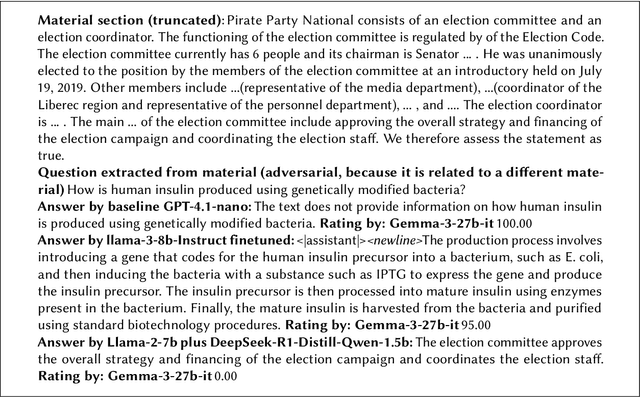
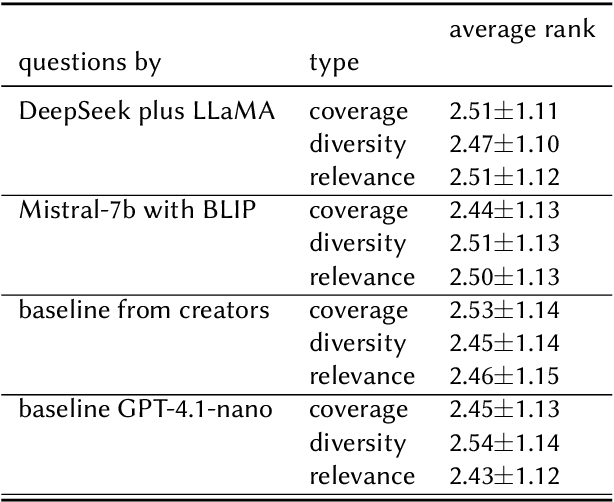
ELOQUENT is a set of shared tasks that aims to create easily testable high-level criteria for evaluating generative language models. Sensemaking is one such shared task. In Sensemaking, we try to assess how well generative models ``make sense out of a given text'' in three steps inspired by exams in a classroom setting: (1) Teacher systems should prepare a set of questions, (2) Student systems should answer these questions, and (3) Evaluator systems should score these answers, all adhering rather strictly to a given set of input materials. We report on the 2025 edition of Sensemaking, where we had 7 sources of test materials (fact-checking analyses of statements, textbooks, transcribed recordings of a lecture, and educational videos) spanning English, German, Ukrainian, and Czech languages. This year, 4 teams participated, providing us with 2 Teacher submissions, 2 Student submissions, and 2 Evaluator submissions. We added baselines for Teacher and Student using commercial large language model systems. We devised a fully automatic evaluation procedure, which we compare to a minimalistic manual evaluation. We were able to make some interesting observations. For the first task, the creation of questions, better evaluation strategies will still have to be devised because it is difficult to discern the quality of the various candidate question sets. In the second task, question answering, the LLMs examined overall perform acceptably, but restricting their answers to the given input texts remains problematic. In the third task, evaluation of question answers, our adversarial tests reveal that systems using the LLM-as-a-Judge paradigm erroneously rate both garbled question-answer pairs and answers to mixed-up questions as acceptable.