 Add to Chrome
 Add to Firefox
 Add to Edge
LLM Agent Based Renewable Energy Forecasting Using Edge and IoT Data A Review of Solar Wind Weather and Grid Aware Decision Support
May 24, 2026
Reliable forecasting of renewable energy generation is a foundational requirement for grid stability energy trading battery scheduling and carbon aware operational planning Solar and wind resources are inherently intermittent their output fluctuates with cloud cover wind speed atmospheric turbulence seasonal patterns and local terrain The proliferation of IoT and edge devices spanning smart meters inverters anemometers pyranometers weather stations and grid interface sensors has created an unprecedented volume of real time operational data that conventional forecasting pipelines are ill equipped to exploit fully This review investigates how large language model LLM agents can enhance renewable energy forecasting by integrating heterogeneous sensor streams weather API data historical generation records grid constraints and contextual reasoning into unified decision support workflows We survey classical forecasting methods statistical time series models deep learning architectures physics hybrid approaches and emerging LLM agent frameworks for explanation uncertainty communication and operator guidance A six layer taxonomy is proposed covering data acquisition preprocessing feature engineering model inference uncertainty estimation and natural language reporting The review identifies twelve open challenges spanning real time deployment model drift under distribution shift uncertainty quantification hallucination control in LLM agents interoperability of edge hardware and integration with energy management systems The paper concludes by recommending a research agenda centred on open benchmarks physics informed LLM grounding and federated forecasting architectures

Exploiting On-chip Heterogeneity of Versal Architecture for GNN Inference Acceleration
Aug 04, 2023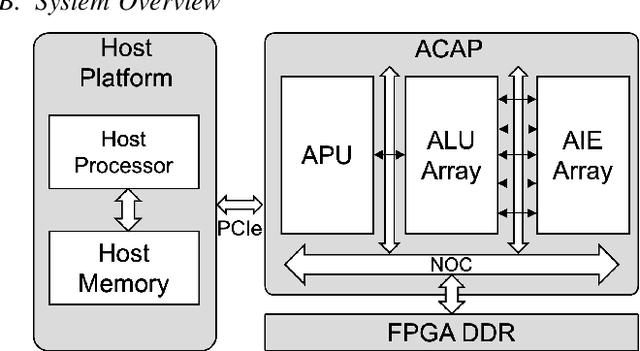
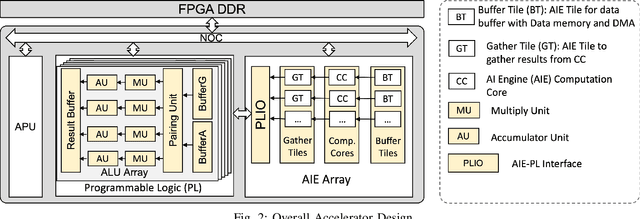
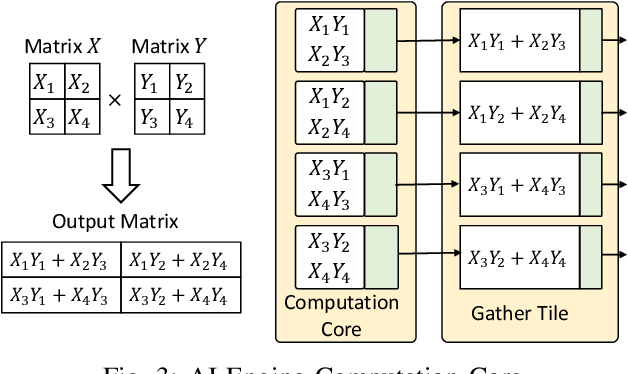
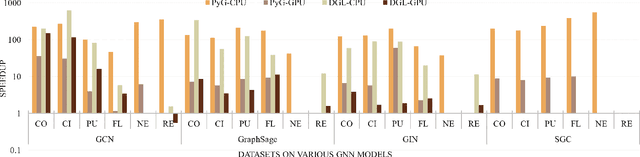
Graph Neural Networks (GNNs) have revolutionized many Machine Learning (ML) applications, such as social network analysis, bioinformatics, etc. GNN inference can be accelerated by exploiting data sparsity in the input graph, vertex features, and intermediate data in GNN computations. For dynamic sparsity exploitation, we leverage the heterogeneous computing capabilities of AMD Versal ACAP architecture to accelerate GNN inference. We develop a custom hardware module that executes the sparse primitives of the computation kernel on the Programmable Logic (PL) and efficiently computes the dense primitives using the AI Engine (AIE). To exploit data sparsity during inference, we devise a runtime kernel mapping strategy that dynamically assigns computation tasks to the PL and AIE based on data sparsity. Our implementation on the VCK5000 ACAP platform leads to superior performance compared with the state-of-the-art implementations on CPU, GPU, ACAP, and other custom GNN accelerators. Compared with these implementations, we achieve significant average runtime speedup across various models and datasets of 162.42x, 17.01x, 9.90x, and 27.23x, respectively. Furthermore, for Graph Convolutional Network (GCN) inference, our approach leads to a speedup of 3.9-96.7x compared to designs using PL only on the same ACAP device.