 Add to Chrome
 Add to Firefox
 Add to Edge
Robostral Navigate
Jul 24, 2026
Deploying navigation systems at scale requires a recipe that minimizes sensor assumptions, generalizes across robot embodiments, and trains efficiently. Yet, today's best systems depend on depth sensors, multi-camera rigs, or pre-built maps, limiting the hardware they support and increasing deployment cost. We introduce Robostral Navigate, an 8B vision-language model built around this scalability objective. The model consumes only a stream of monocular RGB images - the most ubiquitous sensor across robotic platforms and predicts waypoints by pointing to the next target location in the current camera view. Operating purely in image space, rather than robot-specific coordinates, makes the policy naturally robust to changes in camera intrinsics and scene scale, enabling deployment across wheeled, legged, and aerial robots without recalibration. We generate 2.4 million trajectories across 350k simulated scenes to reduce the reliance on real-world data collection and scale easily. We further introduce a prefix-caching training recipe that packs entire episodes into single training sequences, reducing training tokens by 22x and cutting training time from months to days. A tree-based attention mask prevents conditioning on previous ground-truth actions, encouraging visually grounded action prediction, and reinforcement learning is used to further improve exploration and recovery capabilities. On the Room-to-Room and Room-Across-Room in Continuous Environments (R2R-CE and RxR-CE) benchmarks, Robostral Navigate sets a new state of the art. On R2R-CE, it achieves a 77.4% success rate, surpassing the best monocular method by 10.5 points and the strongest depth- or multi-camera system by 5.3 points despite using only a single RGB camera. On RxR-CE, it reaches 75.1% success rate, outperforming all monocular baselines.

BASIL: Balanced Active Semi-supervised Learning for Class Imbalanced Datasets
Mar 10, 2022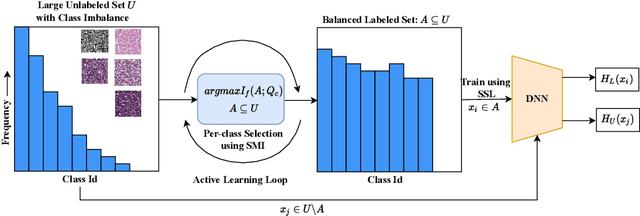
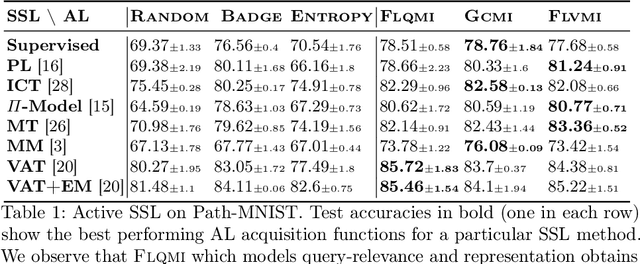
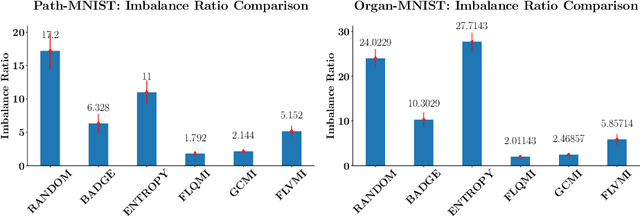
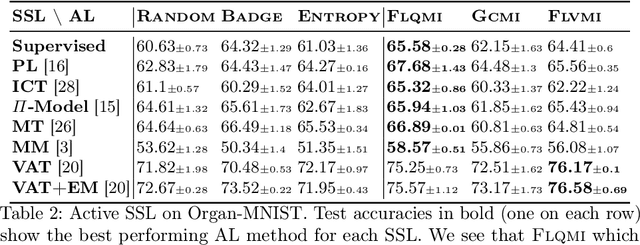
Current semi-supervised learning (SSL) methods assume a balance between the number of data points available for each class in both the labeled and the unlabeled data sets. However, there naturally exists a class imbalance in most real-world datasets. It is known that training models on such imbalanced datasets leads to biased models, which in turn lead to biased predictions towards the more frequent classes. This issue is further pronounced in SSL methods, as they would use this biased model to obtain psuedo-labels (on the unlabeled data) during training. In this paper, we tackle this problem by attempting to select a balanced labeled dataset for SSL that would result in an unbiased model. Unfortunately, acquiring a balanced labeled dataset from a class imbalanced distribution in one shot is challenging. We propose BASIL (Balanced Active Semi-supervIsed Learning), a novel algorithm that optimizes the submodular mutual information (SMI) functions in a per-class fashion to gradually select a balanced dataset in an active learning loop. Importantly, our technique can be efficiently used to improve the performance of any SSL method. Our experiments on Path-MNIST and Organ-MNIST medical datasets for a wide array of SSL methods show the effectiveness of Basil. Furthermore, we observe that Basil outperforms the state-of-the-art diversity and uncertainty based active learning methods since the SMI functions select a more balanced dataset.
Overcoming Conflicting Data for Model Updates
Oct 23, 2020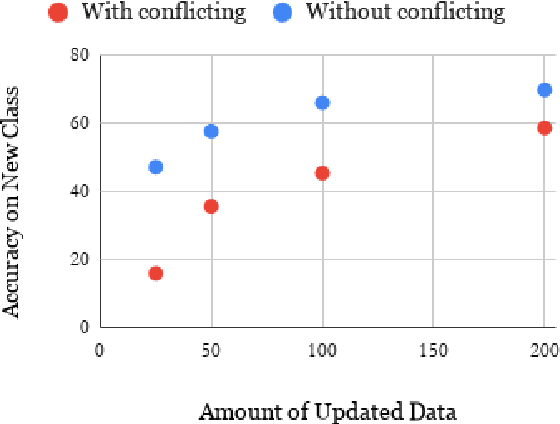
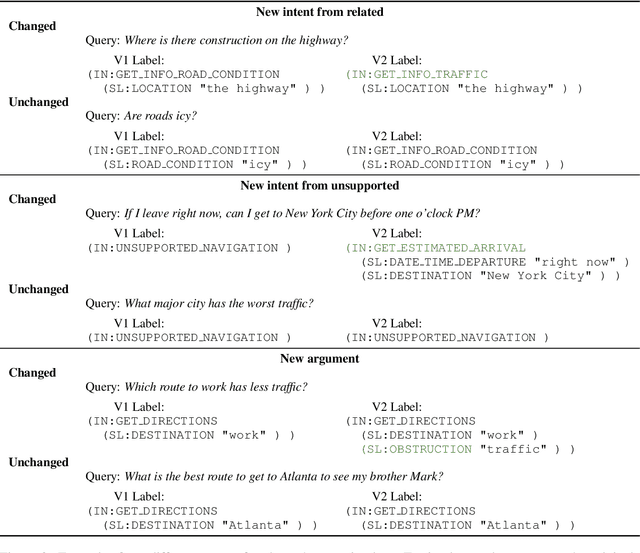
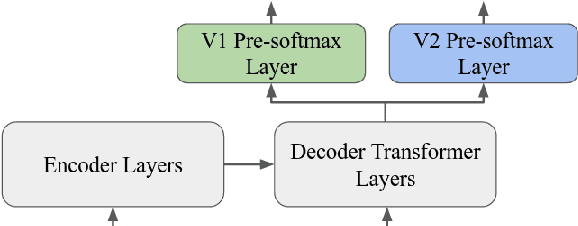
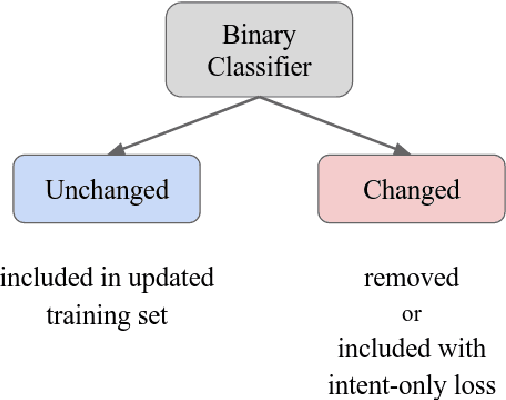
In this paper, we explore how to use a small amount of new data to update a model when the desired output for some examples has changed. When making updates in this way, one potential problem that arises is the presence of conflicting data, or out-of-date labels in the original training set. To evaluate the impact of this problem, we propose an experimental setup for simulating changes to a neural semantic parser. We show that the presence of conflicting data greatly hinders learning of an update, then explore several methods to mitigate its effect. Our methods lead to large improvements in model accuracy compared to a naive mixing strategy, and our best method closes 86% of the accuracy gap between this baseline and an oracle upper bound.