 Add to Chrome
 Add to Firefox
 Add to Edge
Evaluating Post-hoc Explanations of the Transformer-based Genome Language Model DNABERT-2
Apr 23, 2026
Explaining deep neural network predictions on genome sequences enables biological insight and hypothesis generation-often of greater interest than predictive performance alone. While explanations of convolutional neural networks (CNNs) have been shown to capture relevant patterns in genome sequences, it is unclear whether this transfers to more expressive Transformer-based genome language models (gLMs). To answer this question, we adapt AttnLRP, an extension of layer-wise relevance propagation to the attention mechanism, and apply it to the state-of-the-art gLM DNABERT-2. Thereby, we propose strategies to transfer explanations from token and nucleotide level. We evaluate the adaption of AttnLRP on genomic datasets using multiple metrics. Further, we provide an extensive comparison between the explanations of DNABERT-2 and a baseline CNN. Our results demonstrate that AttnLRP yields reliable explanations corresponding to known biological patterns. Hence, like CNNs, gLMs can also help derive biological insights. This work contributes to the explainability of gLMs and addresses the comparability of relevance attributions across different architectures.

Sparse Explanations of Neural Networks Using Pruned Layer-Wise Relevance Propagation
Apr 22, 2024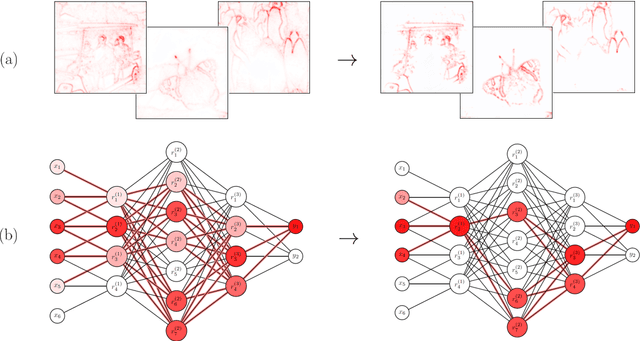
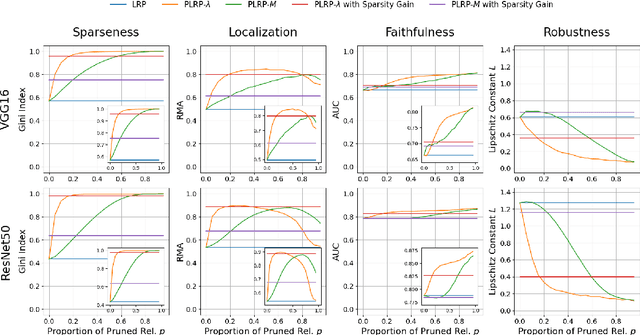
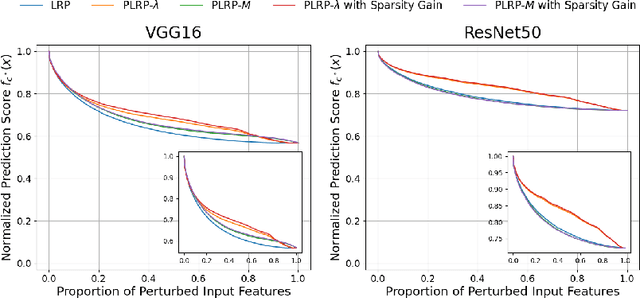
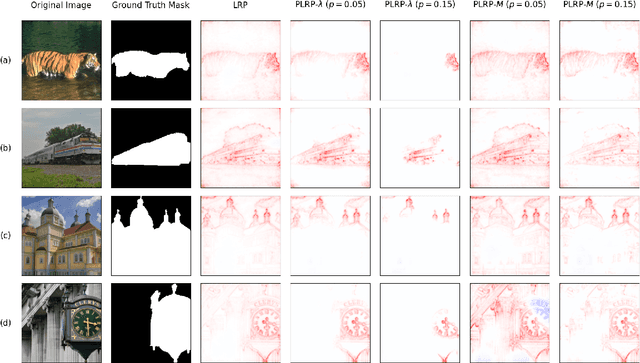
Explainability is a key component in many applications involving deep neural networks (DNNs). However, current explanation methods for DNNs commonly leave it to the human observer to distinguish relevant explanations from spurious noise. This is not feasible anymore when going from easily human-accessible data such as images to more complex data such as genome sequences. To facilitate the accessibility of DNN outputs from such complex data and to increase explainability, we present a modification of the widely used explanation method layer-wise relevance propagation. Our approach enforces sparsity directly by pruning the relevance propagation for the different layers. Thereby, we achieve sparser relevance attributions for the input features as well as for the intermediate layers. As the relevance propagation is input-specific, we aim to prune the relevance propagation rather than the underlying model architecture. This allows to prune different neurons for different inputs and hence, might be more appropriate to the local nature of explanation methods. To demonstrate the efficacy of our method, we evaluate it on two types of data, images and genomic sequences. We show that our modification indeed leads to noise reduction and concentrates relevance on the most important features compared to the baseline.