 Add to Chrome
 Add to Firefox
 Add to Edge
A Standardized Benchmark for Multilabel Antimicrobial Peptide Classification
Nov 06, 2025
Antimicrobial peptides have emerged as promising molecules to combat antimicrobial resistance. However, fragmented datasets, inconsistent annotations, and the lack of standardized benchmarks hinder computational approaches and slow down the discovery of new candidates. To address these challenges, we present the Expanded Standardized Collection for Antimicrobial Peptide Evaluation (ESCAPE), an experimental framework integrating over 80.000 peptides from 27 validated repositories. Our dataset separates antimicrobial peptides from negative sequences and incorporates their functional annotations into a biologically coherent multilabel hierarchy, capturing activities across antibacterial, antifungal, antiviral, and antiparasitic classes. Building on ESCAPE, we propose a transformer-based model that leverages sequence and structural information to predict multiple functional activities of peptides. Our method achieves up to a 2.56% relative average improvement in mean Average Precision over the second-best method adapted for this task, establishing a new state-of-the-art multilabel peptide classification. ESCAPE provides a comprehensive and reproducible evaluation framework to advance AI-driven antimicrobial peptide research.

Enhancing Gene Expression Prediction from Histology Images with Spatial Transcriptomics Completion
Jul 17, 2024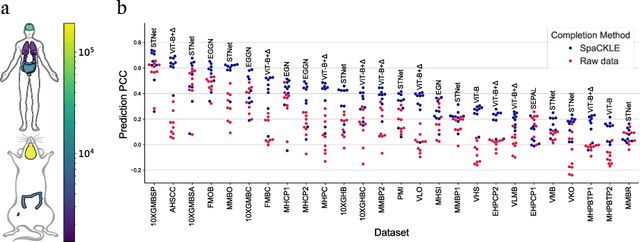
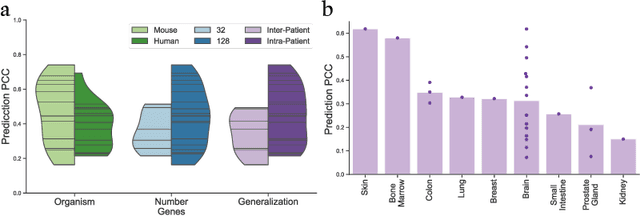
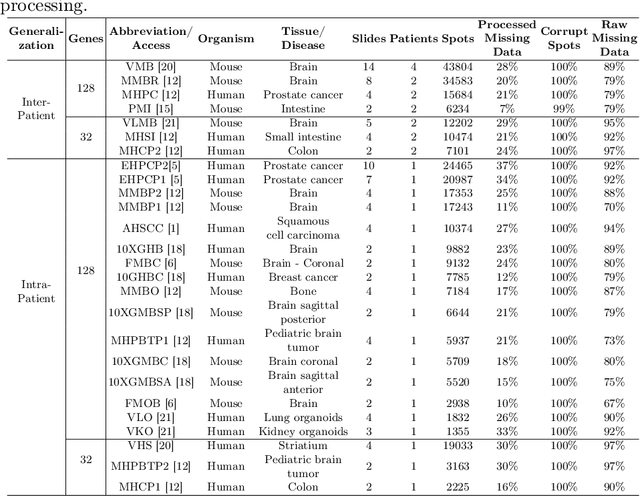
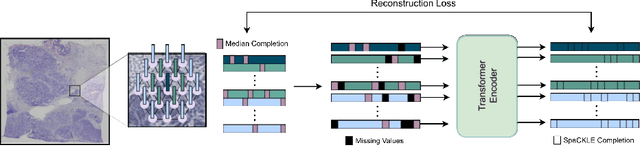
Spatial Transcriptomics is a novel technology that aligns histology images with spatially resolved gene expression profiles. Although groundbreaking, it struggles with gene capture yielding high corruption in acquired data. Given potential applications, recent efforts have focused on predicting transcriptomic profiles solely from histology images. However, differences in databases, preprocessing techniques, and training hyperparameters hinder a fair comparison between methods. To address these challenges, we present a systematically curated and processed database collected from 26 public sources, representing an 8.6-fold increase compared to previous works. Additionally, we propose a state-of-the-art transformer based completion technique for inferring missing gene expression, which significantly boosts the performance of transcriptomic profile predictions across all datasets. Altogether, our contributions constitute the most comprehensive benchmark of gene expression prediction from histology images to date and a stepping stone for future research on spatial transcriptomics.
SEPAL: Spatial Gene Expression Prediction from Local Graphs
Sep 16, 2023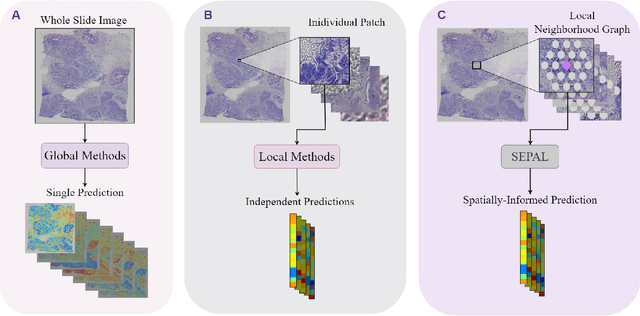
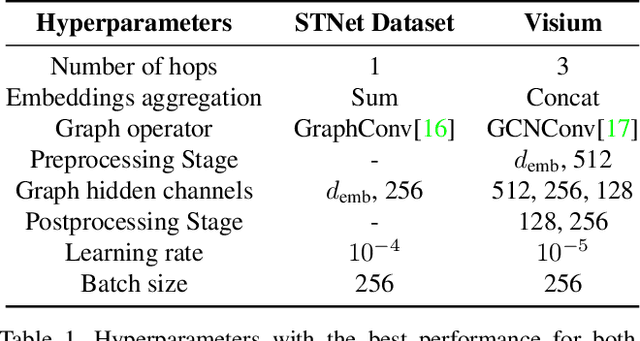
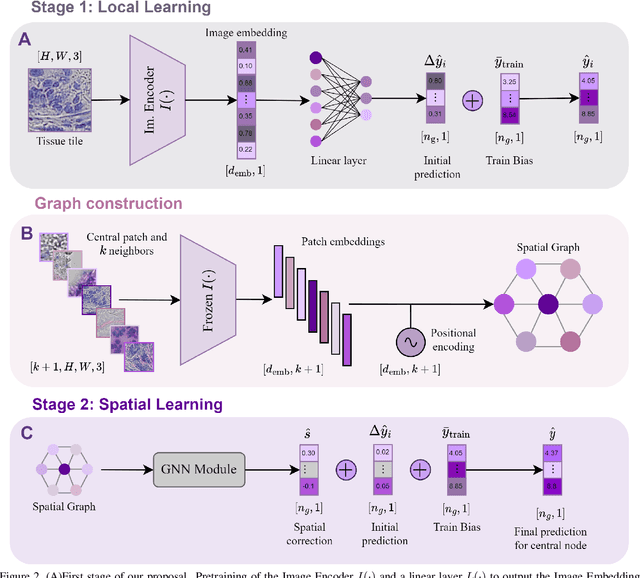
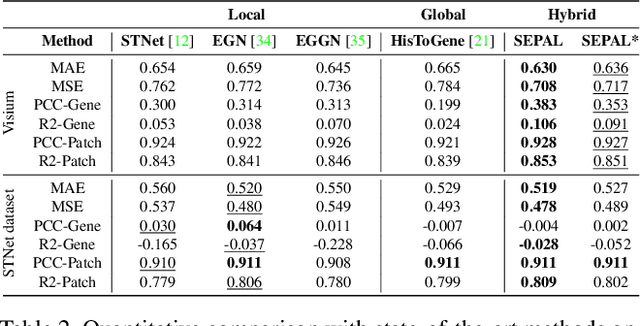
Spatial transcriptomics is an emerging technology that aligns histopathology images with spatially resolved gene expression profiling. It holds the potential for understanding many diseases but faces significant bottlenecks such as specialized equipment and domain expertise. In this work, we present SEPAL, a new model for predicting genetic profiles from visual tissue appearance. Our method exploits the biological biases of the problem by directly supervising relative differences with respect to mean expression, and leverages local visual context at every coordinate to make predictions using a graph neural network. This approach closes the gap between complete locality and complete globality in current methods. In addition, we propose a novel benchmark that aims to better define the task by following current best practices in transcriptomics and restricting the prediction variables to only those with clear spatial patterns. Our extensive evaluation in two different human breast cancer datasets indicates that SEPAL outperforms previous state-of-the-art methods and other mechanisms of including spatial context.