 Add to Chrome
 Add to Firefox
 Add to Edge
A strongly annotated passive acoustic dataset for tropical bird monitoring
May 21, 2026
Passive acoustic monitoring enables continuous, non-invasive biodiversity assessment across diverse ecosystems. The scale of these datasets has driven the adoption of machine learning, with supervised approaches showing strong performance. However, supervised methods require time-resolved annotated datasets, which remain scarce, especially in complex tropical soundscapes. We present PteroSet, a curated dataset of strongly annotated Neotropical bird vocalizations recorded in Puerto Asis (Putumayo) and Pivijay (Magdalena), Colombia, between 2023 and 2025. The dataset comprises 563 recordings (73.62 h) and 15,372 time-frequency annotations, including 6,702 events identified to the species level across 168 species. We release the annotations in a COCO-inspired JSON schema that unifies audio files, taxonomic categories, and labels for machine learning workflows. Beyond providing annotated data, PteroSet serves as a realistic benchmark that highlights key characteristics of tropical soundscapes, including acoustic co-occurrence and domain shift across recording sites. We provide a deep learning baseline for binary bird detection, demonstrating PteroSet's usability and the challenges it presents.

Completing Spatial Transcriptomics Data for Gene Expression Prediction Benchmarking
May 05, 2025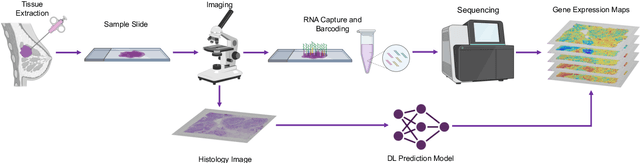
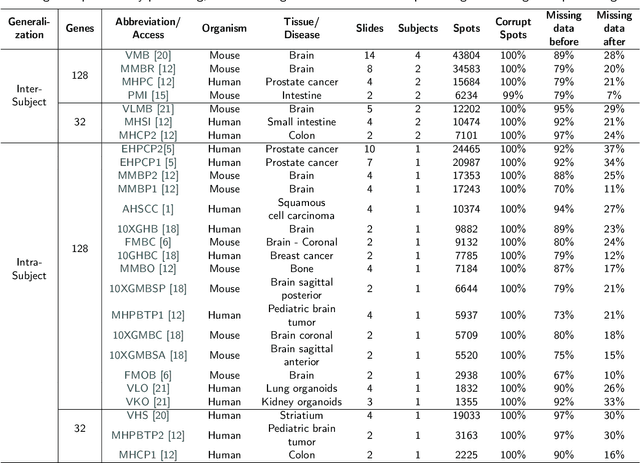
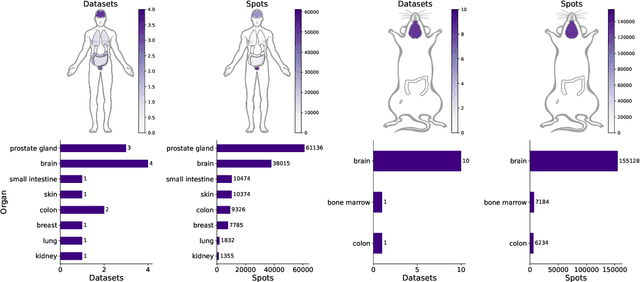
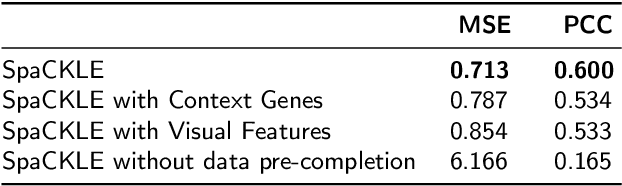
Spatial Transcriptomics is a groundbreaking technology that integrates histology images with spatially resolved gene expression profiles. Among the various Spatial Transcriptomics techniques available, Visium has emerged as the most widely adopted. However, its accessibility is limited by high costs, the need for specialized expertise, and slow clinical integration. Additionally, gene capture inefficiencies lead to significant dropout, corrupting acquired data. To address these challenges, the deep learning community has explored the gene expression prediction task directly from histology images. Yet, inconsistencies in datasets, preprocessing, and training protocols hinder fair comparisons between models. To bridge this gap, we introduce SpaRED, a systematically curated database comprising 26 public datasets, providing a standardized resource for model evaluation. We further propose SpaCKLE, a state-of-the-art transformer-based gene expression completion model that reduces mean squared error by over 82.5% compared to existing approaches. Finally, we establish the SpaRED benchmark, evaluating eight state-of-the-art prediction models on both raw and SpaCKLE-completed data, demonstrating SpaCKLE substantially improves the results across all the gene expression prediction models. Altogether, our contributions constitute the most comprehensive benchmark of gene expression prediction from histology images to date and a stepping stone for future research on Spatial Transcriptomics.
Enhancing Gene Expression Prediction from Histology Images with Spatial Transcriptomics Completion
Jul 17, 2024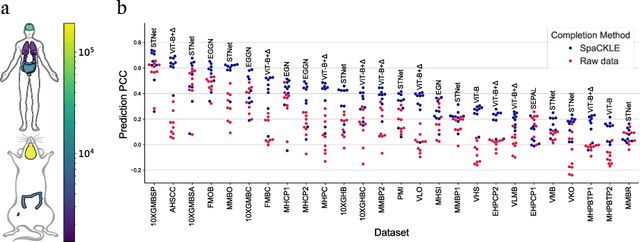
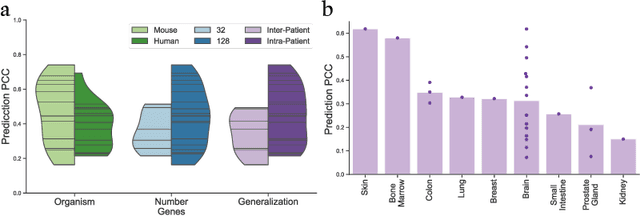
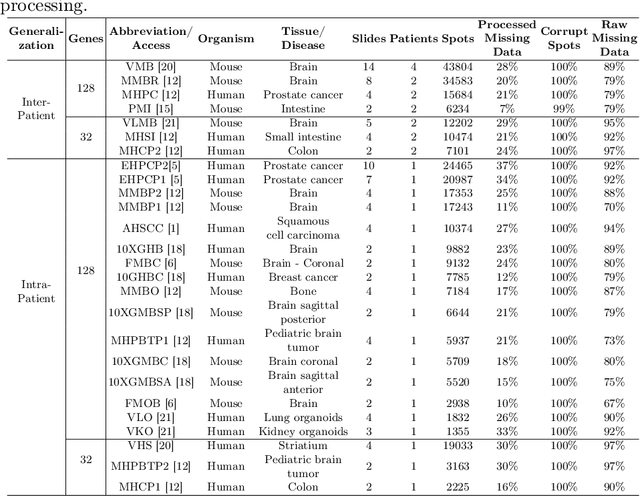
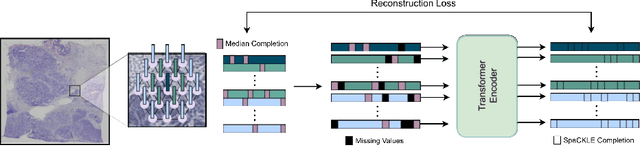
Spatial Transcriptomics is a novel technology that aligns histology images with spatially resolved gene expression profiles. Although groundbreaking, it struggles with gene capture yielding high corruption in acquired data. Given potential applications, recent efforts have focused on predicting transcriptomic profiles solely from histology images. However, differences in databases, preprocessing techniques, and training hyperparameters hinder a fair comparison between methods. To address these challenges, we present a systematically curated and processed database collected from 26 public sources, representing an 8.6-fold increase compared to previous works. Additionally, we propose a state-of-the-art transformer based completion technique for inferring missing gene expression, which significantly boosts the performance of transcriptomic profile predictions across all datasets. Altogether, our contributions constitute the most comprehensive benchmark of gene expression prediction from histology images to date and a stepping stone for future research on spatial transcriptomics.
SEPAL: Spatial Gene Expression Prediction from Local Graphs
Sep 16, 2023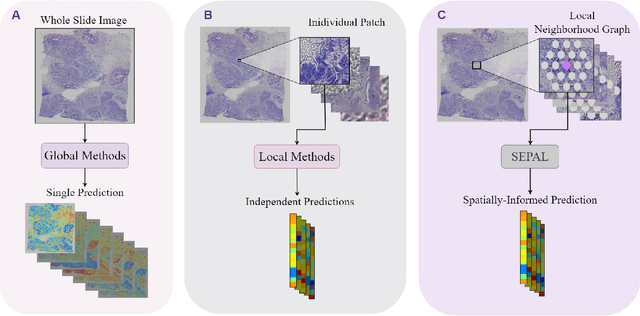
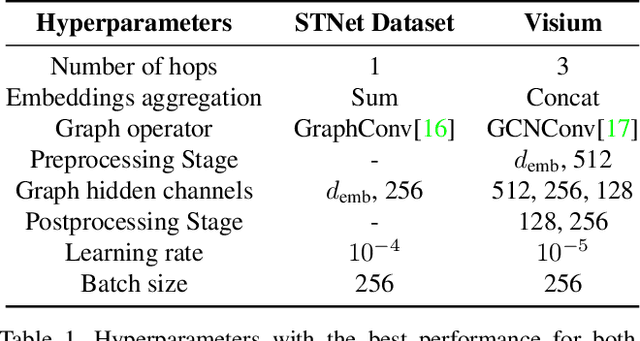
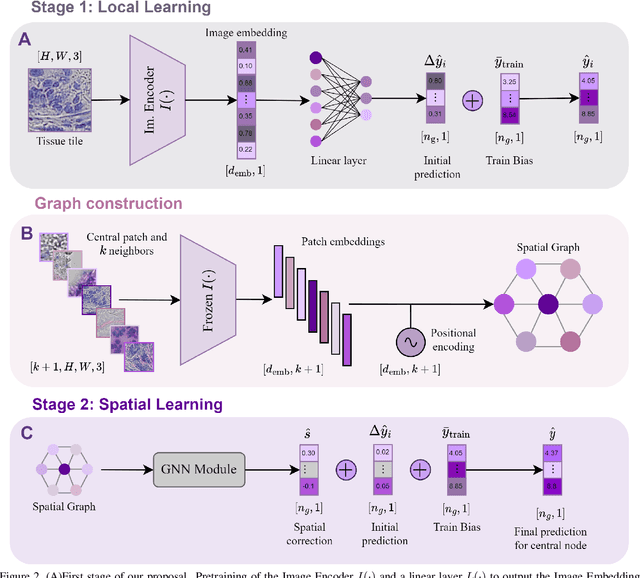
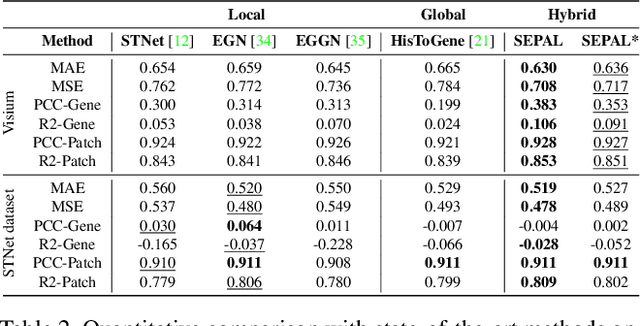
Spatial transcriptomics is an emerging technology that aligns histopathology images with spatially resolved gene expression profiling. It holds the potential for understanding many diseases but faces significant bottlenecks such as specialized equipment and domain expertise. In this work, we present SEPAL, a new model for predicting genetic profiles from visual tissue appearance. Our method exploits the biological biases of the problem by directly supervising relative differences with respect to mean expression, and leverages local visual context at every coordinate to make predictions using a graph neural network. This approach closes the gap between complete locality and complete globality in current methods. In addition, we propose a novel benchmark that aims to better define the task by following current best practices in transcriptomics and restricting the prediction variables to only those with clear spatial patterns. Our extensive evaluation in two different human breast cancer datasets indicates that SEPAL outperforms previous state-of-the-art methods and other mechanisms of including spatial context.