 Add to Chrome
 Add to Firefox
 Add to Edge
Explainable Outlier Detection for Interval-valued Data
Jun 24, 2026
Explainability is increasingly recognized as a key aspect of outlier detection. However, for complex data structures such as interval-valued data, it remains largely unexplored. Building on an outlier detection framework based on the Interval Minimum Covariance Determinant estimator, we propose a novel approach to explain the outlyingness of interval-valued observations using the concept of the Shapley value. We derive a closed-form expression for the Shapley value of the squared robust Interval-Mahalanobis distance, enabling efficient computation of variable contributions. This formulation allows for a fine-grained interpretation of outliers, providing a detailed decomposition into contributions from centers, ranges, and cross-terms of the interval-valued observations. Moreover, the Shapley value is closely connected to the concept of cellwise outliers, as it can help identify variable-specific outliers that may not be evident at multivariate level. We further extend the framework through the Shapley interaction index to capture pairwise variable interactions driving atypical behavior. The practical utility of the proposed approach is illustrated through two real-world datasets.

PAMPO: using pattern matching and pos-tagging for effective Named Entities recognition in Portuguese
Dec 30, 2016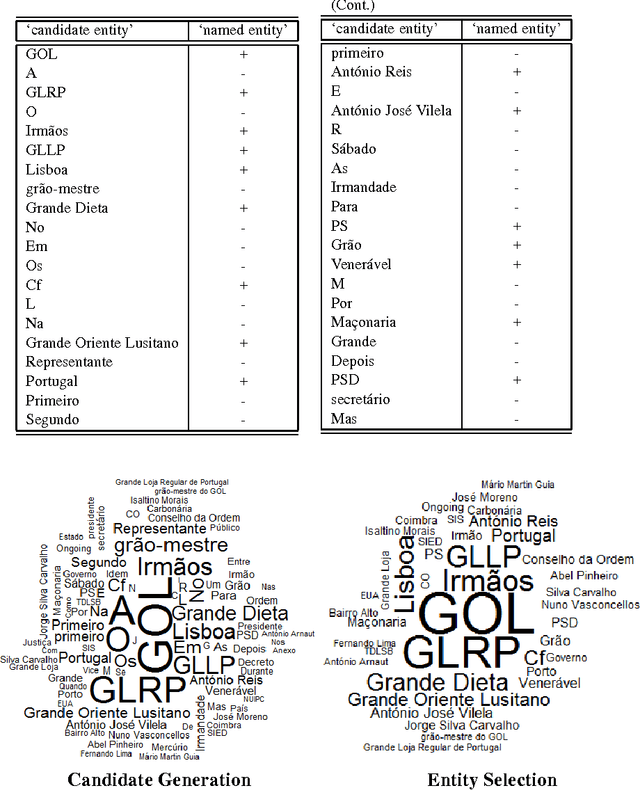
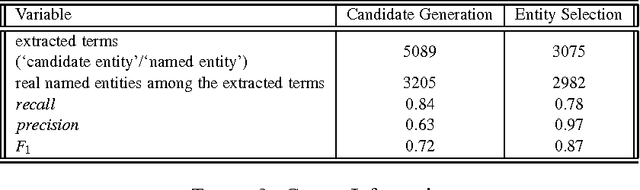
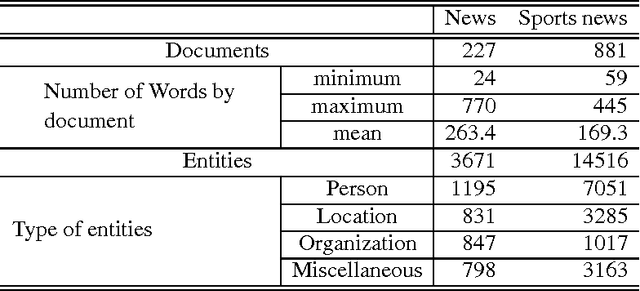
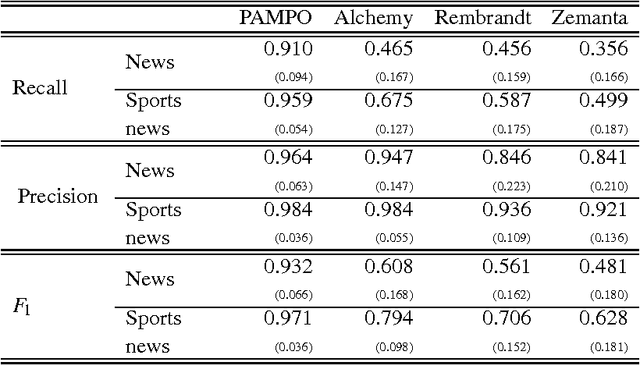
This paper deals with the entity extraction task (named entity recognition) of a text mining process that aims at unveiling non-trivial semantic structures, such as relationships and interaction between entities or communities. In this paper we present a simple and efficient named entity extraction algorithm. The method, named PAMPO (PAttern Matching and POs tagging based algorithm for NER), relies on flexible pattern matching, part-of-speech tagging and lexical-based rules. It was developed to process texts written in Portuguese, however it is potentially applicable to other languages as well. We compare our approach with current alternatives that support Named Entity Recognition (NER) for content written in Portuguese. These are Alchemy, Zemanta and Rembrandt. Evaluation of the efficacy of the entity extraction method on several texts written in Portuguese indicates a considerable improvement on $recall$ and $F_1$ measures.