 Add to Chrome
 Add to Firefox
 Add to Edge
Benchmarking Wireless Representations: High-Dimensional vs. Compressed Embeddings for Efficiency and Robustness
May 03, 2026
Building on recent advances in representation learning for wireless channels, this work investigates the cost-benefit trade-offs of high-dimensional channel embeddings in practical systems. We benchmark multiple wireless representations: high-dimensional learned embeddings from a wireless foundation model, compact autoencoder-based representations with significantly lower dimensionality, and raw data baselines, evaluating their performance across diverse downstream tasks. We then systematically analyze data efficiency, noise robustness, and computational complexity, explicitly characterizing the resource overhead associated with high-dimensional embeddings. Beyond standard tasks such as line-of-sight/non-line-of-sight (LoS/NLoS) classification and beam selection, we introduce power allocation as a new downstream task. Our results reveal clear trade-offs: while high-dimensional embeddings can perform well in few-shot regimes for certain tasks, they incur substantial latency and parameter overhead. In contrast, compressed latent representations learned by autoencoders demonstrate improved noise robustness and more stable performance across tasks, while significantly reducing computational and transmission costs.

On Signal Peak Power Constraint of Over-the-Air Federated Learning
Dec 29, 2025Federated learning (FL) has been considered a promising privacy preserving distributed edge learning framework. Over-the-air computation (AirComp) technique leveraging analog transmission enables the aggregation of local updates directly over-the-air by exploiting the superposition properties of wireless multiple-access channel, thereby drastically reducing the communication bottleneck issues of FL compared with digital transmission schemes. This work points out that existing AirComp-FL overlooks a key practical constraint, the instantaneous peak-power constraints imposed by the non-linearity of radiofrequency power amplifiers. We present and analyze the effect of the classic method to deal with this issue, amplitude clipping combined with filtering. We investigate the effect of instantaneous peak-power constraints in AirComp-FL for both single-carrier and multi-carrier orthogonal frequency-division multiplexing (OFDM) systems. We highlight the specificity of AirComp-FL: the samples depend on the gradient value distribution, leading to a higher peak-to-average power ratio (PAPR) than that observed for uniformly distributed signals. Simulation results demonstrate that, in practical settings, the instantaneous transmit power regularly exceeds the power-amplifier limit; however, by applying clipping and filtering, the FL performance can be degraded. The degradation becomes pronounced especially in multi-carrier OFDM systems due to the in-band distortions caused by clipping and filtering.
Joint Link Adaptation and Device Scheduling Approach for URLLC Industrial IoT Network: A DRL-based Method with Bayesian Optimization
Dec 29, 2025In this article, we consider an industrial internet of things (IIoT) network supporting multi-device dynamic ultra-reliable low-latency communication (URLLC) while the channel state information (CSI) is imperfect. A joint link adaptation (LA) and device scheduling (including the order) design is provided, aiming at maximizing the total transmission rate under strict block error rate (BLER) constraints. In particular, a Bayesian optimization (BO) driven Twin Delayed Deep Deterministic Policy Gradient (TD3) method is proposed, which determines the device served order sequence and the corresponding modulation and coding scheme (MCS) adaptively based on the imperfect CSI. Note that the imperfection of CSI, error sample imbalance in URLLC networks, as well as the parameter sensitivity nature of the TD3 algorithm likely diminish the algorithm's convergence speed and reliability. To address such an issue, we proposed a BO based training mechanism for the convergence speed improvement, which provides a more reliable learning direction and sample selection method to track the imbalance sample problem. Via extensive simulations, we show that the proposed algorithm achieves faster convergence and higher sum-rate performance compared to existing solutions.
Démélange, déconvolution et débruitage conjoints d'un modèle convolutif parcimonieux avec dérive instrumentale, par pénalisation de rapports de normes ou quasi-normes lissées (PENDANTSS)
Jul 04, 2023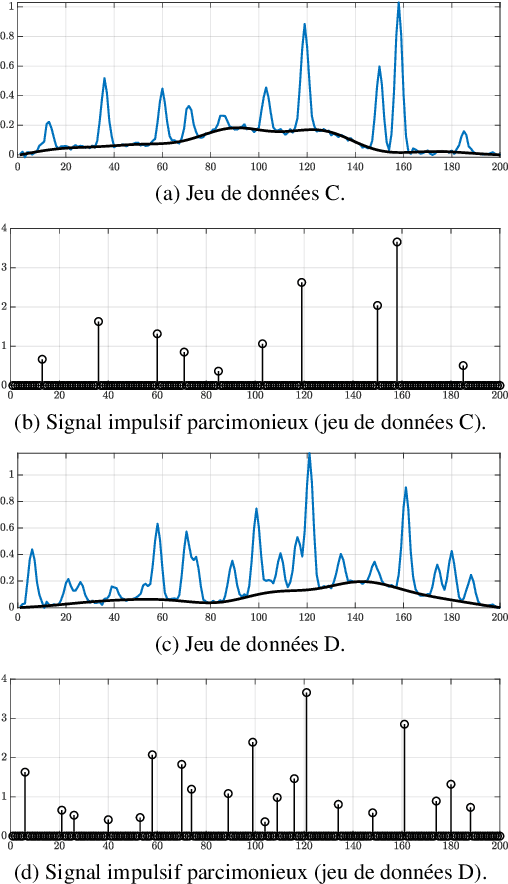
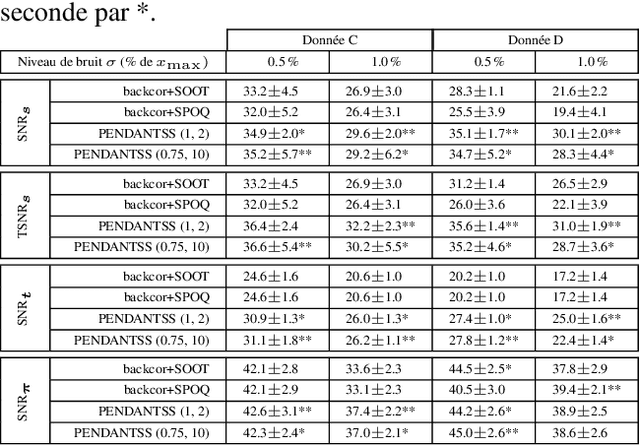
Denoising, detrending, deconvolution: usual restoration tasks, traditionally decoupled. Coupled formulations entail complex ill-posed inverse problems. We propose PENDANTSS for joint trend removal and blind deconvolution of sparse peak-like signals. It blends a parsimonious prior with the hypothesis that smooth trend and noise can somewhat be separated by low-pass filtering. We combine the generalized pseudo-norm ratio SOOT/SPOQ sparse penalties $\ell_p/\ell_q$ with the BEADS ternary assisted source separation algorithm. This results in a both convergent and efficient tool, with a novel Trust-Region block alternating variable metric forward-backward approach. It outperforms comparable methods, when applied to typically peaked analytical chemistry signals. Reproducible code is provided: https://github.com/paulzhengfr/PENDANTSS.
PENDANTSS: PEnalized Norm-ratios Disentangling Additive Noise, Trend and Sparse Spikes
Jan 04, 2023Denoising, detrending, deconvolution: usual restoration tasks, traditionally decoupled. Coupled formulations entail complex ill-posed inverse problems. We propose PENDANTSS for joint trend removal and blind deconvolution of sparse peak-like signals. It blends a parsimonious prior with the hypothesis that smooth trend and noise can somewhat be separated by low-pass filtering. We combine the generalized quasi-norm ratio SOOT/SPOQ sparse penalties $\ell_p/\ell_q$ with the BEADS ternary assisted source separation algorithm. This results in a both convergent and efficient tool, with a novel Trust-Region block alternating variable metric forward-backward approach. It outperforms comparable methods, when applied to typically peaked analytical chemistry signals. Reproducible code is provided.