 Add to Chrome
 Add to Firefox
 Add to Edge
Process Optimization Under Uncertainty for Improving the Bond Quality of Polymer Filaments in Fused Filament Fabrication
Aug 19, 2026
This paper develops a computational framework to optimize the process parameters such that the bond quality between extruded polymer filaments is maximized in fused filament fabrication (FFF). A transient heat transfer analysis providing an estimate of the temperature profile of the filaments is coupled with a sintering neck growth model to assess the bond quality that occurs at the interfaces between adjacent filaments. Predicting the variability in the FFF process is essential for achieving proactive quality control of the manufactured part; however, the models used to predict the variability are affected by assumptions and approximations. This paper systematically quantifies the uncertainty in the bond quality model prediction due to various sources of uncertainty, both aleatory and epistemic, and includes the uncertainty and the model discrepancy in the process parameter optimization. Variance-based sensitivity analysis based on Sobol indices is used to quantify the relative contributions of the different uncertainty sources to the uncertainty in the bond quality. A Gaussian process (GP) surrogate model is constructed to compute and include the model discrepancy within the optimization. Physical experiments are conducted for calibration and validation of the physics model and also for validation of the optimum solution. The results show that the proposed formulation for process parameter optimization under uncertainty results in high bond quality between adjoining filaments of the FFF product.
* 12 pages, ASME Journal of Manufacturing Science and Engineering

Multi-Objective Optimization Under Uncertainty of Part Quality in Fused Filament Fabrication
Aug 19, 2026This work presents a data-driven methodology for multi-objective optimization under uncertainty of process parameters in the fused filament fabrication (FFF) process. The proposed approach optimizes the process parameters with the objectives of minimizing the geometric inaccuracy and maximizing the filament bond quality of the manufactured part. First, experiments are conducted to collect data pertaining to the part quality. Then, Bayesian neural network (BNN) models are constructed to predict the geometric inaccuracy and bond quality as functions of the process parameters. The BNN model captures the model uncertainty caused by the lack of knowledge about model parameters (neuron weights) and the input variability due to the intrinsic randomness in the input parameters. Using the stochastic predictions from these models, different robustness-based design optimization formulations are investigated, wherein process parameters such as nozzle temperature, nozzle speed, and layer thickness are optimized under uncertainty for different multi-objective scenarios. Epistemic uncertainty in the prediction model and the aleatory uncertainty in the input is considered in the optimization. Finally, Pareto surfaces are constructed to estimate the tradeoffs between the objectives. Both the BNN models and the effectiveness of the proposed optimization methodology are validated using the actual manufacturing of the parts.
* ASCE-ASME Journal of Risk and Uncertainty in Engineering Systems, Part B: Mechanical Engineering
Automatic Volumetric Segmentation of Additive Manufacturing Defects with 3D U-Net
Jan 22, 2021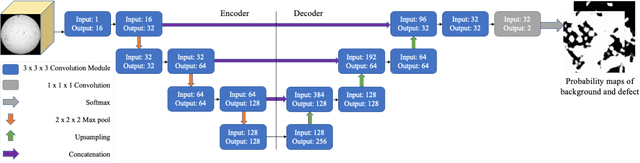
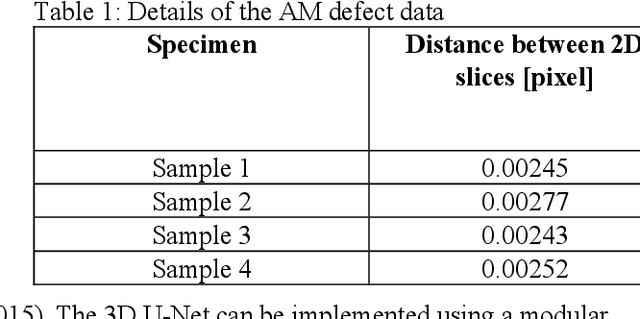
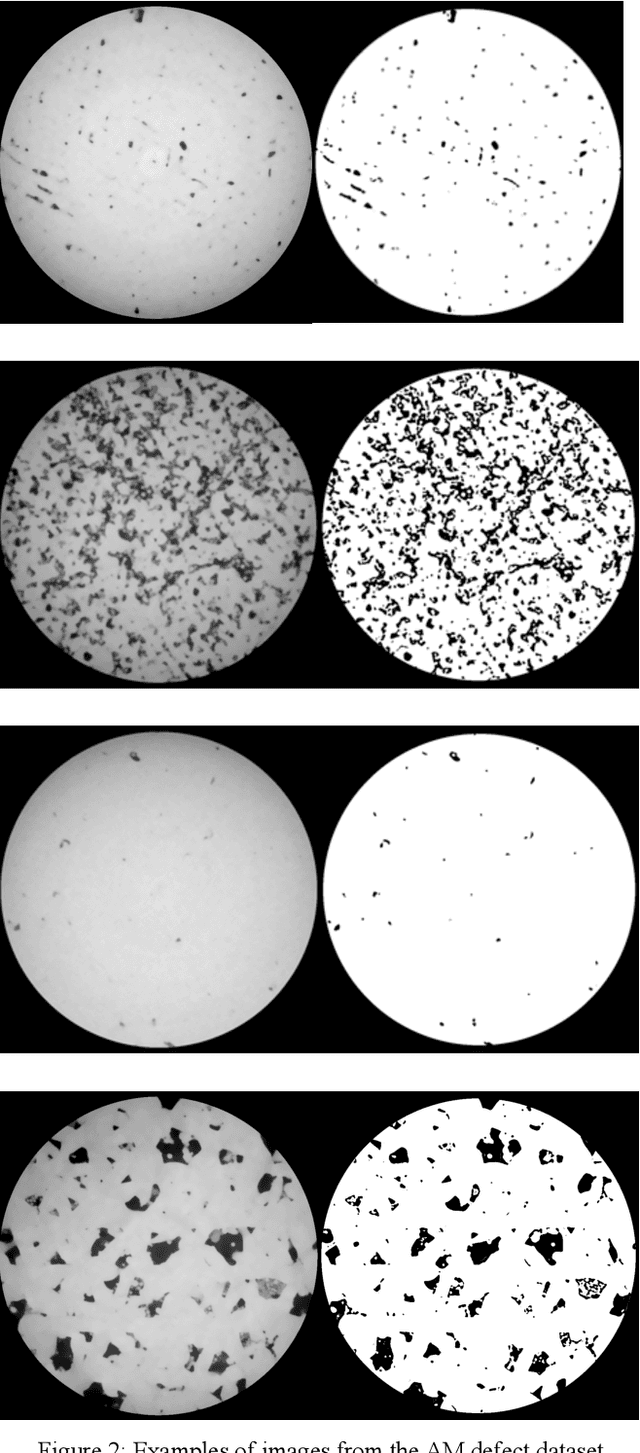
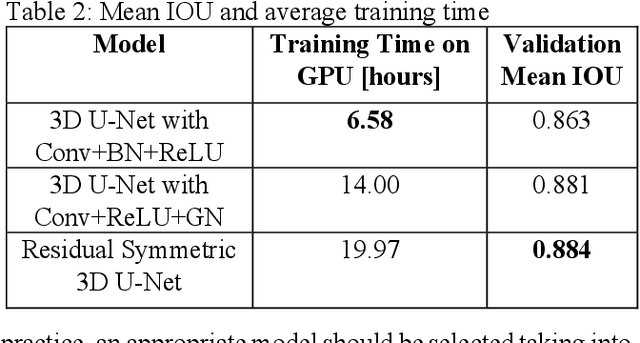
Segmentation of additive manufacturing (AM) defects in X-ray Computed Tomography (XCT) images is challenging, due to the poor contrast, small sizes and variation in appearance of defects. Automatic segmentation can, however, provide quality control for additive manufacturing. Over recent years, three-dimensional convolutional neural networks (3D CNNs) have performed well in the volumetric segmentation of medical images. In this work, we leverage techniques from the medical imaging domain and propose training a 3D U-Net model to automatically segment defects in XCT images of AM samples. This work not only contributes to the use of machine learning for AM defect detection but also demonstrates for the first time 3D volumetric segmentation in AM. We train and test with three variants of the 3D U-Net on an AM dataset, achieving a mean intersection of union (IOU) value of 88.4%.
* Accepted by AAAI 2020 Spring Symposia