 Add to Chrome
 Add to Firefox
 Add to Edge
Improving acoustic drone detection generalization through pretraining and data augmentation
May 29, 2026
Detecting unauthorized UAV flights is critical for surveillance, security, and airspace management. Acoustic drone detection, which relies on the distinctive propeller and motor sounds of UAVs, provides a low-cost, passive solution that requires no line of sight. A central challenge is generalization: reliably distinguishing drone signatures from ambient noise across unseen recording setups, environments, and UAV types (out-of-domain). Inspired by advances in large-scale audio pretraining, we develop a compact DNN-based detector and improve its generalization by (1) pretraining the model for broad sound-event classification before fine-tuning on diverse in-house and public drone recordings, and (2) applying on-the-fly augmentations (pitch shifting, noise mixing, microphone transfer function simulation, spectrogram augmentation) to expose the model to varied acoustic conditions. An ablation study quantifies the impact of each augmentation. For evaluation, we set target false-positive rates (FPR) aligned with real-world surveillance needs and report true-positive rates (TPR) on both in-domain data (public IDMT Berne 2022) and out-of-domain data (public AuDroK). Our results show that pretraining is the dominant factor for robust detection, yielding substantial TPR improvements over training from scratch on all benchmarks. The full augmentation chain provides additional gains on acoustically mismatched out-of-domain data, achieving the best mean TPR on the AuDroK subsets and the largest improvements on the most challenging scenarios. We further validate real-world applicability by measuring false positives on public non-drone corpora (IDMT-TRAFFIC and ESC-50), demonstrating equally low FPR on unfamiliar backgrounds. A distance-dependent analysis on IDMT Berne 2022 shows effective detection at distances up to 150 m.

Multilingual Query-by-Example Keyword Spotting with Metric Learning and Phoneme-to-Embedding Mapping
Apr 19, 2023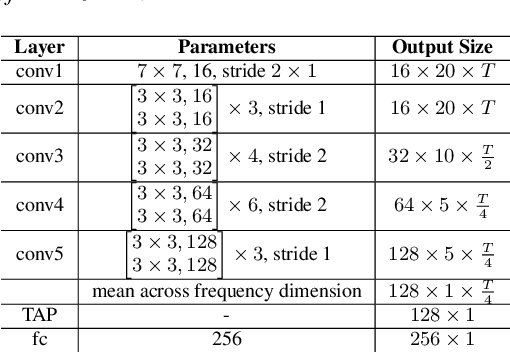
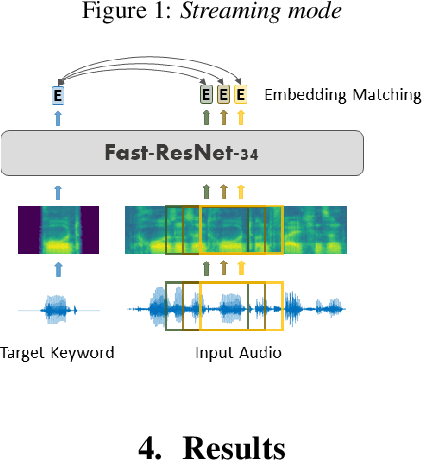
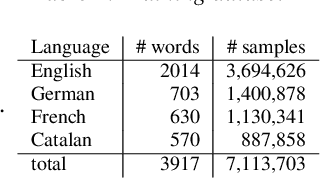
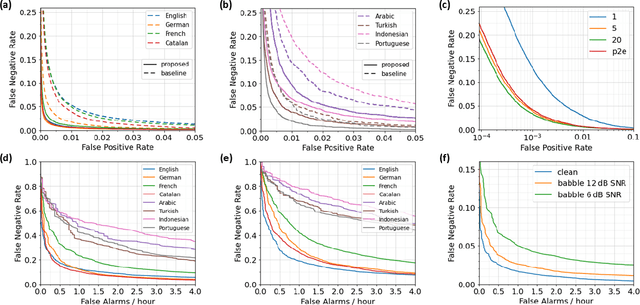
In this paper, we propose a multilingual query-by-example keyword spotting (KWS) system based on a residual neural network. The model is trained as a classifier on a multilingual keyword dataset extracted from Common Voice sentences and fine-tuned using circle loss. We demonstrate the generalization ability of the model to new languages and report a mean reduction in EER of 59.2 % for previously seen and 47.9 % for unseen languages compared to a competitive baseline. We show that the word embeddings learned by the KWS model can be accurately predicted from the phoneme sequences using a simple LSTM model. Our system achieves a promising accuracy for streaming keyword spotting and keyword search on Common Voice audio using just 5 examples per keyword. Experiments on the Hey-Snips dataset show a good performance with a false negative rate of 5.4 % at only 0.1 false alarms per hour.