 Add to Chrome
 Add to Firefox
 Add to Edge
Can an Actor-Critic Optimization Framework Improve Analog Design Optimization?
Mar 25, 2026
Analog design often slows down because even small changes to device sizes or biases require expensive simulation cycles, and high-quality solutions typically occupy only a narrow part of a very large search space. While existing optimizers reduce some of this burden, they largely operate without the kind of judgment designers use when deciding where to search next. This paper presents an actor-critic optimization framework (ACOF) for analog sizing that brings that form of guidance into the loop. Rather than treating optimization as a purely black-box search problem, ACOF separates the roles of proposal and evaluation: an actor suggests promising regions of the design space, while a critic reviews those choices, enforces design legality, and redirects the search when progress is hampered. This structure preserves compatibility with standard simulator-based flows while making the search process more deliberate, stable, and interpretable. Across our test circuits, ACOF improves the top-10 figure of merit by an average of 38.9% over the strongest competing baseline and reduces regret by an average of 24.7%, with peak gains of 70.5% in FoM and 42.2% lower regret on individual circuits. By combining iterative reasoning with simulation-driven search, the framework offers a more transparent path toward automated analog sizing across challenging design spaces.

3D Guard-Layer: An Integrated Agentic AI Safety System for Edge Artificial Intelligence
Nov 11, 2025AI systems have found a wide range of real-world applications in recent years. The adoption of edge artificial intelligence, embedding AI directly into edge devices, is rapidly growing. Despite the implementation of guardrails and safety mechanisms, security vulnerabilities and challenges have become increasingly prevalent in this domain, posing a significant barrier to the practical deployment and safety of AI systems. This paper proposes an agentic AI safety architecture that leverages 3D to integrate a dedicated safety layer. It introduces an adaptive AI safety infrastructure capable of dynamically learning and mitigating attacks against the AI system. The system leverages the inherent advantages of co-location with the edge computing hardware to continuously monitor, detect and proactively mitigate threats to the AI system. The integration of local processing and learning capabilities enhances resilience against emerging network-based attacks while simultaneously improving system reliability, modularity, and performance, all with minimal cost and 3D integration overhead.
Design Rule Checking with a CNN Based Feature Extractor
Dec 21, 2020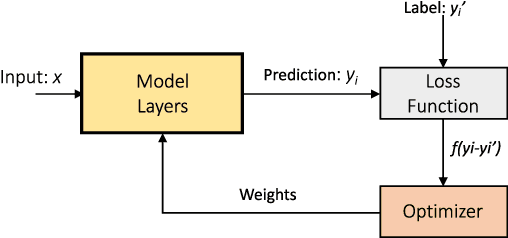
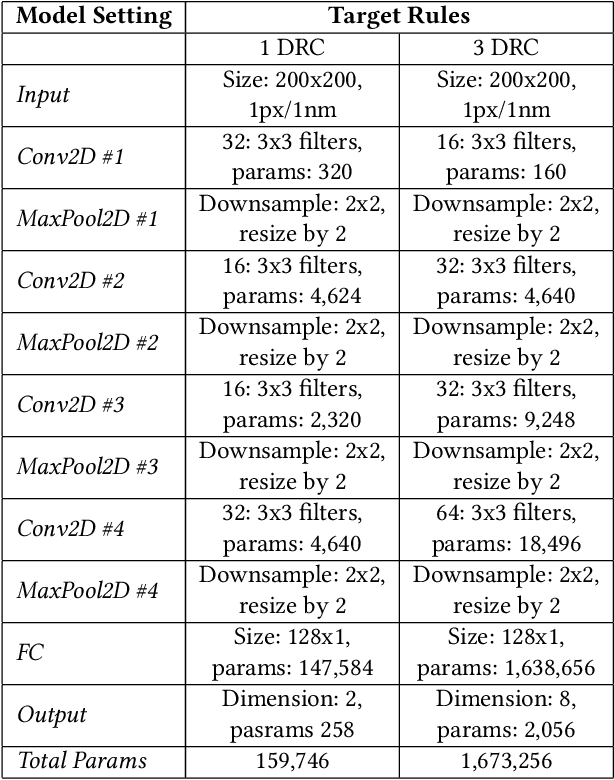
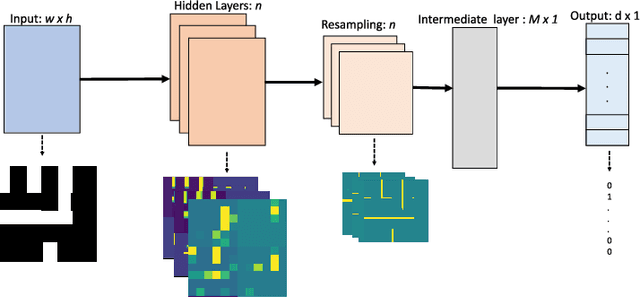
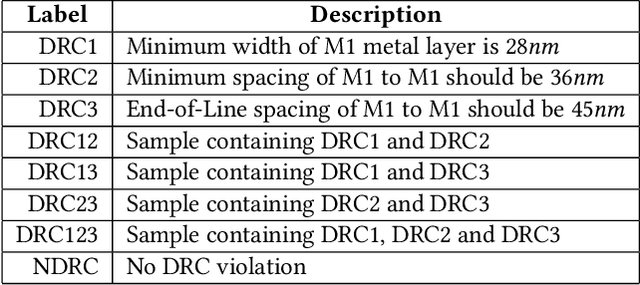
Design rule checking (DRC) is getting increasingly complex in advanced nodes technologies. It would be highly desirable to have a fast interactive DRC engine that could be used during layout. In this work, we establish the proof of feasibility for such an engine. The proposed model consists of a convolutional neural network (CNN) trained to detect DRC violations. The model was trained with artificial data that was derived from a set of $50$ SRAM designs. The focus in this demonstration was metal 1 rules. Using this solution, we can detect multiple DRC violations 32x faster than Boolean checkers with an accuracy of up to 92. The proposed solution can be easily expanded to a complete rule set.