 Add to Chrome
 Add to Firefox
 Add to Edge
Evolving Excellence: Automated Optimization of LLM-based Agents
Dec 09, 2025
Agentic AI systems built on large language models (LLMs) offer significant potential for automating complex workflows, from software development to customer support. However, LLM agents often underperform due to suboptimal configurations; poorly tuned prompts, tool descriptions, and parameters that typically require weeks of manual refinement. Existing optimization methods either are too complex for general use or treat components in isolation, missing critical interdependencies. We present ARTEMIS, a no-code evolutionary optimization platform that jointly optimizes agent configurations through semantically-aware genetic operators. Given only a benchmark script and natural language goals, ARTEMIS automatically discovers configurable components, extracts performance signals from execution logs, and evolves configurations without requiring architectural modifications. We evaluate ARTEMIS on four representative agent systems: the \emph{ALE Agent} for competitive programming on AtCoder Heuristic Contest, achieving a \textbf{$13.6\%$ improvement} in acceptance rate; the \emph{Mini-SWE Agent} for code optimization on SWE-Perf, with a statistically significant \textbf{10.1\% performance gain}; and the \emph{CrewAI Agent} for cost and mathematical reasoning on Math Odyssey, achieving a statistically significant \textbf{$36.9\%$ reduction} in the number of tokens required for evaluation. We also evaluate the \emph{MathTales-Teacher Agent} powered by a smaller open-source model (Qwen2.5-7B) on GSM8K primary-level mathematics problems, achieving a \textbf{22\% accuracy improvement} and demonstrating that ARTEMIS can optimize agents based on both commercial and local models.

evoML Yellow Paper: Evolutionary AI and Optimisation Studio
Dec 20, 2022
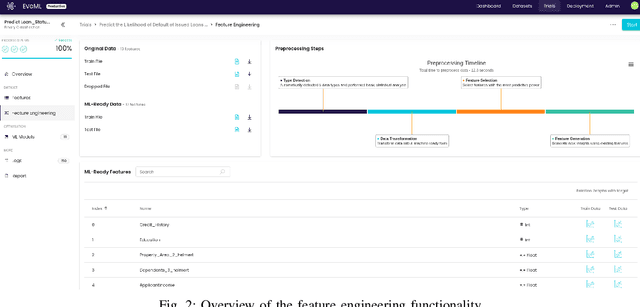
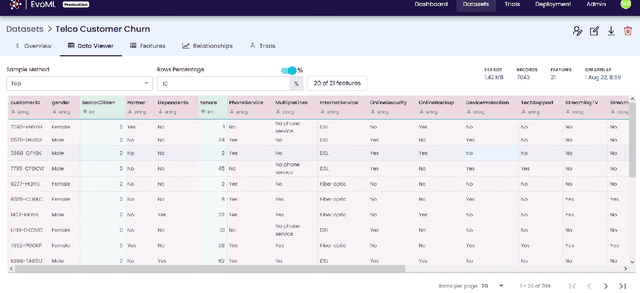
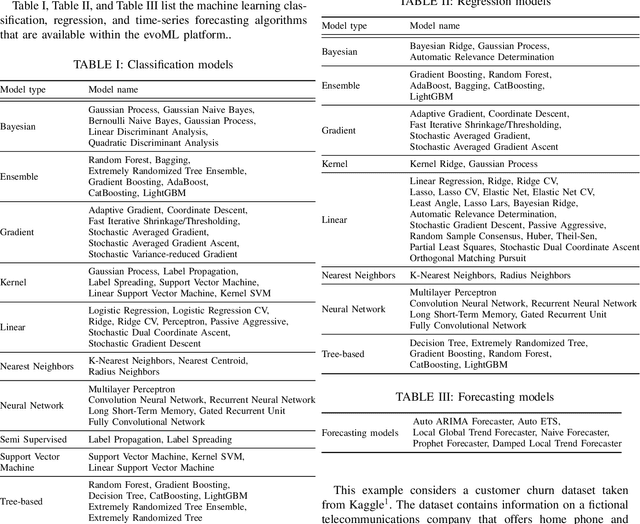
Machine learning model development and optimisation can be a rather cumbersome and resource-intensive process. Custom models are often more difficult to build and deploy, and they require infrastructure and expertise which are often costly to acquire and maintain. Machine learning product development lifecycle must take into account the need to navigate the difficulties of developing and deploying machine learning models. evoML is an AI-powered tool that provides automated functionalities in machine learning model development, optimisation, and model code optimisation. Core functionalities of evoML include data cleaning, exploratory analysis, feature analysis and generation, model optimisation, model evaluation, model code optimisation, and model deployment. Additionally, a key feature of evoML is that it embeds code and model optimisation into the model development process, and includes multi-objective optimisation capabilities.