 Add to Chrome
 Add to Firefox
 Add to Edge
Multivariate Gaussian NeRF for Wide Field-of-View Ultrasound Reconstruction
Apr 27, 2026
Wide Field-of-View (WFoV) reconstruction enhances 3D ultrasound imaging by providing valuable anatomical context for segmentation models and visualization. Clinical ultrasound volumes are predominantly acquired using convex probes, which generate expanding, diverging acoustic beams to maximize anatomical coverage. Stitching these sweeps together traditionally introduces significant compounding artifacts and aliasing due to depth-dependent resolution changes. Here, we introduce Ultra-Wide-NeRF, a Multivariate 3D Gaussian (MVG) NeRF-based method for WFoV ultrasound reconstruction. By explicitly modeling the complex beam geometry using distance-dependent convex volumetric sampling and anisotropic 3D Gaussians, our method inherently mitigates these compounding artifacts and provides anti-aliasing. Beyond simply reconstructing a static 3D grid, our NeRF-based approach yields a continuous neural representation of the tissue, enabling the synthesis of high-fidelity novel views from arbitrary virtual trajectories. We validate Ultra-Wide-NeRF for intracardiac echocardiography on phantom and porcine datasets, demonstrating that our method expands the spatial context important in intraoperative navigation. Code will be open-sourced upon publication.

Sparsity-based background removal for STORM super-resolution images
Jan 15, 2024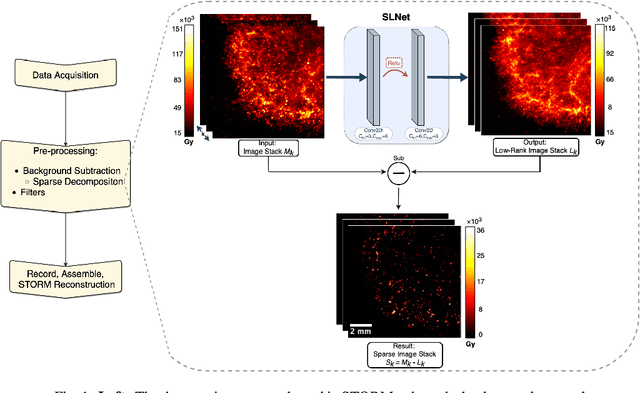
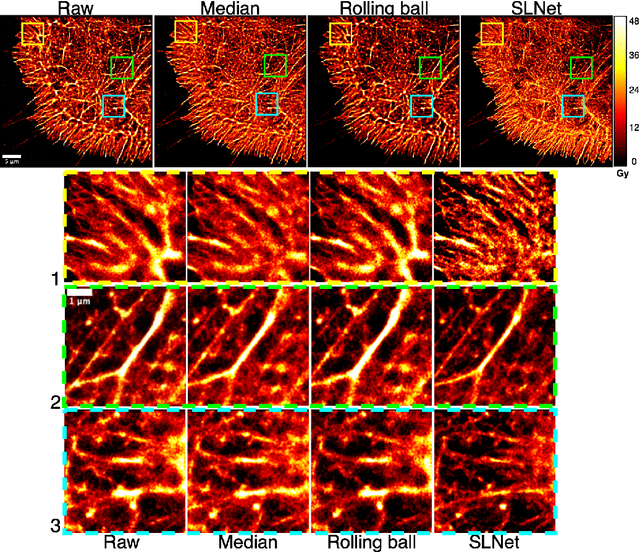
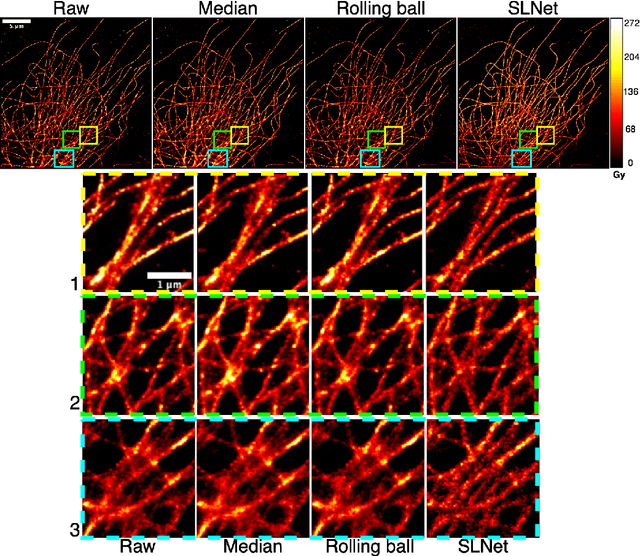
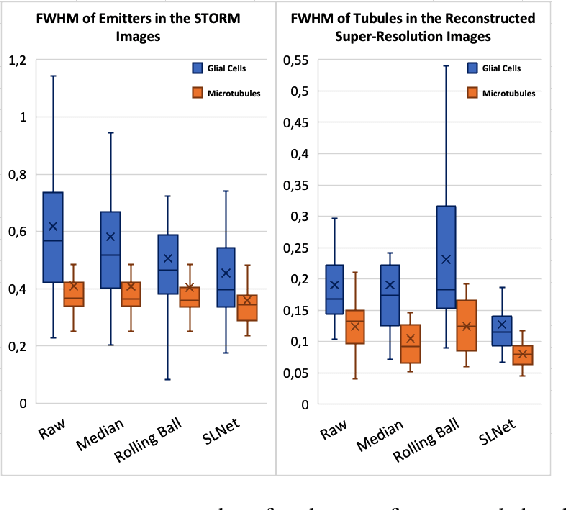
Single-molecule localization microscopy techniques, like stochastic optical reconstruction microscopy (STORM), visualize biological specimens by stochastically exciting sparse blinking emitters. The raw images suffer from unwanted background fluorescence, which must be removed to achieve super-resolution. We introduce a sparsity-based background removal method by adapting a neural network (SLNet) from a different microscopy domain. The SLNet computes a low-rank representation of the images, and then, by subtracting it from the raw images, the sparse component is computed, representing the frames without the background. We compared our approach with widely used background removal methods, such as the median background removal or the rolling ball algorithm, on two commonly used STORM datasets, one glial cell, and one microtubule dataset. The SLNet delivers STORM frames with less background, leading to higher emitters' localization precision and higher-resolution reconstructed images than commonly used methods. Notably, the SLNet is lightweight and easily trainable (<5 min). Since it is trained in an unsupervised manner, no prior information is required and can be applied to any STORM dataset. We uploaded a pre-trained SLNet to the Bioimage model zoo, easily accessible through ImageJ. Our results show that our sparse decomposition method could be an essential and efficient STORM pre-processing tool.