 Add to Chrome
 Add to Firefox
 Add to Edge
TRIAGE: Type-Routed Interventions via Aleatoric-Epistemic Gated Estimation in Robotic Manipulation and Adaptive Perception -- Don't Treat All Uncertainty the Same
Mar 09, 2026
Most uncertainty-aware robotic systems collapse prediction uncertainty into a single scalar score and use it to trigger uniform corrective responses. This aggregation obscures whether uncertainty arises from corrupted observations or from mismatch between the learned model and the true system dynamics. As a result, corrective actions may be applied to the wrong component of the closed loop, degrading performance relative to leaving the policy unchanged. We introduce a lightweight post hoc framework that decomposes uncertainty into aleatoric and epistemic components and uses these signals to regulate system responses at inference time. Aleatoric uncertainty is estimated from deviations in the observation distribution using a Mahalanobis density model, while epistemic uncertainty is detected using a noise robust forward dynamics ensemble that isolates model mismatch from measurement corruption. The two signals remain empirically near orthogonal during closed loop execution and enable type specific responses. High aleatoric uncertainty triggers observation recovery, while high epistemic uncertainty moderates control actions. The same signals also regulate adaptive perception by guiding model capacity selection during tracking inference. Experiments demonstrate consistent improvements across both control and perception tasks. In robotic manipulation, the decomposed controller improves task success from 59.4% to 80.4% under compound perturbations and outperforms a combined uncertainty baseline by up to 21.0%. In adaptive tracking inference on MOT17, uncertainty-guided model selection reduces average compute by 58.2% relative to a fixed high capacity detector while preserving detection quality within 0.4%. Code and demo videos are available at https://divake.github.io/uncertainty-decomposition/.

Uncertainty-Guided Inference-Time Depth Adaptation for Transformer-Based Visual Tracking
Feb 18, 2026Transformer-based single-object trackers achieve state-of-the-art accuracy but rely on fixed-depth inference, executing the full encoder--decoder stack for every frame regardless of visual complexity, thereby incurring unnecessary computational cost in long video sequences dominated by temporally coherent frames. We propose UncL-STARK, an architecture-preserving approach that enables dynamic, uncertainty-aware depth adaptation in transformer-based trackers without modifying the underlying network or adding auxiliary heads. The model is fine-tuned to retain predictive robustness at multiple intermediate depths using random-depth training with knowledge distillation, thus enabling safe inference-time truncation. At runtime, we derive a lightweight uncertainty estimate directly from the model's corner localization heatmaps and use it in a feedback-driven policy that selects the encoder and decoder depth for the next frame based on the prediction confidence by exploiting temporal coherence in video. Extensive experiments on GOT-10k and LaSOT demonstrate up to 12\% GFLOPs reduction, 8.9\% latency reduction, and 10.8\% energy savings while maintaining tracking accuracy within 0.2\% of the full-depth baseline across both short-term and long-term sequences.
Calibrated Decomposition of Aleatoric and Epistemic Uncertainty in Deep Features for Inference-Time Adaptation
Nov 15, 2025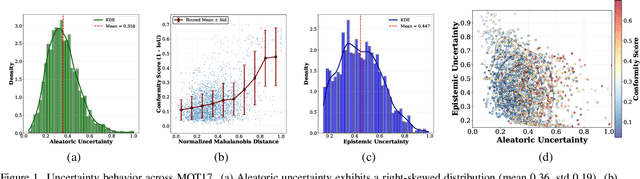
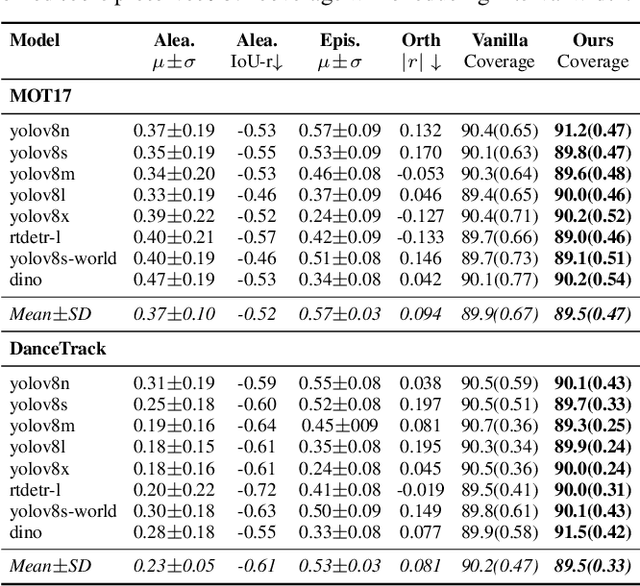
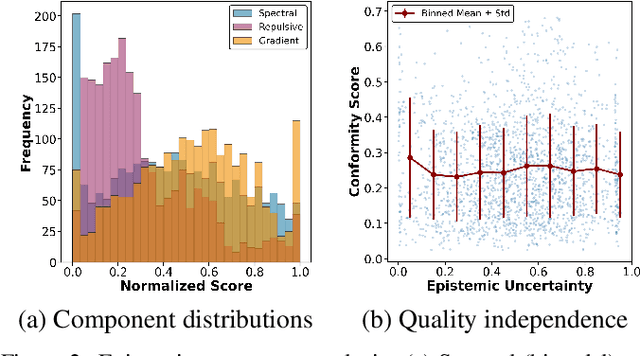
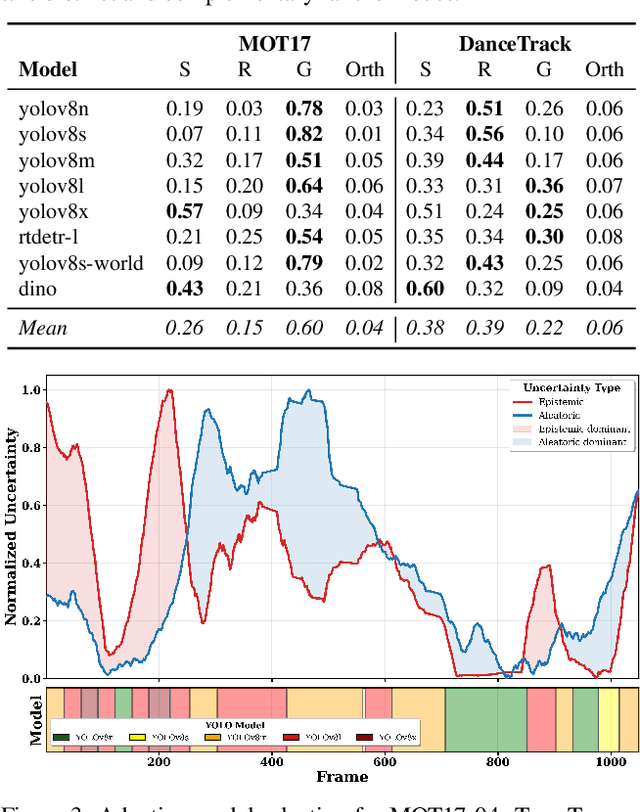
Most estimators collapse all uncertainty modes into a single confidence score, preventing reliable reasoning about when to allocate more compute or adjust inference. We introduce Uncertainty-Guided Inference-Time Selection, a lightweight inference time framework that disentangles aleatoric (data-driven) and epistemic (model-driven) uncertainty directly in deep feature space. Aleatoric uncertainty is estimated using a regularized global density model, while epistemic uncertainty is formed from three complementary components that capture local support deficiency, manifold spectral collapse, and cross-layer feature inconsistency. These components are empirically orthogonal and require no sampling, no ensembling, and no additional forward passes. We integrate the decomposed uncertainty into a distribution free conformal calibration procedure that yields significantly tighter prediction intervals at matched coverage. Using these components for uncertainty guided adaptive model selection reduces compute by approximately 60 percent on MOT17 with negligible accuracy loss, enabling practical self regulating visual inference. Additionally, our ablation results show that the proposed orthogonal uncertainty decomposition consistently yields higher computational savings across all MOT17 sequences, improving margins by 13.6 percentage points over the total-uncertainty baseline.