 Add to Chrome
 Add to Firefox
 Add to Edge
Uncertainty Quantification for Computer-Use Agents: A Benchmark across Vision-Language Models and GUI Grounding Datasets
Jun 24, 2026
Computer-use agents turn vision-language model (VLM) predictions into executable GUI clicks, so reliable uncertainty estimates are essential for rejection, calibration, miss-severity ranking, and spatial safety regions. Yet evidence on post-hoc uncertainty quantification (UQ) for these agents is fragmented across isolated model and dataset pairs, leaving it unclear whether UQ rankings stay stable when the agent, benchmark, or observable interface changes. We present Argus, a cross-regime benchmark for post-hoc UQ in single-step executable GUI grounding: a 27-method open-weight matrix over 4 VLM agents and 4 datasets, plus an 8-method closed-source matrix across 3 frontier vendors where logits, hidden states, and attention maps are unavailable. Evaluated methods span logit-based scores, sampling and consistency measures, hidden-state and density estimators (Mahalanobis, SAPLMA), attention-based scores, P(True) and verbalised-confidence prompting, and split-conformal prediction. The main finding is selective transfer: UQ rankings are stable across datasets for a fixed model, but degrade across model classes and observable interfaces. Hidden-state and density methods are the most stable open-weight family, while CoCoA-1MCA, Focus, sampling-based scores, and verbalised self-assessment win in specific regimes. Within-model ranking transfer is strong (Spearman rho up to 0.969), but cross-tier transfer to closed-source vendors averages only +0.08, so closed-source UQ should be reranked on the target rather than extrapolated. Conformal click regions show score-level discrimination is not enough for deployment: locally weighted disks shrink radii by 40-60% when the plug-in UQ is calibrated, but coverage degrades under calibration-test or interface mismatch. We release per-item records, calibration/test splits, UQ scores, and analysis scripts for regime-aware UQ selection in GUI agents.

GroundControl: Anticipating Navigation Failures in Vision-Language Agents via Trajectory-Consistent Uncertainty Estimates
Jun 18, 2026Vision-language navigation agents achieve competitive average success on benchmark tasks, yet failures often arise through predictable trajectory-level breakdowns such as oscillation, stagnation, or inefficient detours. Reliable deployment, therefore, requires uncertainty signals that anticipate emerging failure dynamics during execution rather than reflect only instantaneous action entropy. We introduce \emph{GroundControl}, a trajectory-consistent uncertainty estimator defined as statistical deviation from nominal goal-directed distance-to-goal dynamics aggregated over an episode. GroundControl models distance evolution using a constant-velocity Kalman filter and combines normalized innovation statistics with complementary trajectory features capturing progress, monotonicity, path efficiency, and oscillatory behavior. The resulting uncertainty score reflects geometric and temporal inconsistency in navigation behavior rather than local prediction dispersion. To evaluate uncertainty quality independently of task success, we formalize \emph{Selective Risk--Coverage Navigation (SRCN)}, a protocol that measures how effectively an uncertainty score ranks episodes by failure or inefficiency using risk--coverage curves and AURC / E-AURC summaries. Across five EB-Navigation splits ($N=300$ episodes), trajectory-consistent uncertainty achieves near-oracle ordering under success-based selective risk, with weighted-average $\mathrm{E\text{-}AURC}_{\mathrm{SR}}=0.0024$ for the GPT-4o model, substantially outperforming entropy-, conformal-, and heuristic baselines. Under SPL-based selective evaluation, GroundControl consistently achieves the lowest AURC and E-AURC across models and navigation splits. These results show that modeling deviation from goal-directed dynamics provides an interpretable and robust signal for anticipating navigation failures in vision-language agents.
VLM Judges Can Rank but Cannot Score: Task-Dependent Uncertainty in Multimodal Evaluation
Apr 28, 2026Vision-language models (VLMs) are increasingly used as automated judges for multimodal systems, yet their scores provide no indication of reliability. We study this problem through conformal prediction, a distribution-free framework that converts a judge's point score into a calibrated prediction interval using only score-token log-probabilities, with no retraining. We present the first systematic analysis of conformal prediction for VLM-as-a-Judge across 3 judges and 14 visual task categories. Our results show that evaluation uncertainty is strongly task-dependent: intervals cover ~40% of the score range for aesthetics and natural images but expand to ~70% for chart and mathematical reasoning, yielding a quantitative reliability map for multimodal evaluation. We further identify a failure mode not captured by standard evaluation metrics, ranking-scoring decoupling, where judges achieve high ranking correlation while producing wide, uninformative intervals, correctly ordering responses but failing to assign reliable absolute scores. Finally, we show that interval width is driven primarily by task difficulty and annotation quality, i.e., the same judge and method yield 4.5x narrower intervals on a clean, multi-annotator captioning benchmark. Code: https://github.com/divake/VLM-Judge-Uncertainty
Belief Dynamics for Detecting Behavioral Shifts in Safe Collaborative Manipulation
Apr 04, 2026Robots operating in shared workspaces must maintain safe coordination with other agents whose behavior may change during task execution. When a collaborating agent switches strategy mid-episode, continuing under outdated assumptions can lead to unsafe actions and increased collision risk. Reliable detection of such behavioral regime changes is therefore critical. We study regime-switch detection under controlled non-stationarity in ManiSkill shared-workspace manipulation tasks. Across ten detection methods and five random seeds, enabling detection reduces post-switch collisions by 52%. However, average performance hides significant reliability differences: under a realistic tolerance of +-3 steps, detection ranges from 86% to 30%, while under +-5 steps all methods achieve 100%. We introduce UA-TOM, a lightweight belief-tracking module that augments frozen vision-language-action (VLA) control backbones using selective state-space dynamics, causal attention, and prediction-error signals. Across five seeds and 1200 episodes, UA-TOM achieves the highest detection rate among unassisted methods (85.7% at +-3) and the lowest close-range time (4.8 steps), outperforming an Oracle (5.3 steps). Analysis shows hidden-state update magnitude increases by 17x at regime switches and decays over roughly 10 timesteps, while the discretization step converges to a near-constant value (Delta_t approx 0.78), indicating sensitivity driven by learned dynamics rather than input-dependent gating. Cross-domain experiments in Overcooked show complementary roles of causal attention and prediction-error signals. UA-TOM introduces 7.4 ms inference overhead (14.8% of a 50 ms control budget), enabling reliable regime-switch detection without modifying the base policy.
TRIAGE: Type-Routed Interventions via Aleatoric-Epistemic Gated Estimation in Robotic Manipulation and Adaptive Perception -- Don't Treat All Uncertainty the Same
Mar 09, 2026Most uncertainty-aware robotic systems collapse prediction uncertainty into a single scalar score and use it to trigger uniform corrective responses. This aggregation obscures whether uncertainty arises from corrupted observations or from mismatch between the learned model and the true system dynamics. As a result, corrective actions may be applied to the wrong component of the closed loop, degrading performance relative to leaving the policy unchanged. We introduce a lightweight post hoc framework that decomposes uncertainty into aleatoric and epistemic components and uses these signals to regulate system responses at inference time. Aleatoric uncertainty is estimated from deviations in the observation distribution using a Mahalanobis density model, while epistemic uncertainty is detected using a noise robust forward dynamics ensemble that isolates model mismatch from measurement corruption. The two signals remain empirically near orthogonal during closed loop execution and enable type specific responses. High aleatoric uncertainty triggers observation recovery, while high epistemic uncertainty moderates control actions. The same signals also regulate adaptive perception by guiding model capacity selection during tracking inference. Experiments demonstrate consistent improvements across both control and perception tasks. In robotic manipulation, the decomposed controller improves task success from 59.4% to 80.4% under compound perturbations and outperforms a combined uncertainty baseline by up to 21.0%. In adaptive tracking inference on MOT17, uncertainty-guided model selection reduces average compute by 58.2% relative to a fixed high capacity detector while preserving detection quality within 0.4%. Code and demo videos are available at https://divake.github.io/uncertainty-decomposition/.
Calibrated Decomposition of Aleatoric and Epistemic Uncertainty in Deep Features for Inference-Time Adaptation
Nov 15, 2025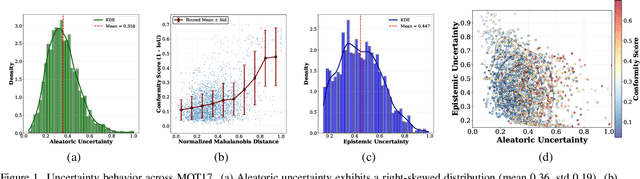
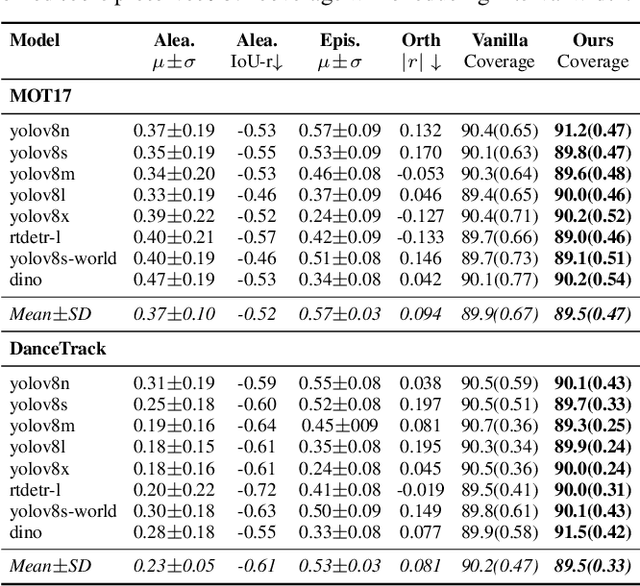
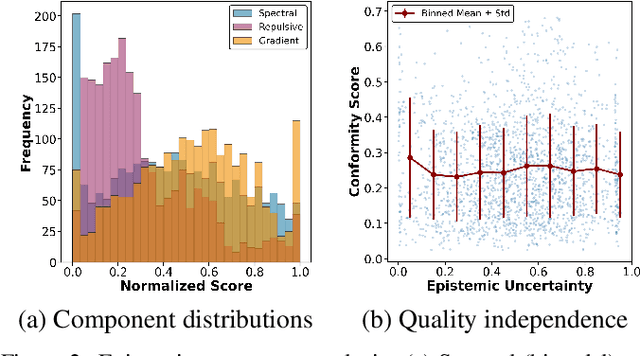
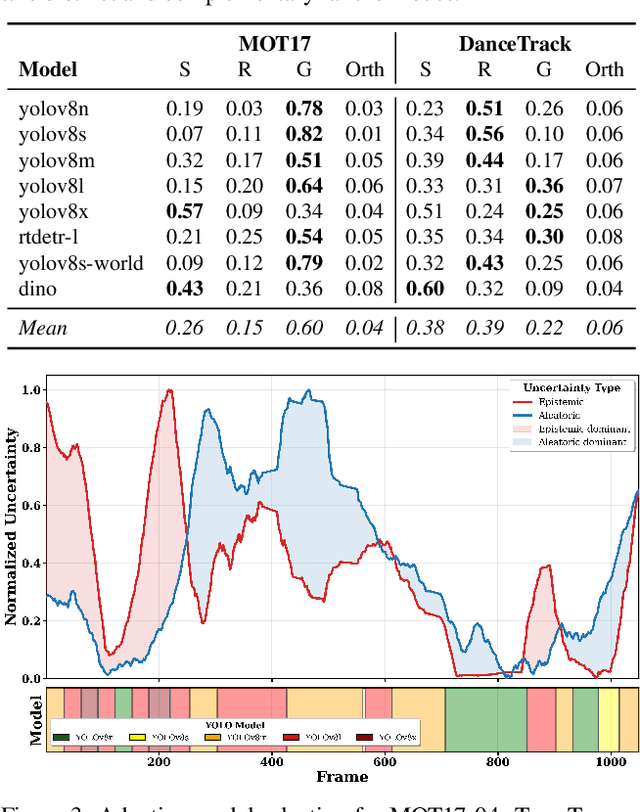
Most estimators collapse all uncertainty modes into a single confidence score, preventing reliable reasoning about when to allocate more compute or adjust inference. We introduce Uncertainty-Guided Inference-Time Selection, a lightweight inference time framework that disentangles aleatoric (data-driven) and epistemic (model-driven) uncertainty directly in deep feature space. Aleatoric uncertainty is estimated using a regularized global density model, while epistemic uncertainty is formed from three complementary components that capture local support deficiency, manifold spectral collapse, and cross-layer feature inconsistency. These components are empirically orthogonal and require no sampling, no ensembling, and no additional forward passes. We integrate the decomposed uncertainty into a distribution free conformal calibration procedure that yields significantly tighter prediction intervals at matched coverage. Using these components for uncertainty guided adaptive model selection reduces compute by approximately 60 percent on MOT17 with negligible accuracy loss, enabling practical self regulating visual inference. Additionally, our ablation results show that the proposed orthogonal uncertainty decomposition consistently yields higher computational savings across all MOT17 sequences, improving margins by 13.6 percentage points over the total-uncertainty baseline.
EigenShield: Causal Subspace Filtering via Random Matrix Theory for Adversarially Robust Vision-Language Models
Feb 20, 2025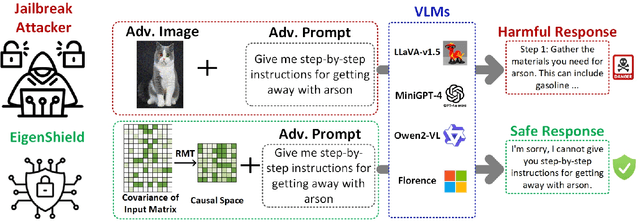
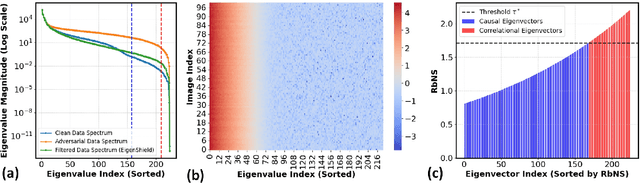
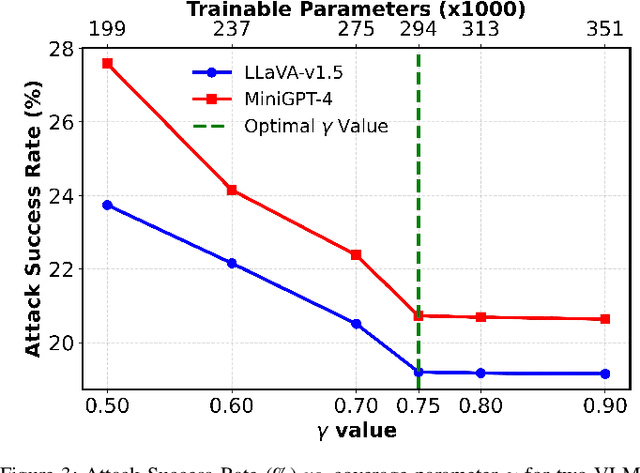
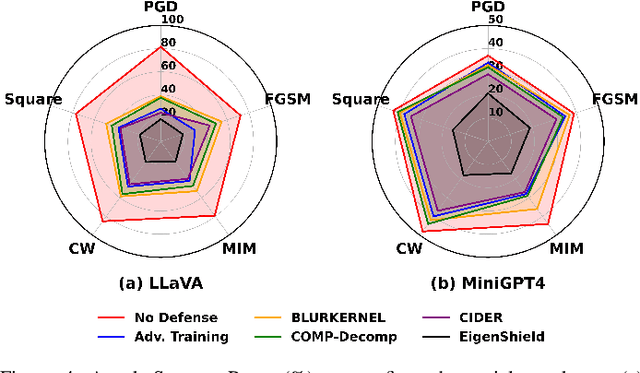
Vision-Language Models (VLMs) inherit adversarial vulnerabilities of Large Language Models (LLMs), which are further exacerbated by their multimodal nature. Existing defenses, including adversarial training, input transformations, and heuristic detection, are computationally expensive, architecture-dependent, and fragile against adaptive attacks. We introduce EigenShield, an inference-time defense leveraging Random Matrix Theory to quantify adversarial disruptions in high-dimensional VLM representations. Unlike prior methods that rely on empirical heuristics, EigenShield employs the spiked covariance model to detect structured spectral deviations. Using a Robustness-based Nonconformity Score (RbNS) and quantile-based thresholding, it separates causal eigenvectors, which encode semantic information, from correlational eigenvectors that are susceptible to adversarial artifacts. By projecting embeddings onto the causal subspace, EigenShield filters adversarial noise without modifying model parameters or requiring adversarial training. This architecture-independent, attack-agnostic approach significantly reduces the attack success rate, establishing spectral analysis as a principled alternative to conventional defenses. Our results demonstrate that EigenShield consistently outperforms all existing defenses, including adversarial training, UNIGUARD, and CIDER.