 Add to Chrome
 Add to Firefox
 Add to Edge
Spatio-Temporal Graphical Model Selection
Apr 14, 2010
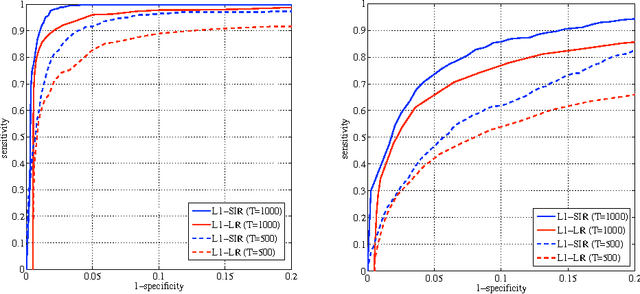


We consider the problem of estimating the topology of spatial interactions in a discrete state, discrete time spatio-temporal graphical model where the interactions affect the temporal evolution of each agent in a network. Among other models, the susceptible, infected, recovered ($SIR$) model for interaction events fall into this framework. We pose the problem as a structure learning problem and solve it using an $\ell_1$-penalized likelihood convex program. We evaluate the solution on a simulated spread of infectious over a complex network. Our topology estimates outperform those of a standard spatial Markov random field graphical model selection using $\ell_1$-regularized logistic regression.

Percolation Thresholds of Updated Posteriors for Tracking Causal Markov Processes in Complex Networks
May 14, 2009


Percolation on complex networks has been used to study computer viruses, epidemics, and other casual processes. Here, we present conditions for the existence of a network specific, observation dependent, phase transition in the updated posterior of node states resulting from actively monitoring the network. Since traditional percolation thresholds are derived using observation independent Markov chains, the threshold of the posterior should more accurately model the true phase transition of a network, as the updated posterior more accurately tracks the process. These conditions should provide insight into modeling the dynamic response of the updated posterior to active intervention and control policies while monitoring large complex networks.