 Add to Chrome
 Add to Firefox
 Add to Edge
Counterfactual Training: Teaching Models Plausible and Actionable Explanations
Jan 22, 2026
We propose a novel training regime termed counterfactual training that leverages counterfactual explanations to increase the explanatory capacity of models. Counterfactual explanations have emerged as a popular post-hoc explanation method for opaque machine learning models: they inform how factual inputs would need to change in order for a model to produce some desired output. To be useful in real-world decision-making systems, counterfactuals should be plausible with respect to the underlying data and actionable with respect to the feature mutability constraints. Much existing research has therefore focused on developing post-hoc methods to generate counterfactuals that meet these desiderata. In this work, we instead hold models directly accountable for the desired end goal: counterfactual training employs counterfactuals during the training phase to minimize the divergence between learned representations and plausible, actionable explanations. We demonstrate empirically and theoretically that our proposed method facilitates training models that deliver inherently desirable counterfactual explanations and additionally exhibit improved adversarial robustness.

Conformal Intent Classification and Clarification for Fast and Accurate Intent Recognition
Mar 27, 2024We present Conformal Intent Classification and Clarification (CICC), a framework for fast and accurate intent classification for task-oriented dialogue systems. The framework turns heuristic uncertainty scores of any intent classifier into a clarification question that is guaranteed to contain the true intent at a pre-defined confidence level. By disambiguating between a small number of likely intents, the user query can be resolved quickly and accurately. Additionally, we propose to augment the framework for out-of-scope detection. In a comparative evaluation using seven intent recognition datasets we find that CICC generates small clarification questions and is capable of out-of-scope detection. CICC can help practitioners and researchers substantially in improving the user experience of dialogue agents with specific clarification questions.
Position Paper: Against Spurious Sparks $-$ Dovelating Inflated AI Claims
Feb 07, 2024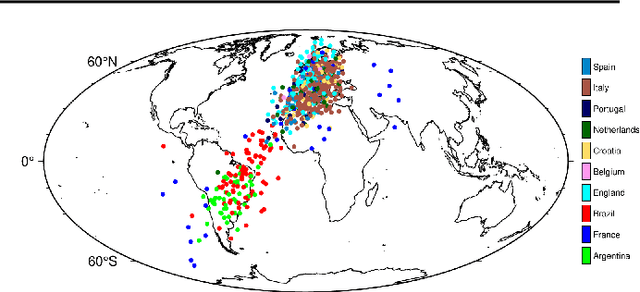
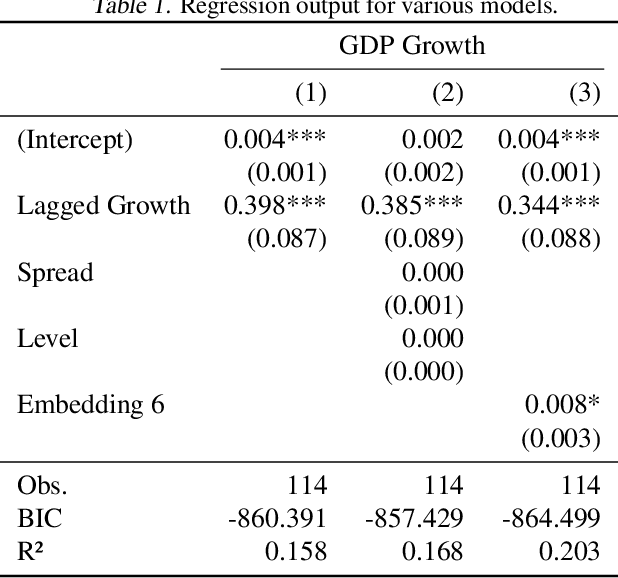
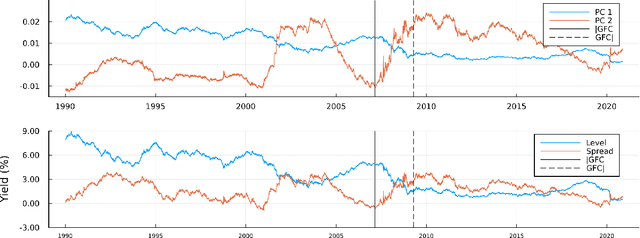

Humans have a tendency to see 'human'-like qualities in objects around them. We name our cars, and talk to pets and even household appliances, as if they could understand us as other humans do. This behavior, called anthropomorphism, is also seeing traction in Machine Learning (ML), where human-like intelligence is claimed to be perceived in Large Language Models (LLMs). In this position paper, considering professional incentives, human biases, and general methodological setups, we discuss how the current search for Artificial General Intelligence (AGI) is a perfect storm for over-attributing human-like qualities to LLMs. In several experiments, we demonstrate that the discovery of human-interpretable patterns in latent spaces should not be a surprising outcome. Also in consideration of common AI portrayal in the media, we call for the academic community to exercise extra caution, and to be extra aware of principles of academic integrity, in interpreting and communicating about AI research outcomes.
Faithful Model Explanations through Energy-Constrained Conformal Counterfactuals
Dec 17, 2023Counterfactual explanations offer an intuitive and straightforward way to explain black-box models and offer algorithmic recourse to individuals. To address the need for plausible explanations, existing work has primarily relied on surrogate models to learn how the input data is distributed. This effectively reallocates the task of learning realistic explanations for the data from the model itself to the surrogate. Consequently, the generated explanations may seem plausible to humans but need not necessarily describe the behaviour of the black-box model faithfully. We formalise this notion of faithfulness through the introduction of a tailored evaluation metric and propose a novel algorithmic framework for generating Energy-Constrained Conformal Counterfactuals that are only as plausible as the model permits. Through extensive empirical studies, we demonstrate that ECCCo reconciles the need for faithfulness and plausibility. In particular, we show that for models with gradient access, it is possible to achieve state-of-the-art performance without the need for surrogate models. To do so, our framework relies solely on properties defining the black-box model itself by leveraging recent advances in energy-based modelling and conformal prediction. To our knowledge, this is the first venture in this direction for generating faithful counterfactual explanations. Thus, we anticipate that ECCCo can serve as a baseline for future research. We believe that our work opens avenues for researchers and practitioners seeking tools to better distinguish trustworthy from unreliable models.
Endogenous Macrodynamics in Algorithmic Recourse
Aug 16, 2023


Existing work on Counterfactual Explanations (CE) and Algorithmic Recourse (AR) has largely focused on single individuals in a static environment: given some estimated model, the goal is to find valid counterfactuals for an individual instance that fulfill various desiderata. The ability of such counterfactuals to handle dynamics like data and model drift remains a largely unexplored research challenge. There has also been surprisingly little work on the related question of how the actual implementation of recourse by one individual may affect other individuals. Through this work, we aim to close that gap. We first show that many of the existing methodologies can be collectively described by a generalized framework. We then argue that the existing framework does not account for a hidden external cost of recourse, that only reveals itself when studying the endogenous dynamics of recourse at the group level. Through simulation experiments involving various state-of the-art counterfactual generators and several benchmark datasets, we generate large numbers of counterfactuals and study the resulting domain and model shifts. We find that the induced shifts are substantial enough to likely impede the applicability of Algorithmic Recourse in some situations. Fortunately, we find various strategies to mitigate these concerns. Our simulation framework for studying recourse dynamics is fast and opensourced.
* 12 pages, 11 figures. Originally published at the 2023 IEEE Conference on Secure and Trustworthy Machine Learning (SaTML). IEEE holds the copyright
Explaining Black-Box Models through Counterfactuals
Aug 14, 2023
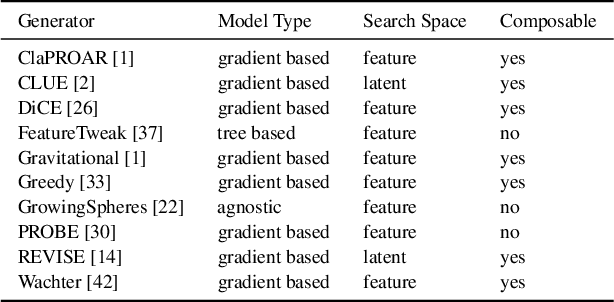
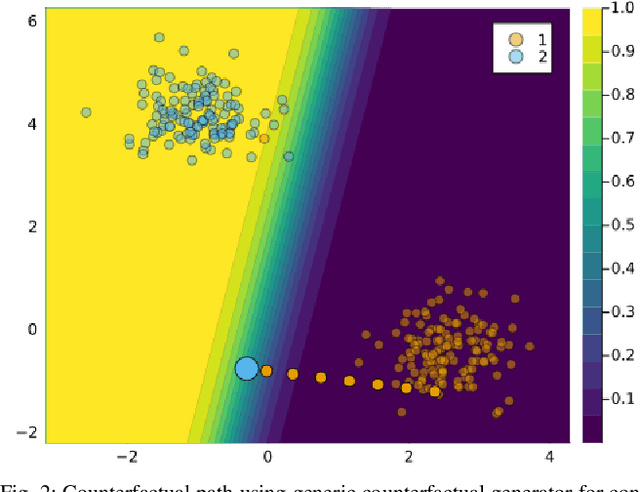

We present CounterfactualExplanations.jl: a package for generating Counterfactual Explanations (CE) and Algorithmic Recourse (AR) for black-box models in Julia. CE explain how inputs into a model need to change to yield specific model predictions. Explanations that involve realistic and actionable changes can be used to provide AR: a set of proposed actions for individuals to change an undesirable outcome for the better. In this article, we discuss the usefulness of CE for Explainable Artificial Intelligence and demonstrate the functionality of our package. The package is straightforward to use and designed with a focus on customization and extensibility. We envision it to one day be the go-to place for explaining arbitrary predictive models in Julia through a diverse suite of counterfactual generators.
* 13 pages, 9 figures, originally published in The Proceedings of the JuliaCon Conferences (JCON)