 Add to Chrome
 Add to Firefox
 Add to Edge
QuBLAST: A Framework for Quantizing Large Language Models with Block-Level Compression Approach and Activation Scaling Strategy
Jun 03, 2026
LLMs have become the state-of-the-art algorithms for solving NLP tasks. However, they typically come at huge computational and memory costs, thus making them difficult to deploy on embedded systems. Toward this, state-of-the-art methods typically employ uniform post-training quantization (PTQ) across attention blocks of the network, hence overlooking the potential of applying different quantization levels in the same network. They also employ complex operations to mitigate the negative impact of activation outliers, hence incurring high computational overheads. Moreover, they have not considered evaluation using emerging LLMs with non-conventional attention architectures (e.g., state-space models), which pose different challenges in applying quantization. To address these limitations, we propose QuBLAST, a novel PTQ methodology that employs block-level compression approach with activation scaling strategy for LLMs. Block-level compression approach enables mixed-precision quantization across blocks of the network, while activation scaling strategy efficiently mitigates the negative impact of activation outliers. Specifically, QuBLAST first analyzes the sensitivity of different attention blocks in the pre-trained model through the cross-entropy loss analysis. QuBLAST leverages this sensitivity analysis to determine the weight quantization level for each attention block in the model. Furthermore, QuBLAST employs the activation scaling map for each block to control the range of activation values and mitigate the negative impact of activation outliers, thereby enabling better quantization results. Experimental results show that, QuBLAST reduces model sizes by 40%-45.2% across different model architectures (i.e., Qwen3-8B, Llama3-8B, Mistral v0.1-8B, and Falcon H1R-7B), while maintaining the performance within 5% perplexity increase for the WikiText-2 and WikiText-103 datasets.

RAVEN: Retrieval-Augmented Vulnerability Exploration Network for Memory Corruption Analysis in User Code and Binary Programs
Apr 20, 2026Large Language Models (LLMs) have demonstrated remarkable capabilities across various cybersecurity tasks, including vulnerability classification, detection, and patching. However, their potential in automated vulnerability report documentation and analysis remains underexplored. We present RAVEN (Retrieval Augmented Vulnerability Exploration Network), a framework leveraging LLM agents and Retrieval Augmented Generation (RAG) to synthesize comprehensive vulnerability analysis reports. Given vulnerable source code, RAVEN generates reports following the Google Project Zero Root Cause Analysis template. The framework uses four modules: an Explorer agent for vulnerability identification, a RAG engine retrieving relevant knowledge from curated databases including Google Project Zero reports and CWE entries, an Analyst agent for impact and exploitation assessment, and a Reporter agent for structured report generation. To ensure quality, RAVEN includes a task specific LLM Judge evaluating reports across structural integrity, ground truth alignment, code reasoning quality, and remediation quality. We evaluate RAVEN on 105 vulnerable code samples covering 15 CWE types from the NIST-SARD dataset. Results show an average quality score of 54.21%, supporting the effectiveness of our approach for automated vulnerability documentation.
QSLM: A Performance- and Memory-aware Quantization Framework with Tiered Search Strategy for Spike-driven Language Models
Jan 02, 2026Large Language Models (LLMs) have been emerging as prominent AI models for solving many natural language tasks due to their high performance (e.g., accuracy) and capabilities in generating high-quality responses to the given inputs. However, their large computational cost, huge memory footprints, and high processing power/energy make it challenging for their embedded deployments. Amid several tinyLLMs, recent works have proposed spike-driven language models (SLMs) for significantly reducing the processing power/energy of LLMs. However, their memory footprints still remain too large for low-cost and resource-constrained embedded devices. Manual quantization approach may effectively compress SLM memory footprints, but it requires a huge design time and compute power to find the quantization setting for each network, hence making this approach not-scalable for handling different networks, performance requirements, and memory budgets. To bridge this gap, we propose QSLM, a novel framework that performs automated quantization for compressing pre-trained SLMs, while meeting the performance and memory constraints. To achieve this, QSLM first identifies the hierarchy of the given network architecture and the sensitivity of network layers under quantization, then employs a tiered quantization strategy (e.g., global-, block-, and module-level quantization) while leveraging a multi-objective performance-and-memory trade-off function to select the final quantization setting. Experimental results indicate that our QSLM reduces memory footprint by up to 86.5%, reduces power consumption by up to 20%, maintains high performance across different tasks (i.e., by up to 84.4% accuracy of sentiment classification on the SST-2 dataset and perplexity score of 23.2 for text generation on the WikiText-2 dataset) close to the original non-quantized model while meeting the performance and memory constraints.
Enabling Efficient Processing of Spiking Neural Networks with On-Chip Learning on Commodity Neuromorphic Processors for Edge AI Systems
Apr 01, 2025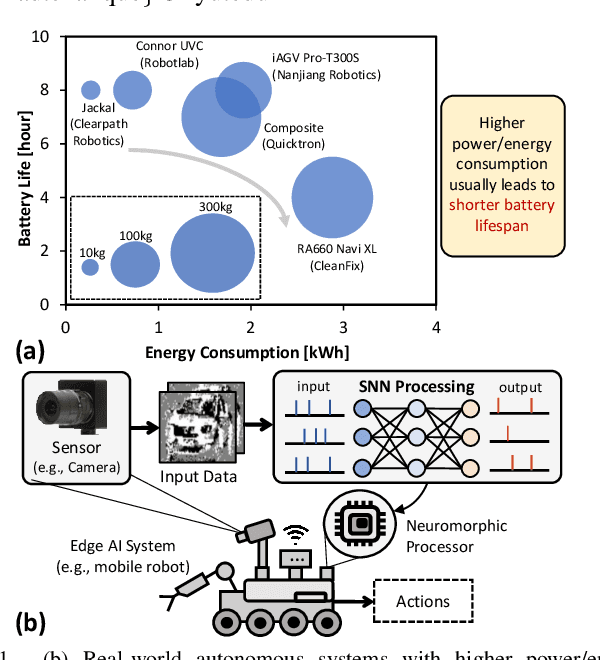
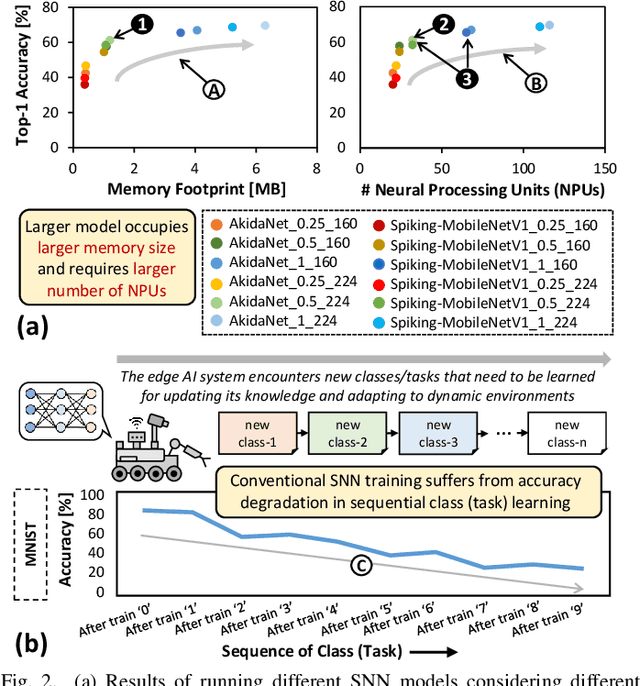
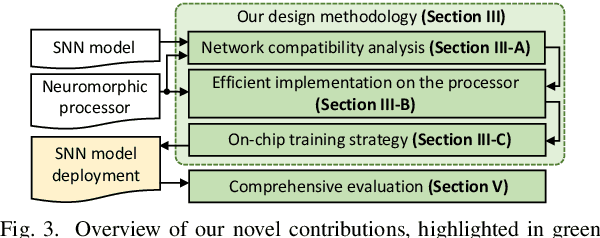
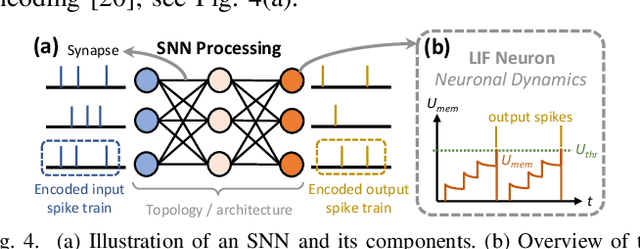
The rising demand for energy-efficient edge AI systems (e.g., mobile agents/robots) has increased the interest in neuromorphic computing, since it offers ultra-low power/energy AI computation through spiking neural network (SNN) algorithms on neuromorphic processors. However, their efficient implementation strategy has not been comprehensively studied, hence limiting SNN deployments for edge AI systems. Toward this, we propose a design methodology to enable efficient SNN processing on commodity neuromorphic processors. To do this, we first study the key characteristics of targeted neuromorphic hardware (e.g., memory and compute budgets), and leverage this information to perform compatibility analysis for network selection. Afterward, we employ a mapping strategy for efficient SNN implementation on the targeted processor. Furthermore, we incorporate an efficient on-chip learning mechanism to update the systems' knowledge for adapting to new input classes and dynamic environments. The experimental results show that the proposed methodology leads the system to achieve low latency of inference (i.e., less than 50ms for image classification, less than 200ms for real-time object detection in video streaming, and less than 1ms in keyword recognition) and low latency of on-chip learning (i.e., less than 2ms for keyword recognition), while incurring less than 250mW of processing power and less than 15mJ of energy consumption across the respective different applications and scenarios. These results show the potential of the proposed methodology in enabling efficient edge AI systems for diverse application use-cases.