 Add to Chrome
 Add to Firefox
 Add to Edge
Pen-Strategist: A Reasoning Framework for Penetration Testing Strategy Formation and Analysis
May 06, 2026
Cyber threats are rapidly increasing, expanding their impact from large-scale enterprises to government services and individual users, making robust security systems increasingly essential. However, a significant shortage of skilled cybersecurity professionals exacerbates this challenge. While recent research has explored automating tasks such as penetration testing using LLM-based agents, existing frameworks often perform poorly due to limited capability in strategy formulation, domain-specific reasoning, and accurate action and tool selection. To overcome these limitations, we propose Pen-Strategist framework, consisting of a novel domain-specific reasoning model that derives pentesting strategies via logical reasoning and a classifier that converts the strategies into actionable steps. First, we construct a reasoning dataset containing logical explanations for both strategy derivation and step selection in pentesting scenarios. We then fine-tune a Qwen-3-14B model for strategy generation using reinforcement learning. Evaluation on the test split of the dataset demonstrates a 87% improvement in strategy derivation performance compared to the baseline. Furthermore, we integrate the fine-tuned Pen-Strategist model into existing automated pentesting frameworks, such as PentestGPT, and evaluate its performance on vulnerable machines, achieving a 47.5% improvement in subtask completion while surpassing the baseline GPT-5. Further experiments on the CTFKnow benchmark show an 18% performance gain over the base model. For step prediction, we train a semantic-based CNN classifier, which outperforms commercial LLMs by 28% and enhances execution stability. Finally, we conduct a user study to qualitatively assess the generated strategies, and Pen-Strategist demonstrates superior performance compared to the Claude-4.6-Sonnet.

Eliciting Least-to-Most Reasoning for Phishing URL Detection
Jan 28, 2026Phishing continues to be one of the most prevalent attack vectors, making accurate classification of phishing URLs essential. Recently, large language models (LLMs) have demonstrated promising results in phishing URL detection. However, their reasoning capabilities that enabled such performance remain underexplored. To this end, in this paper, we propose a Least-to-Most prompting framework for phishing URL detection. In particular, we introduce an "answer sensitivity" mechanism that guides Least-to-Most's iterative approach to enhance reasoning and yield higher prediction accuracy. We evaluate our framework using three URL datasets and four state-of-the-art LLMs, comparing against a one-shot approach and a supervised model. We demonstrate that our framework outperforms the one-shot baseline while achieving performance comparable to that of the supervised model, despite requiring significantly less training data. Furthermore, our in-depth analysis highlights how the iterative reasoning enabled by Least-to-Most, and reinforced by our answer sensitivity mechanism, drives these performance gains. Overall, we show that this simple yet powerful prompting strategy consistently outperforms both one-shot and supervised approaches, despite requiring minimal training or few-shot guidance. Our experimental setup can be found in our Github repository github.sydney.edu.au/htri0928/least-to-most-phishing-detection.
Temporal Convolution-based Hybrid Model Approach with Representation Learning for Real-Time Acoustic Anomaly Detection
Oct 25, 2024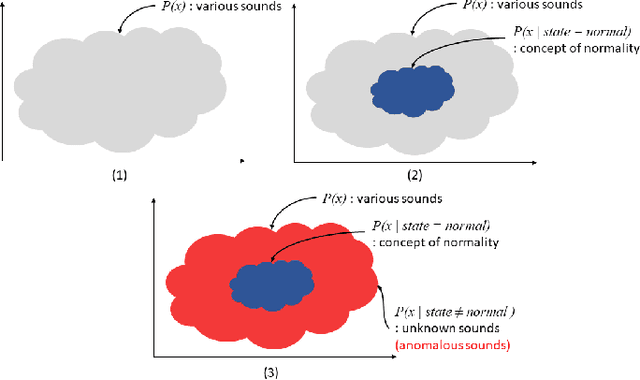
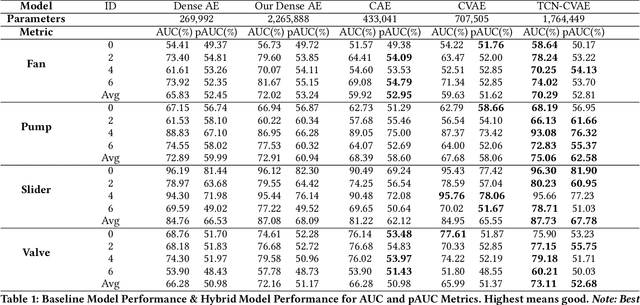
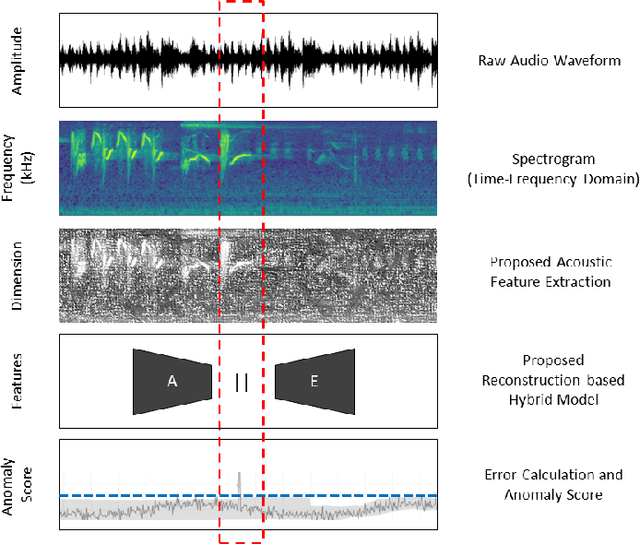
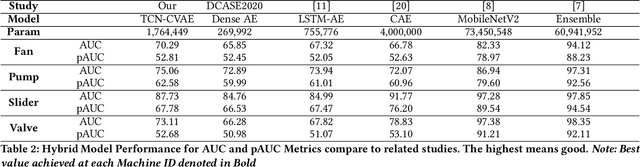
The early detection of potential failures in industrial machinery components is paramount for ensuring the reliability and safety of operations, thereby preserving Machine Condition Monitoring (MCM). This research addresses this imperative by introducing an innovative approach to Real-Time Acoustic Anomaly Detection. Our method combines semi-supervised temporal convolution with representation learning and a hybrid model strategy with Temporal Convolutional Networks (TCN) to handle various intricate anomaly patterns found in acoustic data effectively. The proposed model demonstrates superior performance compared to established research in the field, underscoring the effectiveness of this approach. Not only do we present quantitative evidence of its superiority, but we also employ visual representations, such as t-SNE plots, to further substantiate the model's efficacy.
* 10 pages, 10 figures, ICMLC2024