 Add to Chrome
 Add to Firefox
 Add to Edge
FAST-MEL: A Fast, Accurate, and Storage Efficient Solution for Multimodal Entity Linking
Jun 10, 2026
Multimodal entity linking (MEL) is the task that consists of matching textual and visual mentions of entities in unstructured data to their corresponding entities in a knowledge base (KB). To be effective in large-scale practical settings, MEL systems must meet three objectives: high linking accuracy, computational efficiency, and storage efficiency, i.e., a compact yet efficient index of the KB. In this paper, we highlight that state-of-the-art systems fail to simultaneously satisfy these 3 requirements. To meet this three-fold objective, we propose FAST-MEL, a lightweight encoder-based MEL solution that relies on a novel and compact fixed-size vectorized representation of both the textual and visual information of each entity or mention. It matches the accuracy of the best systems but performs three orders of magnitude faster. It also consumes one order of magnitude less storage than the fastest systems.

A Study on Building Efficient Zero-Shot Relation Extraction Models
Mar 04, 2026Zero-shot relation extraction aims to identify relations between entity mentions using textual descriptions of novel types (i.e., previously unseen) instead of labeled training examples. Previous works often rely on unrealistic assumptions: (1) pairs of mentions are often encoded directly in the input, which prevents offline pre-computation for large scale document database querying; (2) no rejection mechanism is introduced, biasing the evaluation when using these models in a retrieval scenario where some (and often most) inputs are irrelevant and must be ignored. In this work, we study the robustness of existing zero-shot relation extraction models when adapting them to a realistic extraction scenario. To this end, we introduce a typology of existing models, and propose several strategies to build single pass models and models with a rejection mechanism. We adapt several state-of-the-art tools, and compare them in this challenging setting, showing that no existing work is really robust to realistic assumptions, but overall AlignRE (Li et al., 2024) performs best along all criteria.
A Study of the Plausibility of Attention between RNN Encoders in Natural Language Inference
Jan 23, 2025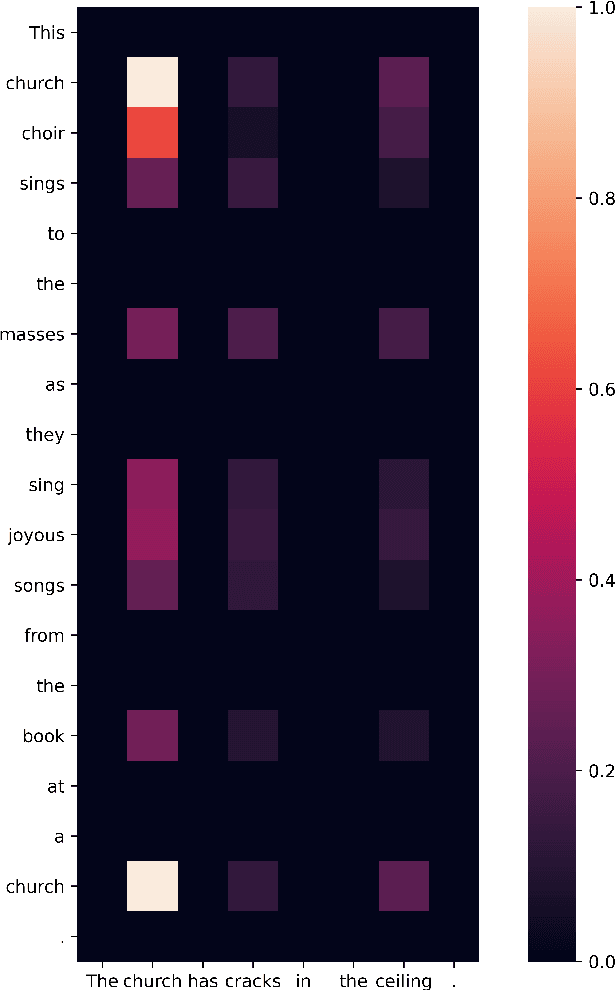
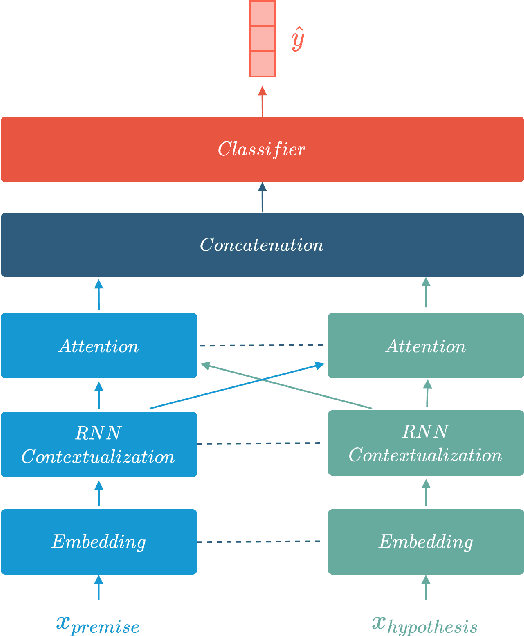
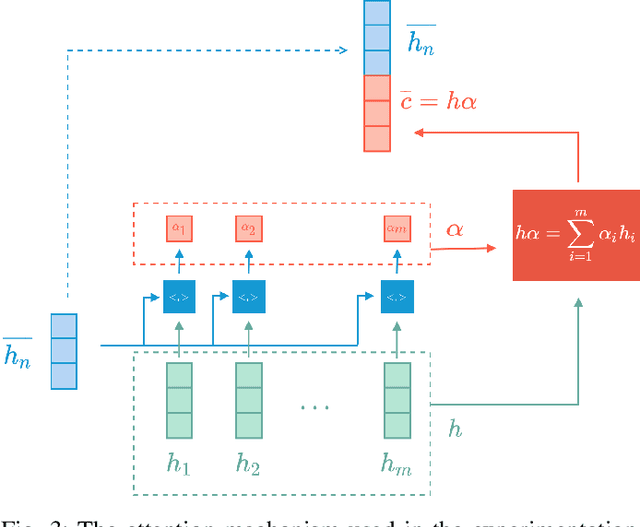
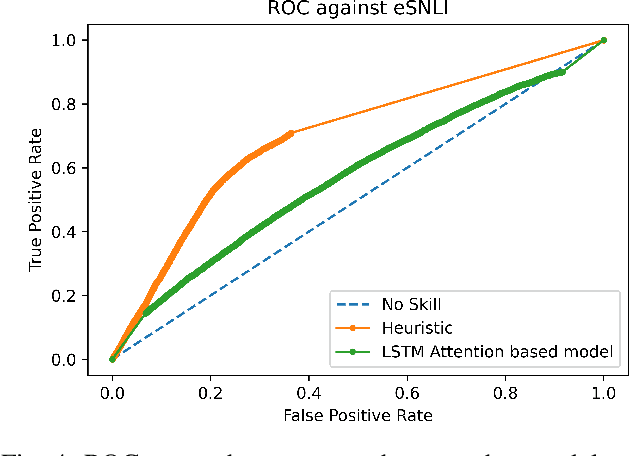
Attention maps in neural models for NLP are appealing to explain the decision made by a model, hopefully emphasizing words that justify the decision. While many empirical studies hint that attention maps can provide such justification from the analysis of sound examples, only a few assess the plausibility of explanations based on attention maps, i.e., the usefulness of attention maps for humans to understand the decision. These studies furthermore focus on text classification. In this paper, we report on a preliminary assessment of attention maps in a sentence comparison task, namely natural language inference. We compare the cross-attention weights between two RNN encoders with human-based and heuristic-based annotations on the eSNLI corpus. We show that the heuristic reasonably correlates with human annotations and can thus facilitate evaluation of plausible explanations in sentence comparison tasks. Raw attention weights however remain only loosely related to a plausible explanation.
Utilisation de la linguistique en reconnaissance de la parole : un état de l'art
May 30, 2006To transcribe speech, automatic speech recognition systems use statistical methods, particularly hidden Markov model and N-gram models. Although these techniques perform well and lead to efficient systems, they approach their maximum possibilities. It seems thus necessary, in order to outperform current results, to use additional information, especially bound to language. However, introducing such knowledge must be realized taking into account specificities of spoken language (hesitations for example) and being robust to possible misrecognized words. This document presents a state of the art of these researches, evaluating the impact of the insertion of linguistic information on the quality of the transcription.