 Add to Chrome
 Add to Firefox
 Add to Edge
ORTHOBO: Orthogonal Bayesian Hyperparameter Optimization
May 07, 2026
Bayesian optimization is widely used for hyperparameter optimization when model evaluations are expensive; however, noisy acquisition estimates can lead to unstable decisions. We identify acquisition estimation noise as a failure mode that was previously overlooked: even when the surrogate model and acquisition target are correctly specified, finite-sample Monte Carlo error can perturb acquisition values. This can, in turn, flip candidate rankings and lead to suboptimal BO decisions. As a remedy, we aim at variance reduction and propose an orthogonal acquisition estimator that subtracts an optimally weighted score-function control variate, which yields an acquisition residual orthogonal to posterior score directions and which thus reduces Monte Carlo variance. We further introduce OrthoBO: a Bayesian optimization framework that combines our orthogonal acquisition estimator with ensemble surrogates and an outer log transformation. We show theoretically that our estimator preserves the target, leads to variance reduction, and improves pairwise ranking stability. We further verify the theoretical properties of OrthoBO through numerical experiments where our framework reduces acquisition estimation variance, stabilizes candidate rankings, and achieves strong performance. We also demonstrate the downstream utility of OrthoBO in hyperparameter optimization for neural network training and fine-tuning.

MedClarify: An information-seeking AI agent for medical diagnosis with case-specific follow-up questions
Feb 19, 2026Large language models (LLMs) are increasingly used for diagnostic tasks in medicine. In clinical practice, the correct diagnosis can rarely be immediately inferred from the initial patient presentation alone. Rather, reaching a diagnosis often involves systematic history taking, during which clinicians reason over multiple potential conditions through iterative questioning to resolve uncertainty. This process requires considering differential diagnoses and actively excluding emergencies that demand immediate intervention. Yet, the ability of medical LLMs to generate informative follow-up questions and thus reason over differential diagnoses remains underexplored. Here, we introduce MedClarify, an AI agent for information-seeking that can generate follow-up questions for iterative reasoning to support diagnostic decision-making. Specifically, MedClarify computes a list of candidate diagnoses analogous to a differential diagnosis, and then proactively generates follow-up questions aimed at reducing diagnostic uncertainty. By selecting the question with the highest expected information gain, MedClarify enables targeted, uncertainty-aware reasoning to improve diagnostic performance. In our experiments, we first demonstrate the limitations of current LLMs in medical reasoning, which often yield multiple, similarly likely diagnoses, especially when patient cases are incomplete or relevant information for diagnosis is missing. We then show that our information-theoretic reasoning approach can generate effective follow-up questioning and thereby reduces diagnostic errors by ~27 percentage points (p.p.) compared to a standard single-shot LLM baseline. Altogether, MedClarify offers a path to improve medical LLMs through agentic information-seeking and to thus promote effective dialogues with medical LLMs that reflect the iterative and uncertain nature of real-world clinical reasoning.
Slowing Down Forgetting in Continual Learning
Nov 11, 2024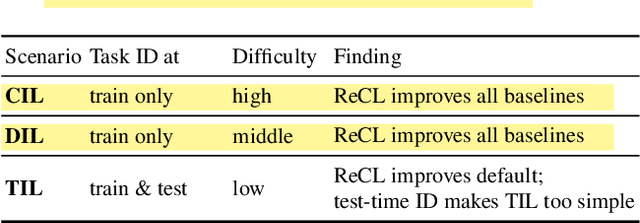
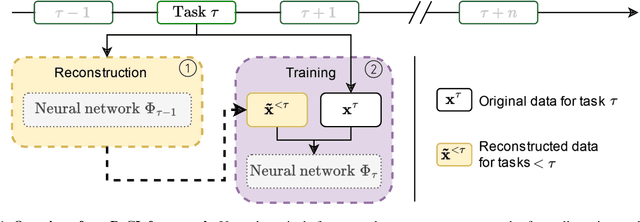
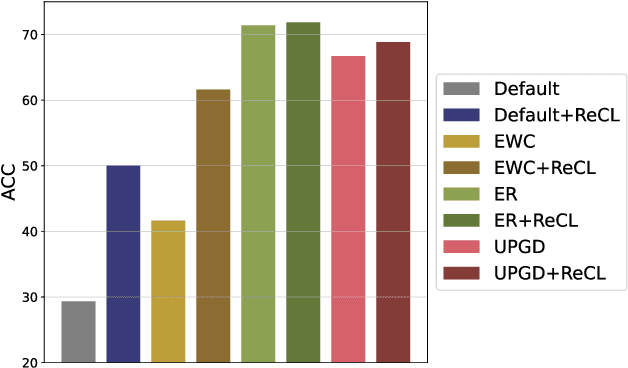
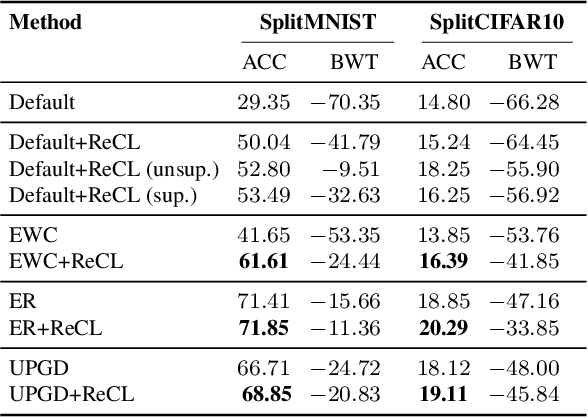
A common challenge in continual learning (CL) is catastrophic forgetting, where the performance on old tasks drops after new, additional tasks are learned. In this paper, we propose a novel framework called ReCL to slow down forgetting in CL. Our framework exploits an implicit bias of gradient-based neural networks due to which these converge to margin maximization points. Such convergence points allow us to reconstruct old data from previous tasks, which we then combine with the current training data. Our framework is flexible and can be applied on top of existing, state-of-the-art CL methods to slow down forgetting. We further demonstrate the performance gain from our framework across a large series of experiments, including different CL scenarios (class incremental, domain incremental, task incremental learning) different datasets (MNIST, CIFAR10), and different network architectures. Across all experiments, we find large performance gains through ReCL. To the best of our knowledge, our framework is the first to address catastrophic forgetting by leveraging models in CL as their own memory buffers.
Global Vegetation Modeling with Pre-Trained Weather Transformers
Mar 27, 2024
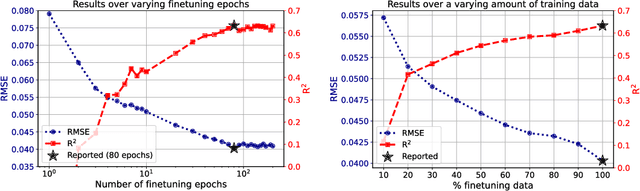
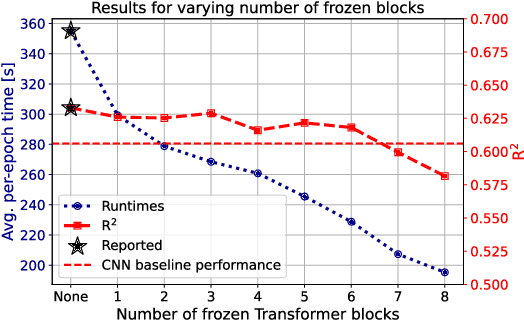
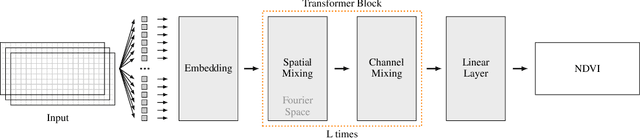
Accurate vegetation models can produce further insights into the complex interaction between vegetation activity and ecosystem processes. Previous research has established that long-term trends and short-term variability of temperature and precipitation affect vegetation activity. Motivated by the recent success of Transformer-based Deep Learning models for medium-range weather forecasting, we adapt the publicly available pre-trained FourCastNet to model vegetation activity while accounting for the short-term dynamics of climate variability. We investigate how the learned global representation of the atmosphere's state can be transferred to model the normalized difference vegetation index (NDVI). Our model globally estimates vegetation activity at a resolution of \SI{0.25}{\degree} while relying only on meteorological data. We demonstrate that leveraging pre-trained weather models improves the NDVI estimates compared to learning an NDVI model from scratch. Additionally, we compare our results to other recent data-driven NDVI modeling approaches from machine learning and ecology literature. We further provide experimental evidence on how much data and training time is necessary to turn FourCastNet into an effective vegetation model. Code and models will be made available upon publication.