 Add to Chrome
 Add to Firefox
 Add to Edge
Self-Intersection-Aware 3D Human Motion Generation Using an Efficient Human Sphere Proxy
May 26, 2026
Human motion generation has made tremendous progress in recent years, with state-of-the-art approaches surpassing ground truth data in leading evaluation benchmarks. However, visual inspection of the generated motions paints a different picture. Even state-of-the-art approaches generate motions frequently containing self-intersections, i.e., body parts interpenetrating, which are strong artifacts, severely limiting the perceived motion quality. We introduce a novel loss, which explicitly penalizes self-intersections, to the training of human motion generation methods. We base our loss on a sphere proxy of human geometry, which allows us to calculate a self-intersection loss 98% faster and uses 83% less memory than comparable methods based on triangular meshes. The loss is agnostic to the specific approach, and we add it to the training of the recent human motion generation methods human motion diffusion model (MDM) and MoMask. Our extensive experiments show a reduction of self-intersections in generated motions of up to 49% while improving other evaluation metrics. The code is available at https://github.com/boschresearch/humansphereproxy .

Augmenting Zero-Shot Detection Training with Image Labels
Jun 12, 2023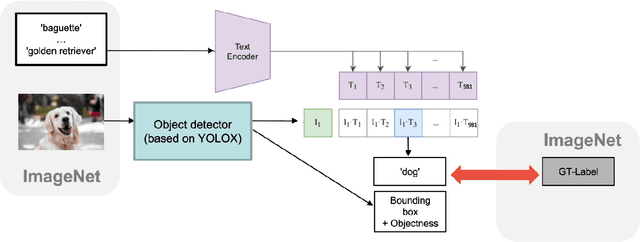
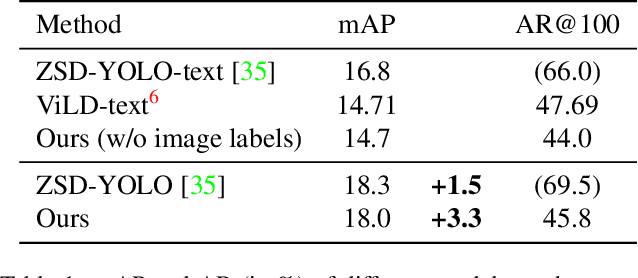
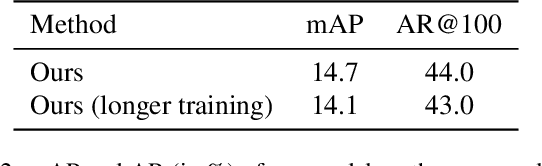
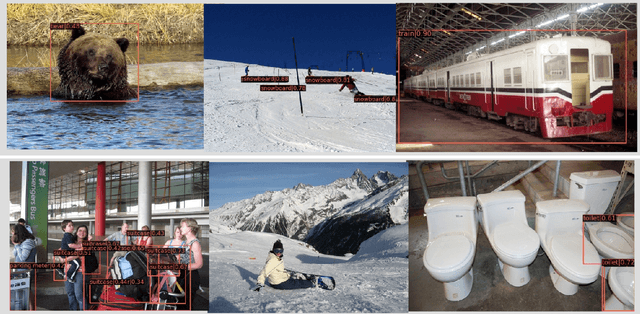
Zero-shot detection (ZSD), i.e., detection on classes not seen during training, is essential for real world detection use-cases, but remains a difficult task. Recent research attempts ZSD with detection models that output embeddings instead of direct class labels. To this aim, the output of the detection model must be aligned to a learned embedding space such as CLIP. However, this alignment is hindered by detection data sets which are expensive to produce compared to image classification annotations, and the resulting lack of category diversity in the training data. We address this challenge by leveraging the CLIP embedding space in combination with image labels from ImageNet. Our results show that image labels are able to better align the detector output to the embedding space and thus have a high potential for ZSD. Compared to only training on detection data, we see a significant gain by adding image label data of 3.3 mAP for the 65/15 split on COCO on the unseen classes, i.e., we more than double the gain of related work.