 Add to Chrome
 Add to Firefox
 Add to Edge
Outage Performance of $3$D Mobile UAV Caching for Hybrid Satellite-Terrestrial Networks
Jun 10, 2021
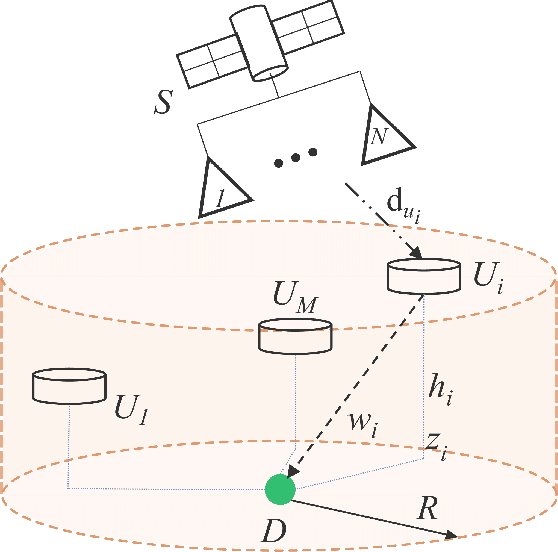
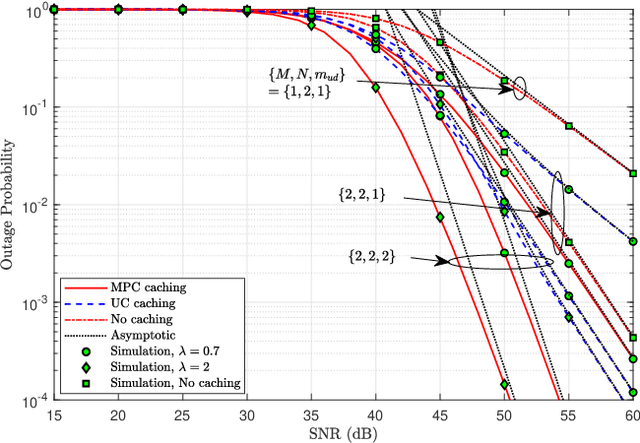
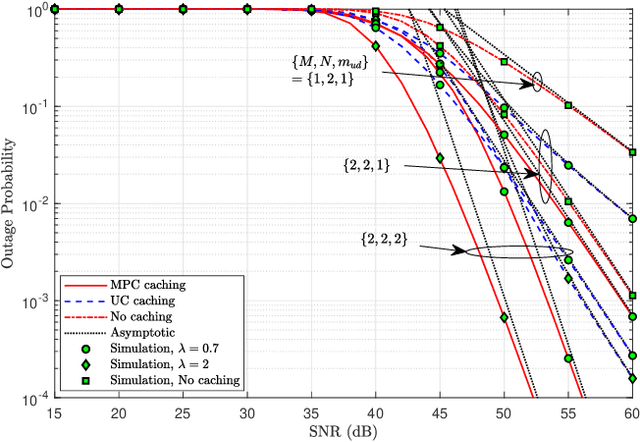
In this paper, we consider a hybrid satellite-terrestrial network (HSTN) where a multiantenna satellite communicates with a ground user equipment (UE) with the help of multiple cache-enabled amplify-and-forward (AF) three-dimensional ($3$D) mobile unmanned aerial vehicle (UAV) relays. Herein, we employ the two fundamental most popular content (MPC) and uniform content (UC) caching schemes for two types of mobile UAV relays, namely fully $3$D and fixed height. Taking into account the multiantenna satellite links and the random $3$D distances between UAV relays and UE, we analyze the outage probability (OP) of considered system with MPC and UC caching schemes. We further carry out the corresponding asymptotic OP analysis to present the insights on achievable performance gains of two schemes for both types of $3$D mobile UAV relaying. Specifically, we show the following: (a) MPC caching dominates the UC and no caching schemes; (b) fully $3$D mobile UAV relaying outperforms its fixed height counterpart. We finally corroborate the theoretic analysis by simulations.

Outage Performance of Multi-UAV Relaying-based Imperfect Hardware Hybrid Satellite-Terrestrial Networks
Jun 08, 2021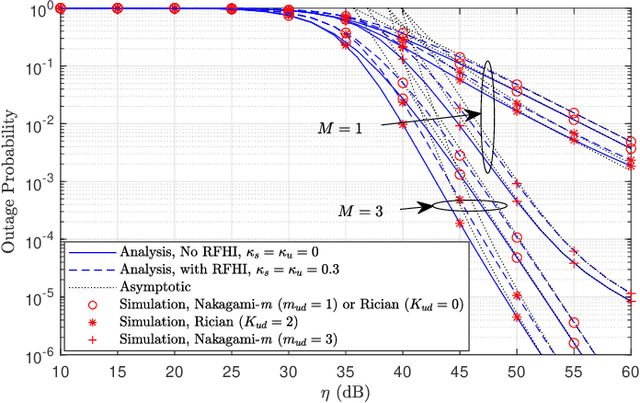
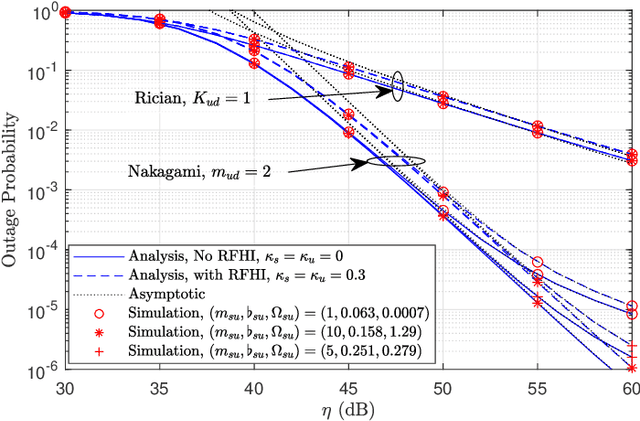
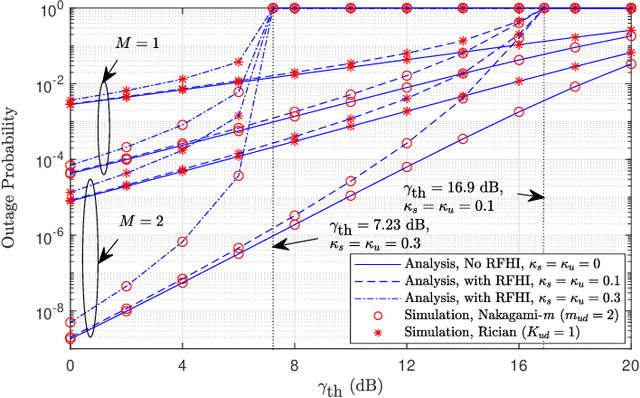
In this paper, we consider an imperfect hardware hybrid satellite-terrestrial network (HSTN) where the satellite communication with a ground user equipment (UE) is aided by the multiple amplify-and-forward (AF) three-dimensional ($3$D) mobile unmanned aerial vehicle (UAV) relays. Herein, we consider that all transceiver nodes are corrupted by the radio frequency hardware impairments (RFHI). Further, a stochastic mixed mobility (MM) model is employed to characterize the instantaneous location of $3$D mobile UAV relays in a cylindrical cell with UE lying at its center on ground plane. Taking into account the aggregate RFHI model for satellite and UAV relay transceivers and the random $3$D distances-based path loss for UAV relay-UE links, we investigate the outage probability (OP) and corresponding asymptotic outage behaviour of the system under an opportunistic relay selection scheme in a unified form for shadowed-Rician satellite links' channels and Nakagami-\emph{m} as well as Rician terrestrial links' channels. We corroborate theoretical analysis by simulations.