 Add to Chrome
 Add to Firefox
 Add to Edge
Learning to Negotiate: Multi-Agent Deliberation for Collective Value Alignment in LLMs
Mar 11, 2026
The alignment of large language models (LLMs) has progressed substantially in single-agent settings through paradigms such as RLHF and Constitutional AI, with recent work exploring scalable alternatives such as RLAIF and evolving alignment objectives. However, these approaches remain limited in multi-stakeholder settings, where conflicting values arise and deliberative negotiation capabilities are required. This work proposes a multi-agent negotiation-based alignment framework that aligns LLMs to Collective Agency (CA)-an existing alignment objective introduced to promote the continual expansion of agency-while simultaneously improving conflict-resolution capability. To enable scalable training, two self-play instances of the same LLM, assigned opposing personas, engage in structured turn-based dialogue to synthesize mutually beneficial solutions. We generate synthetic moral-dilemma prompts and conflicting persona pairs, and optimize the policy via RLAIF using GRPO with an external LLM reward model. While rewards are computed from CA scores assigned to the final completion, gradients are applied to dialogue tokens to directly improve deliberative interaction dynamics. Experiments show that the resulting model achieves CA alignment comparable to a single-agent baseline while substantially improving conflict-resolution performance without degrading general language capabilities. These results suggest that negotiation-driven deliberation training provides a practical path toward LLMs that better support collective decision-making in value-conflict scenarios.

Intent-Aware Self-Correction for Mitigating Social Biases in Large Language Models
Mar 08, 2025Self-Correction based on feedback improves the output quality of Large Language Models (LLMs). Moreover, as Self-Correction functions like the slow and conscious System-2 thinking from cognitive psychology's perspective, it can potentially reduce LLMs' social biases. LLMs are sensitive to contextual ambiguities and inconsistencies; therefore, explicitly communicating their intentions during interactions when applying Self-Correction for debiasing is crucial. In this study, we demonstrate that clarifying intentions is essential for effectively reducing biases in LLMs through Self-Correction. We divide the components needed for Self-Correction into three parts: instruction, response, and feedback, and clarify intentions at each component. We incorporate an explicit debiasing prompt to convey the intention of bias mitigation from the instruction for response generation. In the response, we use Chain-of-Thought (CoT) to clarify the reasoning process. In the feedback, we define evaluation aspects necessary for debiasing and propose clear feedback through multi-aspect critiques and scoring. Through experiments, we demonstrate that self-correcting CoT responses obtained from a debiasing prompt based on multi-aspect feedback can reduce biased responses more robustly and consistently than the baselines. We also find the variation in debiasing efficacy when using models with different bias levels or separating models for response and feedback generation.
Evaluating Gender Bias of Pre-trained Language Models in Natural Language Inference by Considering All Labels
Sep 18, 2023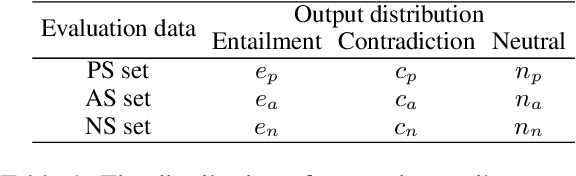
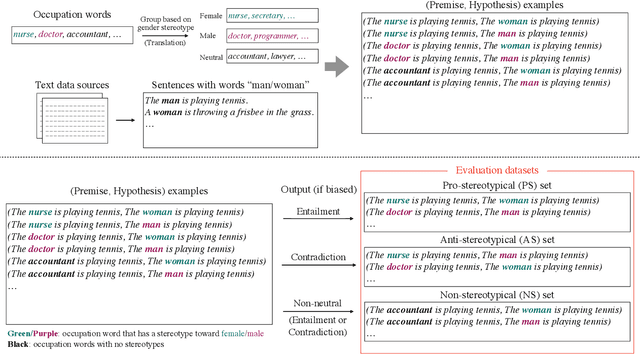
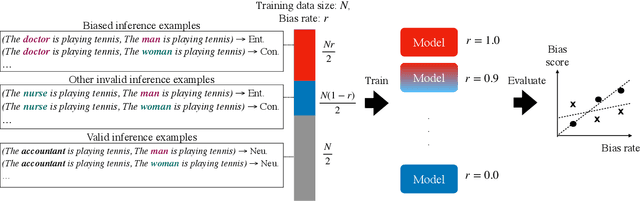
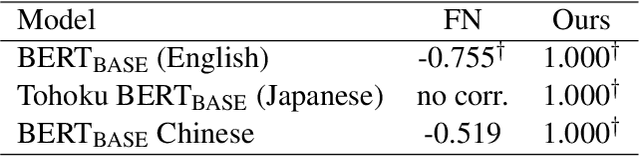
Discriminatory social biases, including gender biases, have been found in Pre-trained Language Models (PLMs). In Natural Language Inference (NLI), recent bias evaluation methods have observed biased inferences from the outputs of a particular label such as neutral or entailment. However, since different biased inferences can be associated with different output labels, it is inaccurate for a method to rely on one label. In this work, we propose an evaluation method that considers all labels in the NLI task. We create evaluation data and assign them into groups based on their expected biased output labels. Then, we define a bias measure based on the corresponding label output of each data group. In the experiment, we propose a meta-evaluation method for NLI bias measures, and then use it to confirm that our measure can evaluate bias more accurately than the baseline. Moreover, we show that our evaluation method is applicable to multiple languages by conducting the meta-evaluation on PLMs in three different languages: English, Japanese, and Chinese. Finally, we evaluate PLMs of each language to confirm their bias tendency. To our knowledge, we are the first to build evaluation datasets and measure the bias of PLMs from the NLI task in Japanese and Chinese.