 Add to Chrome
 Add to Firefox
 Add to Edge
Interpretable Hybrid Deep Q-Learning Framework for IoT-Based Food Spoilage Prediction with Synthetic Data Generation and Hardware Validation
Dec 22, 2025
The need for an intelligent, real-time spoilage prediction system has become critical in modern IoT-driven food supply chains, where perishable goods are highly susceptible to environmental conditions. Existing methods often lack adaptability to dynamic conditions and fail to optimize decision making in real time. To address these challenges, we propose a hybrid reinforcement learning framework integrating Long Short-Term Memory (LSTM) and Recurrent Neural Networks (RNN) for enhanced spoilage prediction. This hybrid architecture captures temporal dependencies within sensor data, enabling robust and adaptive decision making. In alignment with interpretable artificial intelligence principles, a rule-based classifier environment is employed to provide transparent ground truth labeling of spoilage levels based on domain-specific thresholds. This structured design allows the agent to operate within clearly defined semantic boundaries, supporting traceable and interpretable decisions. Model behavior is monitored using interpretability-driven metrics, including spoilage accuracy, reward-to-step ratio, loss reduction rate, and exploration decay. These metrics provide both quantitative performance evaluation and insights into learning dynamics. A class-wise spoilage distribution visualization is used to analyze the agents decision profile and policy behavior. Extensive evaluations on simulated and real-time hardware data demonstrate that the LSTM and RNN based agent outperforms alternative reinforcement learning approaches in prediction accuracy and decision efficiency while maintaining interpretability. The results highlight the potential of hybrid deep reinforcement learning with integrated interpretability for scalable IoT-based food monitoring systems.

Challenges in the application of a mortality prediction model for COVID-19 patients on an Indian cohort
Jan 15, 2021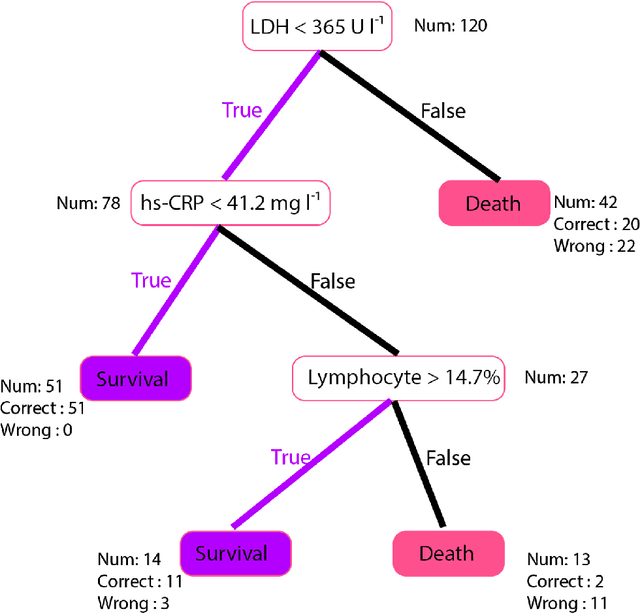
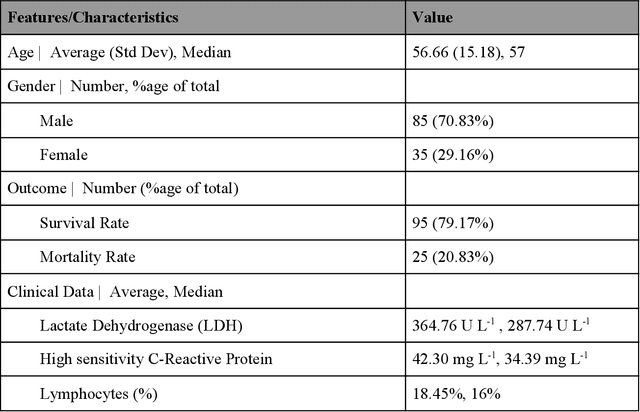
Many countries are now experiencing the third wave of the COVID-19 pandemic straining the healthcare resources with an acute shortage of hospital beds and ventilators for the critically ill patients. This situation is especially worse in India with the second largest load of COVID-19 cases and a relatively resource-scarce medical infrastructure. Therefore, it becomes essential to triage the patients based on the severity of their disease and devote resources towards critically ill patients. Yan et al. 1 have published a very pertinent research that uses Machine learning (ML) methods to predict the outcome of COVID-19 patients based on their clinical parameters at the day of admission. They used the XGBoost algorithm, a type of ensemble model, to build the mortality prediction model. The final classifier is built through the sequential addition of multiple weak classifiers. The clinically operable decision rule was obtained from a 'single-tree XGBoost' and used lactic dehydrogenase (LDH), lymphocyte and high-sensitivity C-reactive protein (hs-CRP) values. This decision tree achieved a 100% survival prediction and 81% mortality prediction. However, these models have several technical challenges and do not provide an out of the box solution that can be deployed for other populations as has been reported in the "Matters Arising" section of Yan et al. Here, we show the limitations of this model by deploying it on one of the largest datasets of COVID-19 patients containing detailed clinical parameters collected from India.
Response Prediction of Structural System Subject to Earthquake Motions using Artificial Neural Network
May 15, 2007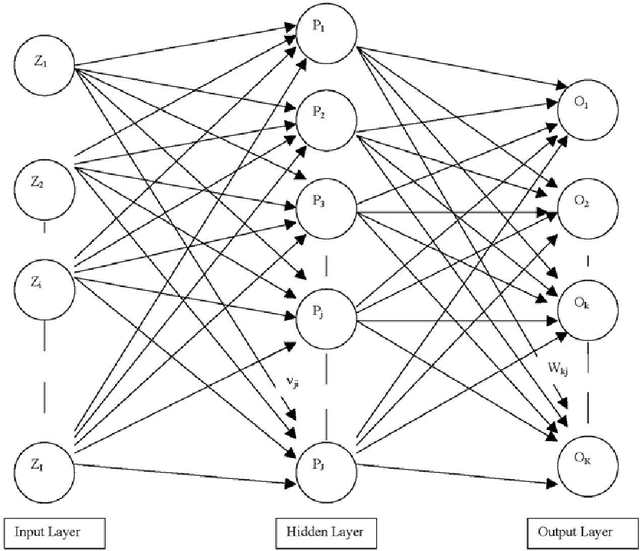
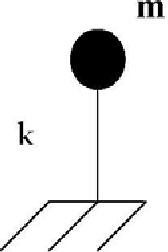
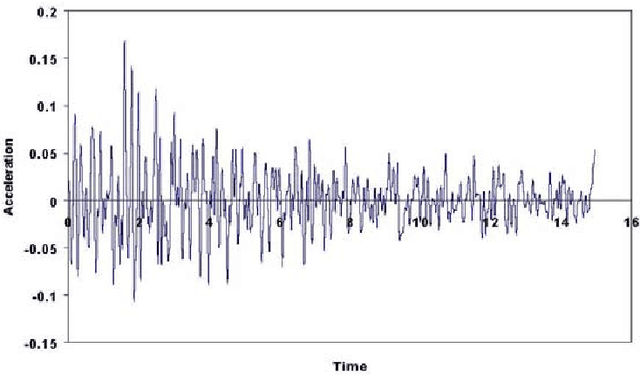
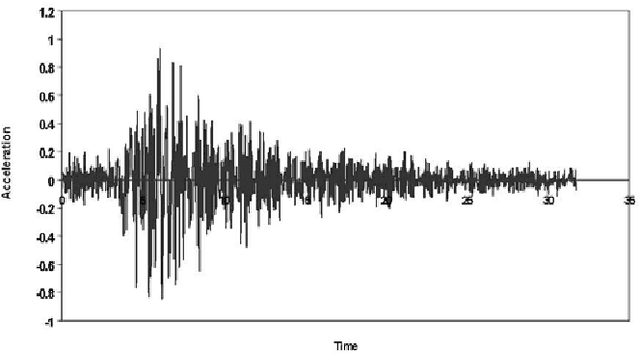
This paper uses Artificial Neural Network (ANN) models to compute response of structural system subject to Indian earthquakes at Chamoli and Uttarkashi ground motion data. The system is first trained for a single real earthquake data. The trained ANN architecture is then used to simulate earthquakes with various intensities and it was found that the predicted responses given by ANN model are accurate for practical purposes. When the ANN is trained by a part of the ground motion data, it can also identify the responses of the structural system well. In this way the safeness of the structural systems may be predicted in case of future earthquakes without waiting for the earthquake to occur for the lessons. Time period and the corresponding maximum response of the building for an earthquake has been evaluated, which is again trained to predict the maximum response of the building at different time periods. The trained time period versus maximum response ANN model is also tested for real earthquake data of other place, which was not used in the training and was found to be in good agreement.