 Add to Chrome
 Add to Firefox
 Add to Edge
HumanMoveVQA: Can Video MLLMs reason about human movement in videos?
Jun 29, 2026
Despite the rapid advance of Multimodal Large Language Models (MLLMs) in high-level video understanding, a fundamental bottleneck remains: these models collapse complex human motion into coarse semantic labels. Existing benchmarks mostly focus on scene-centric events or local joint articulations, failing to probe global human motion in space over time (trajectory and orientation changes). We introduce HumanMoveVQA, the first comprehensive benchmark designed to evaluate global trajectory and orientation reasoning from an exocentric perspective. Our benchmark utilizes a first-frame anchored world coordinate system, preserving translation and rotation relative to a fixed starting point. We propose a scalable, multi-stage pipeline that lifts 2D video observations into world-consistent 3D motion tracks to generate over 10K structured question-answer pairs across seven reasoning categories, including motion aggregation, sequential ordering, and trajectory-level inference. Our extensive evaluation reveals a critical capability gap in state-of-the-art proprietary models on deep human motion understanding. However, we demonstrate that this is a learnable problem; by fine-tuning an open-source baseline with our targeted, world-consistent supervision, we achieve a significant improvement. HumanMoveVQA establishes a rigorous geometric foundation for developing next-generation, movement-aware video understanding models.

Artistic Domain Generalisation Methods are Limited by their Deep Representations
Jul 29, 2019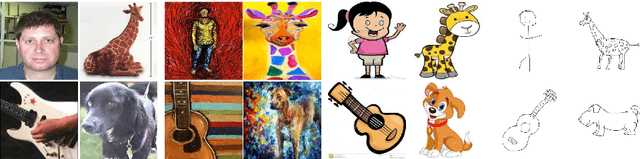
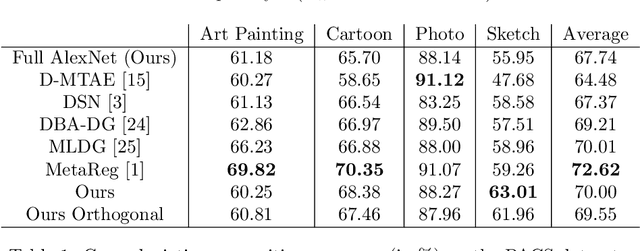
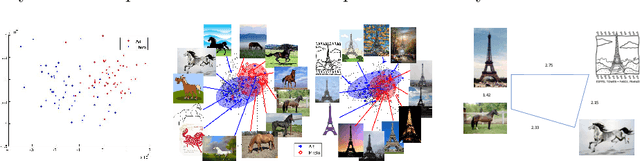
The cross-depiction problem refers to the task of recognising visual objects regardless of their depictions; whether photographed, painted, sketched, {\em etc}. In the past, some researchers considered cross-depiction to be domain adaptation (DA). More recent work considers cross-depiction as domain generalisation (DG), in which algorithms extend recognition from one set of domains (such as photographs and coloured artwork) to another (such as sketches). We show that fixing the last layer of AlexNet to random values provides a performance comparable to state of the art DA and DG algorithms, when tested over the PACS benchmark. With support from background literature, our results lead us to conclude that texture alone is insufficient to support generalisation; rather, higher-order representations such as structure and shape are necessary.