 Add to Chrome
 Add to Firefox
 Add to Edge
Platonic Representations in the Human Brain: Unsupervised Recovery of Universal Geometry
May 19, 2026
The Strong Platonic Representation Hypothesis suggests that representational convergence in artificial neural networks can be harnessed constructively: embeddings can be translated across models through a universal latent space without paired data. We ask whether an analogous geometry can be recovered across human brains. Using fMRI data from the Natural Scenes Dataset, we propose a self-supervised encoder that learns subject-specific embeddings from brain data alone by exploiting repeated stimulus presentations. We show that these independently learned spaces can be translated across subjects using unsupervised orthogonal rotations, without paired cross-subject samples or intermediate model representations. Synchronizing pairwise rotations into a single shared latent space further improves cross-subject retrieval, indicating that subject-specific spaces are mutually compatible with a common coordinate system. These results provide evidence for a shared neural geometry in the human visual cortex: subject-specific fMRI representations are approximately isometric across individuals and can be translated through purely geometric transformations.

Open-Vocabulary Attention Maps with Token Optimization for Semantic Segmentation in Diffusion Models
Mar 21, 2024

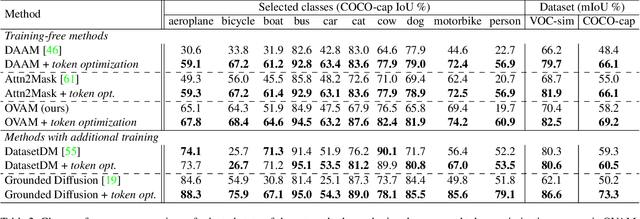

Diffusion models represent a new paradigm in text-to-image generation. Beyond generating high-quality images from text prompts, models such as Stable Diffusion have been successfully extended to the joint generation of semantic segmentation pseudo-masks. However, current extensions primarily rely on extracting attentions linked to prompt words used for image synthesis. This approach limits the generation of segmentation masks derived from word tokens not contained in the text prompt. In this work, we introduce Open-Vocabulary Attention Maps (OVAM)-a training-free method for text-to-image diffusion models that enables the generation of attention maps for any word. In addition, we propose a lightweight optimization process based on OVAM for finding tokens that generate accurate attention maps for an object class with a single annotation. We evaluate these tokens within existing state-of-the-art Stable Diffusion extensions. The best-performing model improves its mIoU from 52.1 to 86.6 for the synthetic images' pseudo-masks, demonstrating that our optimized tokens are an efficient way to improve the performance of existing methods without architectural changes or retraining.