 Add to Chrome
 Add to Firefox
 Add to Edge
Artificial Intelligence for the Electron Ion Collider (AI4EIC)
Jul 17, 2023
The Electron-Ion Collider (EIC), a state-of-the-art facility for studying the strong force, is expected to begin commissioning its first experiments in 2028. This is an opportune time for artificial intelligence (AI) to be included from the start at this facility and in all phases that lead up to the experiments. The second annual workshop organized by the AI4EIC working group, which recently took place, centered on exploring all current and prospective application areas of AI for the EIC. This workshop is not only beneficial for the EIC, but also provides valuable insights for the newly established ePIC collaboration at EIC. This paper summarizes the different activities and R&D projects covered across the sessions of the workshop and provides an overview of the goals, approaches and strategies regarding AI/ML in the EIC community, as well as cutting-edge techniques currently studied in other experiments.

Decision-Theoretic Bidding Based on Learned Density Models in Simultaneous, Interacting Auctions
Jun 26, 2011


Auctions are becoming an increasingly popular method for transacting business, especially over the Internet. This article presents a general approach to building autonomous bidding agents to bid in multiple simultaneous auctions for interacting goods. A core component of our approach learns a model of the empirical price dynamics based on past data and uses the model to analytically calculate, to the greatest extent possible, optimal bids. We introduce a new and general boosting-based algorithm for conditional density estimation problems of this kind, i.e., supervised learning problems in which the goal is to estimate the entire conditional distribution of the real-valued label. This approach is fully implemented as ATTac-2001, a top-scoring agent in the second Trading Agent Competition (TAC-01). We present experiments demonstrating the effectiveness of our boosting-based price predictor relative to several reasonable alternatives.
ATTac-2000: An Adaptive Autonomous Bidding Agent
Jun 03, 2011
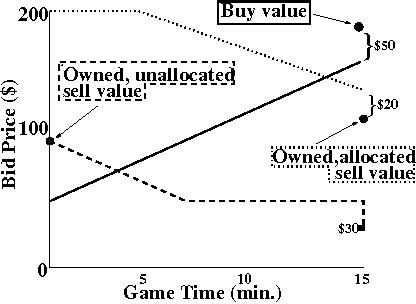

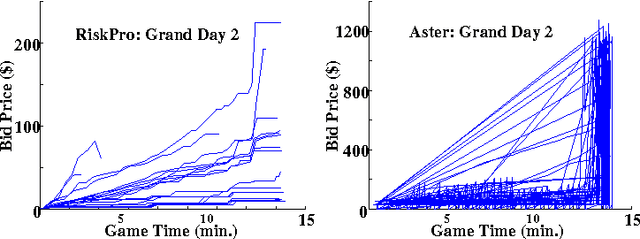
The First Trading Agent Competition (TAC) was held from June 22nd to July 8th, 2000. TAC was designed to create a benchmark problem in the complex domain of e-marketplaces and to motivate researchers to apply unique approaches to a common task. This article describes ATTac-2000, the first-place finisher in TAC. ATTac-2000 uses a principled bidding strategy that includes several elements of adaptivity. In addition to the success at the competition, isolated empirical results are presented indicating the robustness and effectiveness of ATTac-2000's adaptive strategy.
FLECS: Planning with a Flexible Commitment Strategy
Jun 01, 1995


There has been evidence that least-commitment planners can efficiently handle planning problems that involve difficult goal interactions. This evidence has led to the common belief that delayed-commitment is the "best" possible planning strategy. However, we recently found evidence that eager-commitment planners can handle a variety of planning problems more efficiently, in particular those with difficult operator choices. Resigned to the futility of trying to find a universally successful planning strategy, we devised a planner that can be used to study which domains and problems are best for which planning strategies. In this article we introduce this new planning algorithm, FLECS, which uses a FLExible Commitment Strategy with respect to plan-step orderings. It is able to use any strategy from delayed-commitment to eager-commitment. The combination of delayed and eager operator-ordering commitments allows FLECS to take advantage of the benefits of explicitly using a simulated execution state and reasoning about planning constraints. FLECS can vary its commitment strategy across different problems and domains, and also during the course of a single planning problem. FLECS represents a novel contribution to planning in that it explicitly provides the choice of which commitment strategy to use while planning. FLECS provides a framework to investigate the mapping from planning domains and problems to efficient planning strategies.
* See http://www.jair.org/ for an online appendix and other files accompanying this article