 Add to Chrome
 Add to Firefox
 Add to Edge
Characterizing MARL for Energy Control: A Multi-KPI Benchmark on the CityLearn Environment
Feb 22, 2026
The optimization of urban energy systems is crucial for the advancement of sustainable and resilient smart cities, which are becoming increasingly complex with multiple decision-making units. To address scalability and coordination concerns, Multi-Agent Reinforcement Learning (MARL) is a promising solution. This paper addresses the imperative need for comprehensive and reliable benchmarking of MARL algorithms on energy management tasks. CityLearn is used as a case study environment because it realistically simulates urban energy systems, incorporates multiple storage systems, and utilizes renewable energy sources. By doing so, our work sets a new standard for evaluation, conducting a comparative study across multiple key performance indicators (KPIs). This approach illuminates the key strengths and weaknesses of various algorithms, moving beyond traditional KPI averaging which often masks critical insights. Our experiments utilize widely accepted baselines such as Proximal Policy Optimization (PPO) and Soft Actor Critic (SAC), and encompass diverse training schemes including Decentralized Training with Decentralized Execution (DTDE) and Centralized Training with Decentralized Execution (CTDE) approaches and different neural network architectures. Our work also proposes novel KPIs that tackle real world implementation challenges such as individual building contribution and battery storage lifetime. Our findings show that DTDE consistently outperforms CTDE in both average and worst-case performance. Additionally, temporal dependency learning improved control on memory dependent KPIs such as ramping and battery usage, contributing to more sustainable battery operation. Results also reveal robustness to agent or resource removal, highlighting both the resilience and decentralizability of the learned policies.

Breaking the Performance Ceiling in Complex Reinforcement Learning requires Inference Strategies
May 27, 2025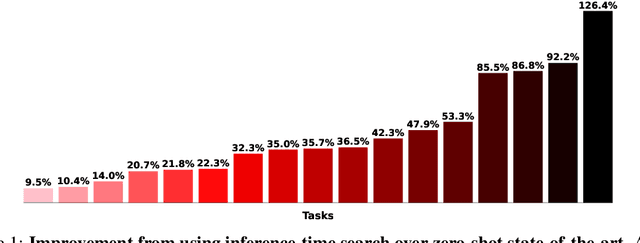
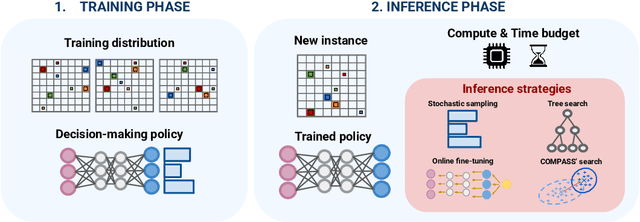
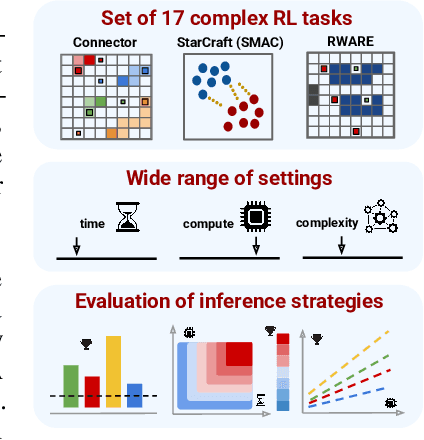
Reinforcement learning (RL) systems have countless applications, from energy-grid management to protein design. However, such real-world scenarios are often extremely difficult, combinatorial in nature, and require complex coordination between multiple agents. This level of complexity can cause even state-of-the-art RL systems, trained until convergence, to hit a performance ceiling which they are unable to break out of with zero-shot inference. Meanwhile, many digital or simulation-based applications allow for an inference phase that utilises a specific time and compute budget to explore multiple attempts before outputting a final solution. In this work, we show that such an inference phase employed at execution time, and the choice of a corresponding inference strategy, are key to breaking the performance ceiling observed in complex multi-agent RL problems. Our main result is striking: we can obtain up to a 126% and, on average, a 45% improvement over the previous state-of-the-art across 17 tasks, using only a couple seconds of extra wall-clock time during execution. We also demonstrate promising compute scaling properties, supported by over 60k experiments, making it the largest study on inference strategies for complex RL to date. Our experimental data and code are available at https://sites.google.com/view/inf-marl.