 Add to Chrome
 Add to Firefox
 Add to Edge
Onboard MuJoCo-based Model Predictive Control for Shipboard Crane with Double-Pendulum Sway Suppression
Mar 17, 2026
Transferring heavy payloads in maritime settings relies on efficient crane operation, limited by hazardous double-pendulum payload sway. This sway motion is further exacerbated in offshore environments by external perturbations from wind and ocean waves. Manual suppression of these oscillations on an underactuated crane system by human operators is challenging. Existing control methods struggle in such settings, often relying on simplified analytical models, while deep reinforcement learning (RL) approaches tend to generalise poorly to unseen conditions. Deploying a predictive controller onto compute-constrained, highly non-linear physical systems without relying on extensive offline training or complex analytical models remains a significant challenge. Here we show a complete real-time control pipeline centered on the MuJoCo MPC framework that leverages a cross-entropy method planner to evaluate candidate action sequences directly within a physics simulator. By using simulated rollouts, this sampling-based approach successfully reconciles the conflicting objectives of dynamic target tracking and sway damping without relying on complex analytical models. We demonstrate that the controller can run effectively on a resource-constrained embedded hardware, while outperforming traditional PID and RL baselines in counteracting external base perturbations. Furthermore, our system demonstrates robustness even when subjected to unmodeled physical discrepancies like the introduction of a second payload.

H-WM: Robotic Task and Motion Planning Guided by Hierarchical World Model
Feb 11, 2026World models are becoming central to robotic planning and control, as they enable prediction of future state transitions. Existing approaches often emphasize video generation or natural language prediction, which are difficult to directly ground in robot actions and suffer from compounding errors over long horizons. Traditional task and motion planning relies on symbolic logic world models, such as planning domains, that are robot-executable and robust for long-horizon reasoning. However, these methods typically operate independently of visual perception, preventing synchronized symbolic and perceptual state prediction. We propose a Hierarchical World Model (H-WM) that jointly predicts logical and visual state transitions within a unified bilevel framework. H-WM combines a high-level logical world model with a low-level visual world model, integrating the robot-executable, long-horizon robustness of symbolic reasoning with perceptual grounding from visual observations. The hierarchical outputs provide stable and consistent intermediate guidance for long-horizon tasks, mitigating error accumulation and enabling robust execution across extended task sequences. To train H-WM, we introduce a robotic dataset that aligns robot motion with symbolic states, actions, and visual observations. Experiments across vision-language-action (VLA) control policies demonstrate the effectiveness and generality of the approach.
From Tabula Rasa to Emergent Abilities: Discovering Robot Skills via Real-World Unsupervised Quality-Diversity
Aug 28, 2025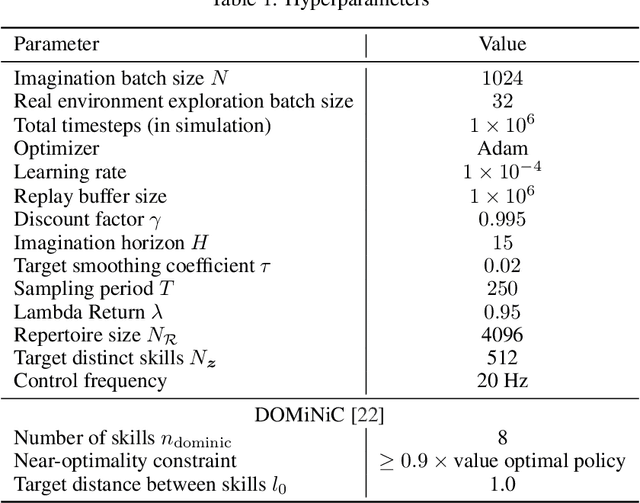
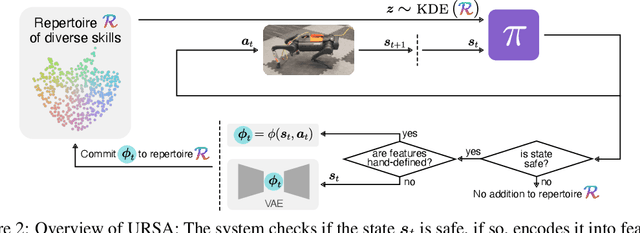

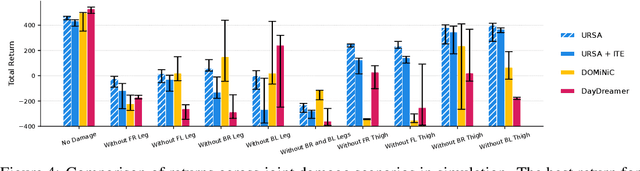
Autonomous skill discovery aims to enable robots to acquire diverse behaviors without explicit supervision. Learning such behaviors directly on physical hardware remains challenging due to safety and data efficiency constraints. Existing methods, including Quality-Diversity Actor-Critic (QDAC), require manually defined skill spaces and carefully tuned heuristics, limiting real-world applicability. We propose Unsupervised Real-world Skill Acquisition (URSA), an extension of QDAC that enables robots to autonomously discover and master diverse, high-performing skills directly in the real world. We demonstrate that URSA successfully discovers diverse locomotion skills on a Unitree A1 quadruped in both simulation and the real world. Our approach supports both heuristic-driven skill discovery and fully unsupervised settings. We also show that the learned skill repertoire can be reused for downstream tasks such as real-world damage adaptation, where URSA outperforms all baselines in 5 out of 9 simulated and 3 out of 5 real-world damage scenarios. Our results establish a new framework for real-world robot learning that enables continuous skill discovery with limited human intervention, representing a significant step toward more autonomous and adaptable robotic systems. Demonstration videos are available at https://adaptive-intelligent-robotics.github.io/URSA.