 Add to Chrome
 Add to Firefox
 Add to Edge
Material Database Agent: A Multimodal Agentic Framework for Scientific Literature Mining
May 05, 2026
Materials science workflows rely on structured and unstructured data from the vast body of available scientific literature. However, most of the experimental details remain buried in text, tables, graphs and figures. Thus, constructing databases that incorporate this data is a manual, time-consuming, and hard-to-scale process. Multimodal large language models have made it feasible to extract information from text and scientific figures with high speed and accuracy. This opens the possibility of an AI system that can create production-scale material databases. Material Database Agent (MDA) is a modular, multi-agent system architecture for converting research literature into structured databases. MDA accepts article PDFs as input, which are subsequently processed in parallel into markdown files and figures. Multiple sub-agents read these markdown files and figures in parallel to assemble sub-databases for each paper. These sub-databases are then compiled into a single tabular database by an agent. As opposed to using either a rule-based approach or a single-pass pipeline for extracting information, MDA is a specialized architecture for transforming the literature into a database in the field of materials science. More generally, this study provides a basis for positioning multimodal agentic information extraction as a viable means for constructing next-generation scientific databases from the primary literature.

NANOGPT: A Query-Driven Large Language Model Retrieval-Augmented Generation System for Nanotechnology Research
Feb 27, 2025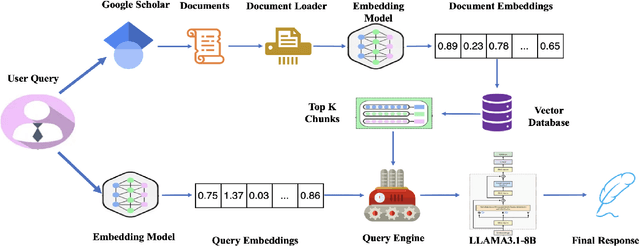
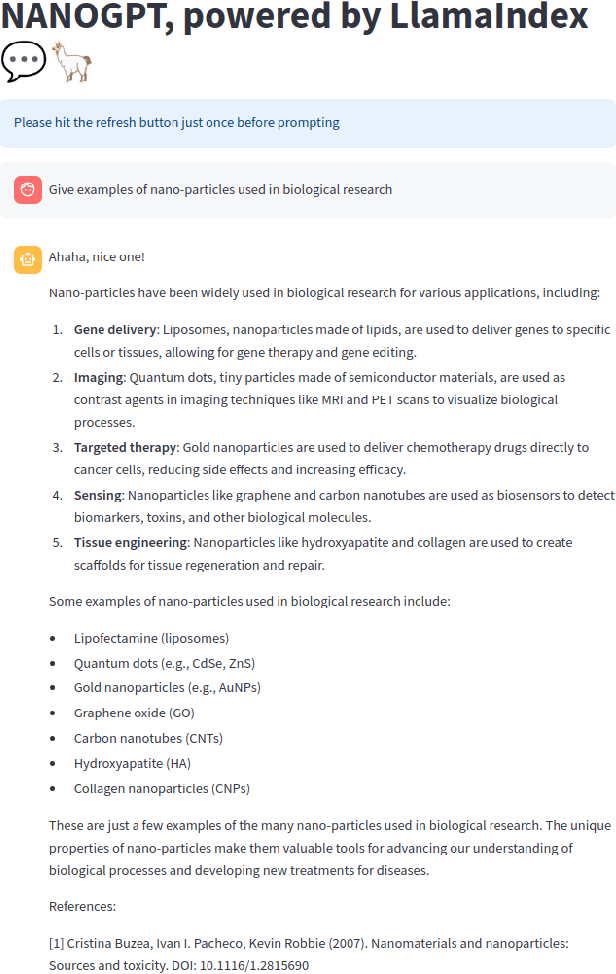
This paper presents the development and application of a Large Language Model Retrieval-Augmented Generation (LLM-RAG) system tailored for nanotechnology research. The system leverages the capabilities of a sophisticated language model to serve as an intelligent research assistant, enhancing the efficiency and comprehensiveness of literature reviews in the nanotechnology domain. Central to this LLM-RAG system is its advanced query backend retrieval mechanism, which integrates data from multiple reputable sources. The system retrieves relevant literature by utilizing Google Scholar's advanced search, and scraping open-access papers from Elsevier, Springer Nature, and ACS Publications. This multifaceted approach ensures a broad and diverse collection of up-to-date scholarly articles and papers. The proposed system demonstrates significant potential in aiding researchers by providing a streamlined, accurate, and exhaustive literature retrieval process, thereby accelerating research advancements in nanotechnology. The effectiveness of the LLM-RAG system is validated through rigorous testing, illustrating its capability to significantly reduce the time and effort required for comprehensive literature reviews, while maintaining high accuracy, query relevance and outperforming standard, publicly available LLMS.