 Add to Chrome
 Add to Firefox
 Add to Edge
Pepti-Agent: An AI Agent for Peptide Design and Optimization
Jun 13, 2026
Therapeutic peptides occupy a valuable design space between small molecules and biologics, but their development requires satisfying several competing constraints at once: solubility, hemolytic activity, and nonspecific surface fouling are governed by overlapping sequence features, so improving one property often degrades another. Computational design addresses this by pairing generative models with sequence-based property predictors, iteratively proposing and refining candidates. However, these components are typically wired together as monolithic scripts that are difficult to inspect, extend, or reuse, and they often refine sequences by natural-language reasoning rather than by tracking the evolving multi-property state of each candidate. We present Pepti-Agent, a closed-loop, peptide-specific framework that exposes generation, property prediction, and single-residue mutation as independently inspectable Model Context Protocol (MCP) tools. A large language model controller invokes these tools and consults live predictor output between calls, so refinement is guided by each sequence's current property profile rather than by language reasoning alone. Task-specific PeptideGPT models generate candidates, ProtBERT-based classifiers score solubility, hemolysis, and non-fouling, and two interchangeable mutation operators propose sequence edits. By recording a per-step trace of controller decisions, predictor outputs, and accepted mutations, Pepti-Agent offers a reproducible substrate for benchmarking multi-objective design strategies and for prioritizing candidates for experimental validation.

Material Database Agent: A Multimodal Agentic Framework for Scientific Literature Mining
May 05, 2026Materials science workflows rely on structured and unstructured data from the vast body of available scientific literature. However, most of the experimental details remain buried in text, tables, graphs and figures. Thus, constructing databases that incorporate this data is a manual, time-consuming, and hard-to-scale process. Multimodal large language models have made it feasible to extract information from text and scientific figures with high speed and accuracy. This opens the possibility of an AI system that can create production-scale material databases. Material Database Agent (MDA) is a modular, multi-agent system architecture for converting research literature into structured databases. MDA accepts article PDFs as input, which are subsequently processed in parallel into markdown files and figures. Multiple sub-agents read these markdown files and figures in parallel to assemble sub-databases for each paper. These sub-databases are then compiled into a single tabular database by an agent. As opposed to using either a rule-based approach or a single-pass pipeline for extracting information, MDA is a specialized architecture for transforming the literature into a database in the field of materials science. More generally, this study provides a basis for positioning multimodal agentic information extraction as a viable means for constructing next-generation scientific databases from the primary literature.
PolyJarvis: LLM Agent for Autonomous Polymer MD Simulations
Apr 02, 2026All-atom molecular dynamics (MD) simulations can predict polymer properties from molecular structure, yet their execution requires specialized expertise in force field selection, system construction, equilibration, and property extraction. We present PolyJarvis, an agent that couples a large language model (LLM) with the RadonPy simulation platform through Model Context Protocol (MCP) servers, enabling end-to-end polymer property prediction from natural language input. Given a polymer name or SMILES string, PolyJarvis autonomously executes monomer construction, charge assignment, polymerization, force field parameterization, GPU-accelerated equilibration, and property calculation. Validation is conducted on polyethylene (PE), atactic polystyrene (aPS), poly(methyl methacrylate) (PMMA), and poly(ethylene glycol) (PEG). Results show density predictions within 0.1--4.8% and bulk moduli within 17--24% of reference values for aPS and PMMA. PMMA glass transition temperature (Tg) (395~K) matches experiment within +10--18~K, while the remaining three polymers overestimate Tg by +38 to +47K (vs upper experimental bounds). Of the 8 property--polymer combinations with directly comparable experimental references, 5 meet strict acceptance criteria. For cases lacking suitable amorphous-phase experimental, agreement with prior MD literature is reported separately. The remaining Tg failures are attributable primarily to the intrinsic MD cooling-rate bias rather than agent error. This work demonstrates that LLM-driven agents can autonomously execute polymer MD workflows producing results consistent with expert-run simulations.
Catalyst-Agent: Autonomous heterogeneous catalyst screening and optimization with an LLM Agent
Mar 01, 2026The discovery of novel catalysts tailored for particular applications is a major challenge for the twenty-first century. Traditional methods for this include time-consuming and expensive experimental trial-and-error approaches in labs based on chemical theory or heavily computational first-principles approaches based on density functional theory. Recent studies show that deep learning models like graph neural networks (GNNs) can significantly speed up the screening and discovery of catalyst materials by many orders of magnitude, with very high accuracy and fidelity. In this work, we introduce Catalyst-Agent, a Model Context Protocol (MCP) server-based, LLM-powered AI agent. It can explore vast material databases using the OPTIMADE API, make structural modifications, calculate adsorption energies using Meta FAIRchem's UMA (GNN) model via FAIRchem's AdsorbML workflow and slab construction, and make useful material suggestions to the researcher in a closed-loop manner, including surface-level modifications to refine near-miss candidates. It is tested on three pivotal reactions: the oxygen reduction reaction (ORR), the nitrogen reduction reaction (NRR), and the CO2 reduction reaction (CO2RR). Catalyst-Agent achieves a success rate of 23-34 percent among all the materials it chooses and evaluates, and manages to converge in 1-2 trials per successful material on average. This work demonstrates the potential of AI agents to exercise their planning capabilities and tool use to operationalize the catalyst screening workflow, provide useful, testable hypotheses, and accelerate future scientific discoveries for humanity with minimal human intervention.
PolyAgent: Large Language Model Agent for Polymer Design
Jan 23, 2026On-demand Polymer discovery is essential for various industries, ranging from biomedical to reinforcement materials. Experiments with polymers have a long trial-and-error process, leading to long procedures and extensive resources. For these processes, machine learning has accelerated scientific discovery at the property prediction and latent space search fronts. However, laboratory researchers cannot readily access codes and these models to extract individual structures and properties due to infrastructure limitations. We present a closed-loop polymer structure-property predictor integrated in a terminal for early-stage polymer discovery. The framework is powered by LLM reasoning to provide users with property prediction, property-guided polymer structure generation, and structure modification capabilities. The SMILES sequences are guided by the synthetic accessibility score and the synthetic complexity score (SC Score) to ensure that polymer generation is as close as possible to synthetically accessible monomer-level structures. This framework addresses the challenge of generating novel polymer structures for laboratory researchers, thereby providing computational insights into polymer research.
Automating MD simulations for Proteins using Large language Models: NAMD-Agent
Jul 10, 2025Molecular dynamics simulations are an essential tool in understanding protein structure, dynamics, and function at the atomic level. However, preparing high quality input files for MD simulations can be a time consuming and error prone process. In this work, we introduce an automated pipeline that leverages Large Language Models (LLMs), specifically Gemini 2.0 Flash, in conjunction with python scripting and Selenium based web automation to streamline the generation of MD input files. The pipeline exploits CHARMM GUI's comprehensive web-based interface for preparing simulation-ready inputs for NAMD. By integrating Gemini's code generation and iterative refinement capabilities, simulation scripts are automatically written, executed, and revised to navigate CHARMM GUI, extract appropriate parameters, and produce the required NAMD input files. Post processing is performed using additional software to further refine the simulation outputs, thereby enabling a complete and largely hands free workflow. Our results demonstrate that this approach reduces setup time, minimizes manual errors, and offers a scalable solution for handling multiple protein systems in parallel. This automated framework paves the way for broader application of LLMs in computational structural biology, offering a robust and adaptable platform for future developments in simulation automation.
NANOGPT: A Query-Driven Large Language Model Retrieval-Augmented Generation System for Nanotechnology Research
Feb 27, 2025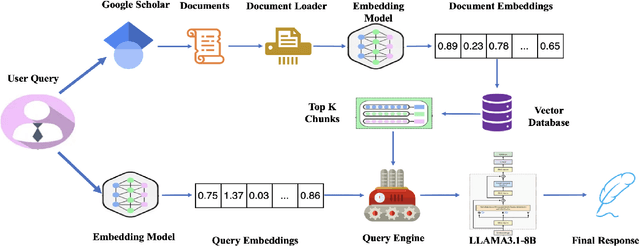
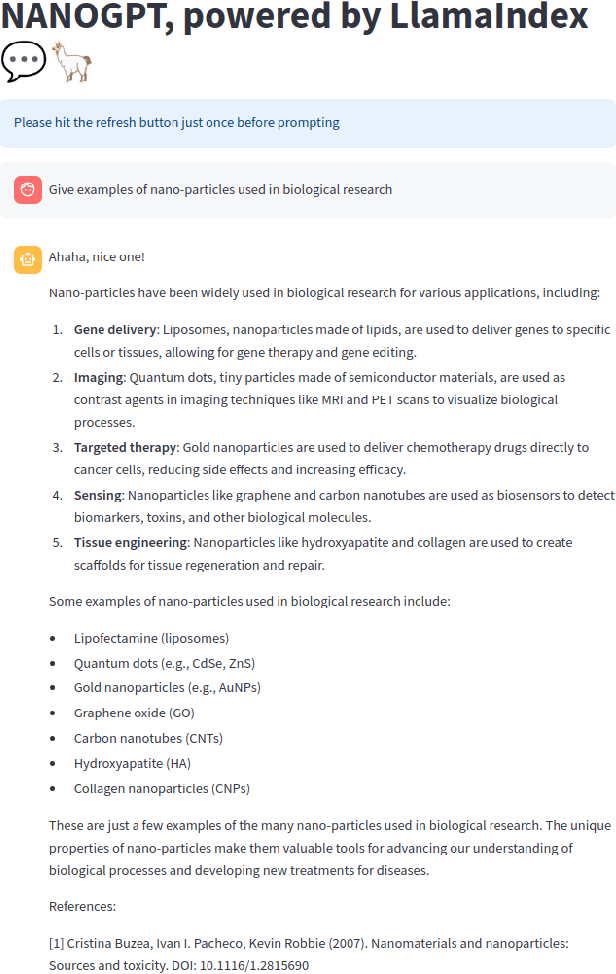
This paper presents the development and application of a Large Language Model Retrieval-Augmented Generation (LLM-RAG) system tailored for nanotechnology research. The system leverages the capabilities of a sophisticated language model to serve as an intelligent research assistant, enhancing the efficiency and comprehensiveness of literature reviews in the nanotechnology domain. Central to this LLM-RAG system is its advanced query backend retrieval mechanism, which integrates data from multiple reputable sources. The system retrieves relevant literature by utilizing Google Scholar's advanced search, and scraping open-access papers from Elsevier, Springer Nature, and ACS Publications. This multifaceted approach ensures a broad and diverse collection of up-to-date scholarly articles and papers. The proposed system demonstrates significant potential in aiding researchers by providing a streamlined, accurate, and exhaustive literature retrieval process, thereby accelerating research advancements in nanotechnology. The effectiveness of the LLM-RAG system is validated through rigorous testing, illustrating its capability to significantly reduce the time and effort required for comprehensive literature reviews, while maintaining high accuracy, query relevance and outperforming standard, publicly available LLMS.
AMGPT: a Large Language Model for Contextual Querying in Additive Manufacturing
May 24, 2024Generalized large language models (LLMs) such as GPT-4 may not provide specific answers to queries formulated by materials science researchers. These models may produce a high-level outline but lack the capacity to return detailed instructions on manufacturing and material properties of novel alloys. Enhancing a smaller model with specialized domain knowledge may provide an advantage over large language models which cannot be retrained quickly enough to keep up with the rapid pace of research in metal additive manufacturing (AM). We introduce "AMGPT," a specialized LLM text generator designed for metal AM queries. The goal of AMGPT is to assist researchers and users in navigating the extensive corpus of literature in AM. Instead of training from scratch, we employ a pre-trained Llama2-7B model from Hugging Face in a Retrieval-Augmented Generation (RAG) setup, utilizing it to dynamically incorporate information from $\sim$50 AM papers and textbooks in PDF format. Mathpix is used to convert these PDF documents into TeX format, facilitating their integration into the RAG pipeline managed by LlamaIndex. Expert evaluations of this project highlight that specific embeddings from the RAG setup accelerate response times and maintain coherence in the generated text.