 Add to Chrome
 Add to Firefox
 Add to Edge
Designing FSMs Specifications from Requirements with GPT 4.0
Mar 31, 2026
Finite state machines (FSM) are executable formal specifications of reactive systems. These machines are designed based on systems' requirements. The requirements are often recorded in textual documents written in natural languages. FSMs play a crucial role in different phases of the model-driven system engineering (MDE). For example, they serve to automate testing activities. FSM quality is critical: the lower the quality of FSM, the higher the number of faults surviving the testing phase and the higher the risk of failure of the systems in production, which could lead to catastrophic scenarios. Therefore, this paper leverages recent advances in the domain of LLM to propose an LLM-based framework for designing FSMs from requirements. The framework also suggests an expert-centric approach based on FSM mutation and test generation for repairing the FSMs produced by LLMs. This paper also provides an experimental analysis and evaluation of LLM's capacities in performing the tasks presented in the framework and FSM repair via various methods. The paper presents experimental results with simulated data. These results and methods bring a new analysis and vision of LLMs that are useful for further development of machine learning technology and its applications to MDE.

An Approach to Evaluating Learning Algorithms for Decision Trees
Oct 26, 2020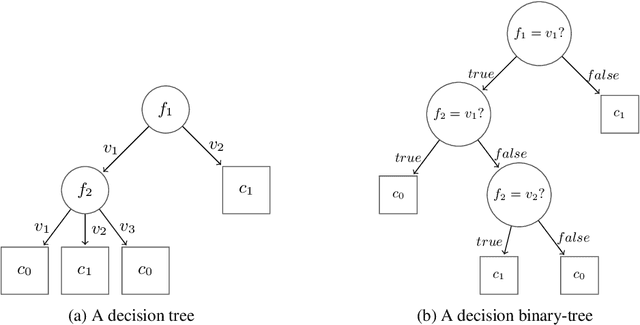
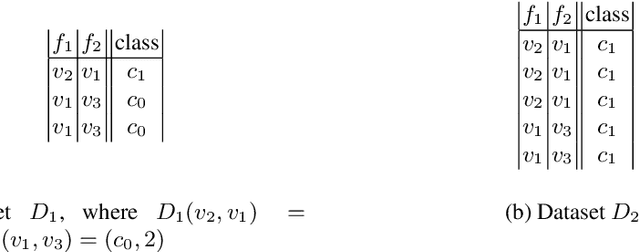
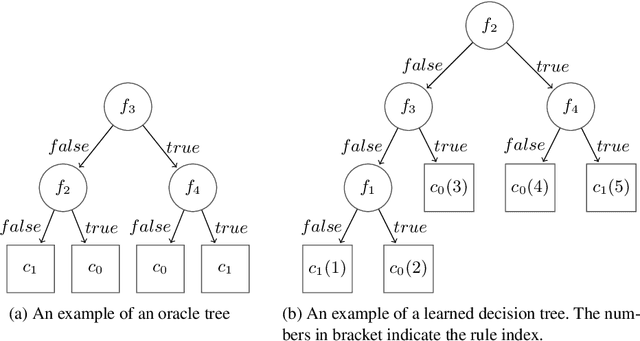
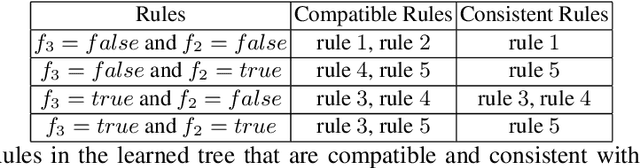
Learning algorithms produce software models for realising critical classification tasks. Decision trees models are simpler than other models such as neural network and they are used in various critical domains such as the medical and the aeronautics. Low or unknown learning ability algorithms does not permit us to trust the produced software models, which lead to costly test activities for validating the models and to the waste of learning time in case the models are likely to be faulty due to the learning inability. Methods for evaluating the decision trees learning ability, as well as that for the other models, are needed especially since the testing of the learned models is still a hot topic. We propose a novel oracle-centered approach to evaluate (the learning ability of) learning algorithms for decision trees. It consists of generating data from reference trees playing the role of oracles, producing learned trees with existing learning algorithms, and determining the degree of correctness (DOE) of the learned trees by comparing them with the oracles. The average DOE is used to estimate the quality of the learning algorithm. the We assess five decision tree learning algorithms based on the proposed approach.