 Add to Chrome
 Add to Firefox
 Add to Edge
When Many Answers Are Valid, Voting Fails: Symbolic Verification for Best-of-K Causal Reasoning in LLMs
Aug 04, 2026
Self-consistency assumes the most frequent answer among sampled reasoning traces is the most reliable, but this can fail in causal reasoning: samples often repeat the same confounding error, and votes fragment across multiple valid answers, letting an invalid answer win despite a valid minority trace. We introduce CALVER (Causal Axiom-Level VERification), a training-free symbolic verifier that scores structured traces against Pearl's causal criteria, including -separation, backdoor adjustment, and intervention, and selects the highest-scoring candidate without consulting a reference answer. On CLEAR find-one-valid queries that admit multiple graph-valid answers, CALVER reaches 42.1% where plurality, a reward model, an LLM judge, and model confidence remain near 30% on identical frozen pools. Scaling the judge to 72B does not close the gap. In an audited clean-core subset, 11 of 21 graph-valid CALVER selections differ from the benchmark's listed answer while still satisfying the requested predicate. The advantage widens with the sampling budget and reproduces across ten published Bayesian networks, a second model family, and settings where the model must build the graph from text. CALVER also improves thresholded average-treatment-effect decisions against exact ground truth, generalizes to logic under a truth-table checker, and scores each candidate in milliseconds on CPU. CALVER needs only a causal structure, supplied outright or built from the text; wherever that holds, selection can aggregate via causal validity.

A Particle-based Sparse Gaussian Process Optimizer
Nov 26, 2022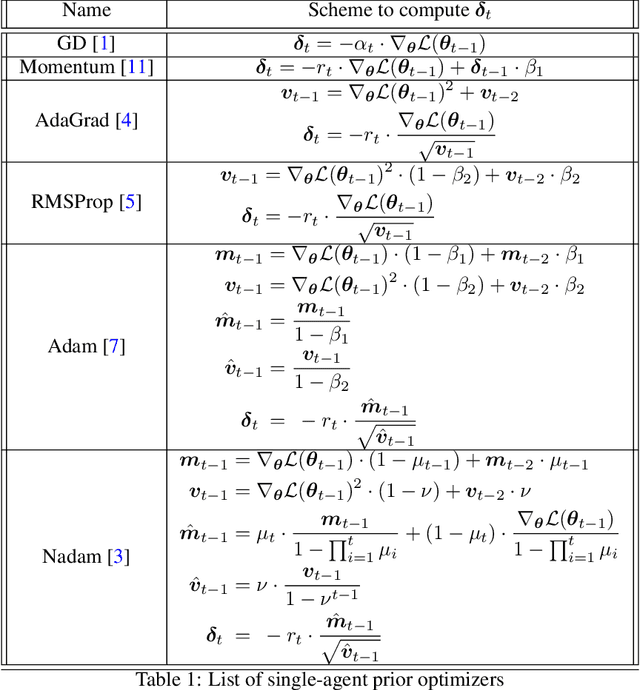
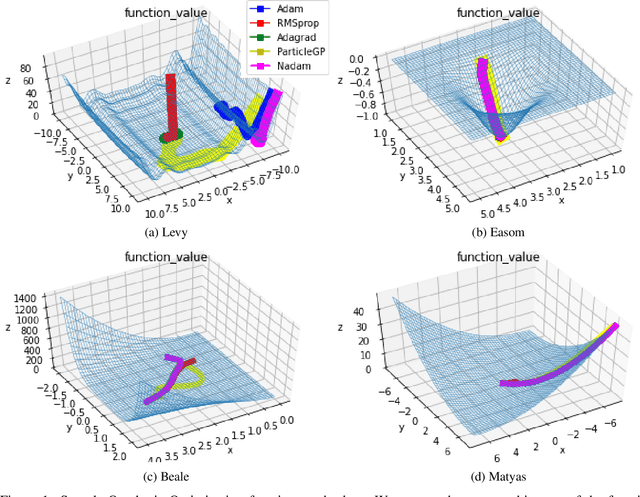
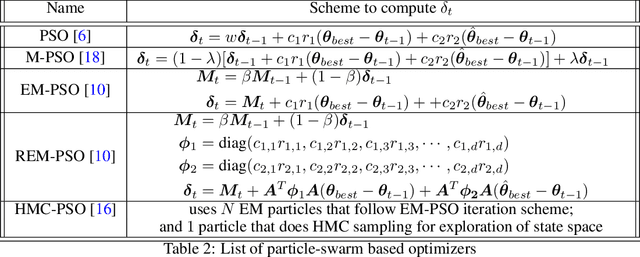
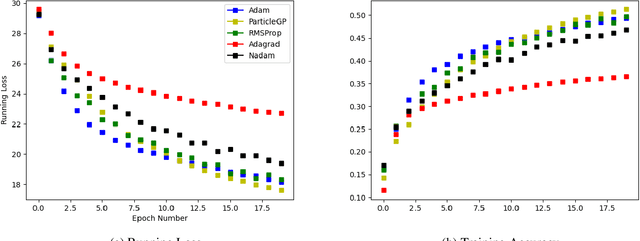
Task learning in neural networks typically requires finding a globally optimal minimizer to a loss function objective. Conventional designs of swarm based optimization methods apply a fixed update rule, with possibly an adaptive step-size for gradient descent based optimization. While these methods gain huge success in solving different optimization problems, there are some cases where these schemes are either inefficient or suffering from local-minimum. We present a new particle-swarm-based framework utilizing Gaussian Process Regression to learn the underlying dynamical process of descent. The biggest advantage of this approach is greater exploration around the current state before deciding a descent direction. Empirical results show our approach can escape from the local minima compare with the widely-used state-of-the-art optimizers when solving non-convex optimization problems. We also test our approach under high-dimensional parameter space case, namely, image classification task.
A Swarm Variant for the Schrödinger Solver
Apr 20, 2021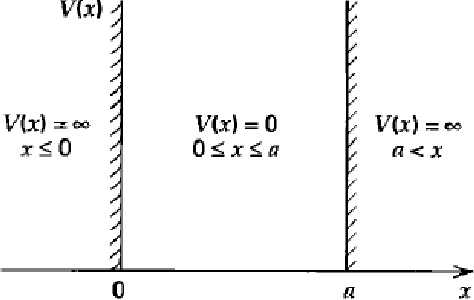
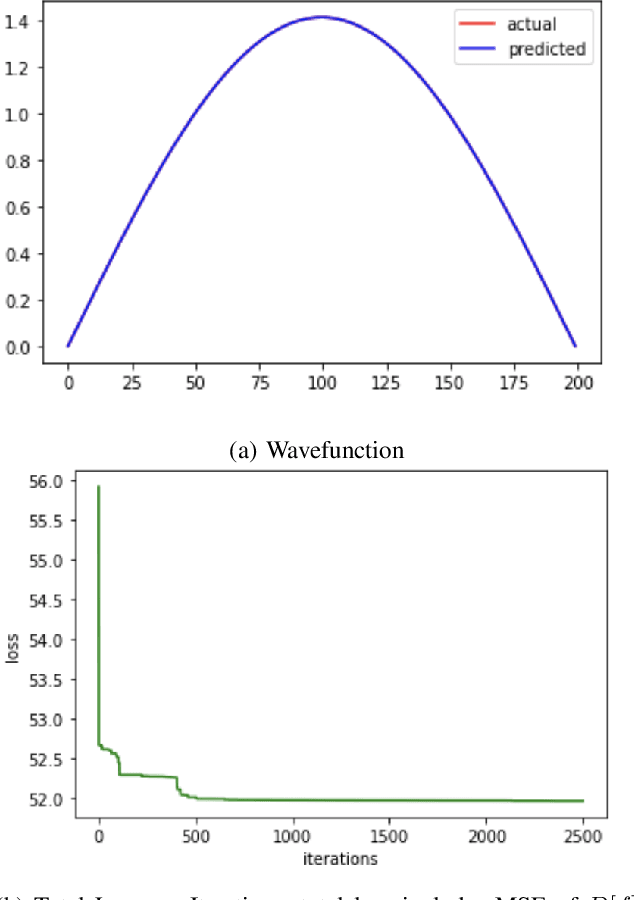
This paper introduces application of the Exponentially Averaged Momentum Particle Swarm Optimization (EM-PSO) as a derivative-free optimizer for Neural Networks. It adopts PSO's major advantages such as search space exploration and higher robustness to local minima compared to gradient-descent optimizers such as Adam. Neural network based solvers endowed with gradient optimization are now being used to approximate solutions to Differential Equations. Here, we demonstrate the novelty of EM-PSO in approximating gradients and leveraging the property in solving the Schr\"odinger equation, for the Particle-in-a-Box problem. We also provide the optimal set of hyper-parameters supported by mathematical proofs, suited for our algorithm.