 Add to Chrome
 Add to Firefox
 Add to Edge
QCommE2E: An Open-Source Simulation of End-to-End Quantum Communication Systems
May 23, 2026
This paper presents QCommE2E as an open-source simulation framework for end-to-end quantum communication systems, with explicit tutorial emphasis. The primary objective is to develop a comprehensive framework that includes transmitters, receivers, communication channels, performance metrics, and visualization tools, to facilitate the systematic design, configuration, and analysis of experimental simulations for novel quantum communication architectures. As the primary use case, we walk through the current quantum channel comparison, which maps textbook quantum-information channels and reduced optical-fiber/free-space surrogates into a single executable benchmark. We describe the common density-matrix interface, the matched modulation and detection chain, and the exact role of the channel classes Depolarizing Channel, Dephasing Channel, Erasure Channel, Bosonic Channel, Turbulence Channel, and PMD Channel. We also explain the current visualization layer, which projects received states onto constellation and Bloch representations for qualitative inspection. To keep the implementation-faithful, we provide a summary of the baseline execution, which uses a square 16-QAM embedding, a pretty-good-measurement detector constructed from the same reference-state codebook, and BER/SER. Finally, we position the channel-comparison as an entry point for broader future work, including equalization, quantum autoencoder, learning-based, and system-level algorithm integration.

A Review on Quantum Satellite Communications: Challenges and Future Directions
May 04, 2026Quantum satellite communication (QSC) is emerging as a strategic technology for secure global networking and long-distance quantum connectivity. This review prioritizes the major challenges that still hinder large-scale deployment, including atmospheric loss, beam pointing and tracking, payload constraints, synchronization, scalability, and integration with terrestrial infrastructure. To contextualize these issues, we provide only a concise overview of the core concepts and enabling technologies behind QSC, together with representative milestones such as the Micius mission. Building on this background, the paper surveys recent advances in protocols, hybrid space--terrestrial architectures, turbulence mitigation, and AI-assisted optimization. It then examines future directions, including quantum Internet integration, daylight operation, satellite-supported repeaters, and space-based quantum computing. By centering the discussion on open technical bottlenecks and emerging research trajectories, this review aims to support researchers and engineers working toward practical and resilient QSC systems.
End-to-End Deep Learning in Phase Noisy Coherent Optical Link
Feb 28, 2025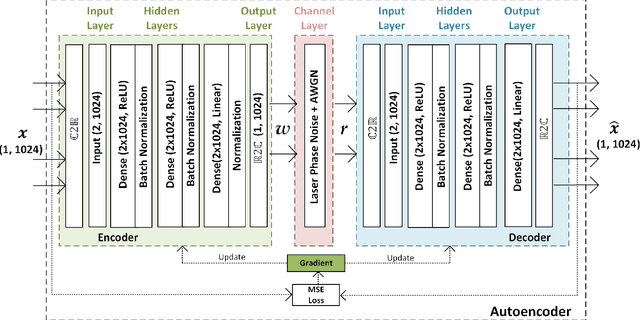
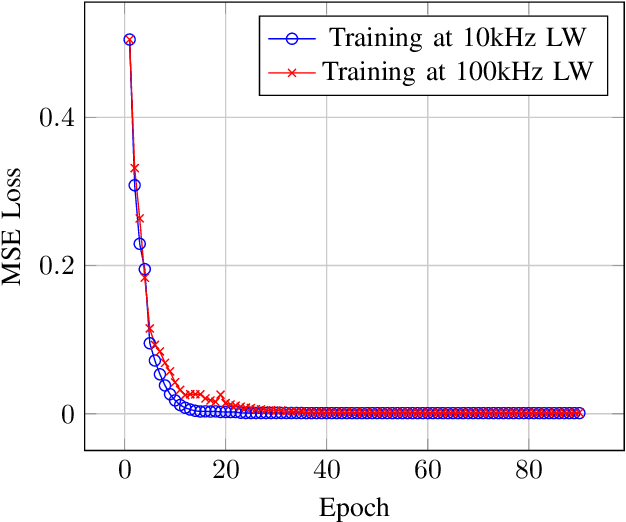
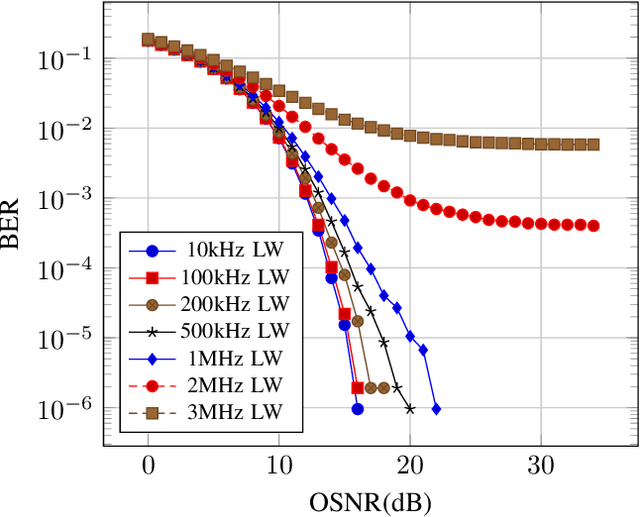
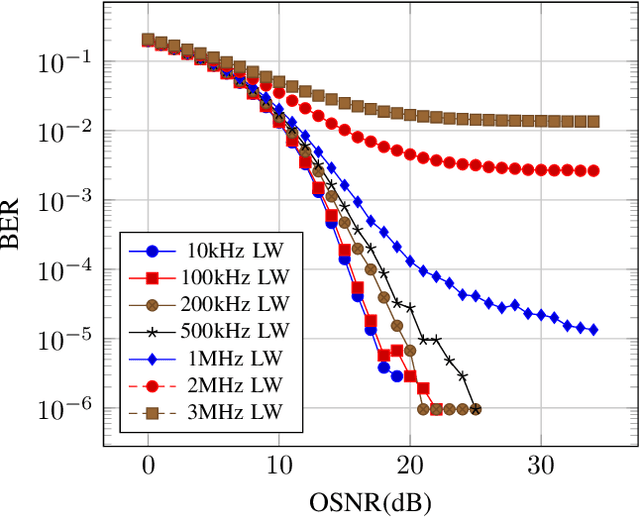
In coherent optical orthogonal frequency-division multiplexing (CO-OFDM) fiber communications, a novel end-to-end learning framework to mitigate Laser Phase Noise (LPN) impairments is proposed in this paper. Inspired by Autoencoder (AE) principles, the proposed approach trains a model to learn robust symbol sequences capable of combat LPN, even from low-cost distributed feedback (DFB) lasers with linewidths up to 2 MHz. This allows for the use of high-level modulation formats and large-scale Fast Fourier Transform (FFT) processing, maximizing spectral efficiency in CO-OFDM systems. By eliminating the need for complex traditional techniques, this approach offers a potentially more efficient and streamlined solution for CO-OFDM systems. The most significant achievement of this study is the demonstration that the proposed AE-based model can enhance system performance by reducing the bit error rate (BER) to below the threshold of forward error correction (FEC), even under severe phase noise conditions, thus proving its effectiveness and efficiency in practical deployment scenarios.
A Review on Deep Learning Autoencoder in the Design of Next-Generation Communication Systems
Dec 18, 2024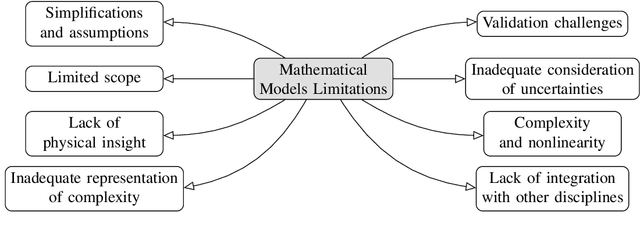

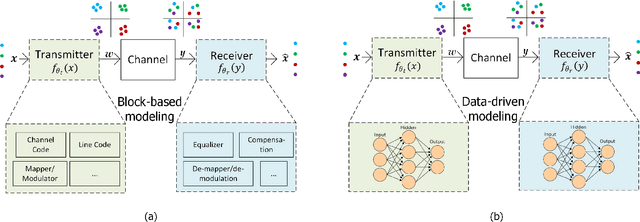

Traditional mathematical models used in designing next-generation communication systems often fall short due to inherent simplifications, narrow scope, and computational limitations. In recent years, the incorporation of deep learning (DL) methodologies into communication systems has made significant progress in system design and performance optimisation. Autoencoders (AEs) have become essential, enabling end-to-end learning that allows for the combined optimisation of transmitters and receivers. Consequently, AEs offer a data-driven methodology capable of bridging the gap between theoretical models and real-world complexities. The paper presents a comprehensive survey of the application of AEs within communication systems, with a particular focus on their architectures, associated challenges, and future directions. We examine 120 recent studies across wireless, optical, semantic, and quantum communication fields, categorising them according to transceiver design, channel modelling, digital signal processing, and computational complexity. This paper further examines the challenges encountered in the implementation of AEs, including the need for extensive training data, the risk of overfitting, and the requirement for differentiable channel models. Through data-driven approaches, AEs provide robust solutions for end-to-end system optimisation, surpassing traditional mathematical models confined by simplifying assumptions. This paper also summarises the computational complexity associated with AE-based systems by conducting an in-depth analysis employing the metric of floating-point operations per second (FLOPS). This analysis encompasses the evaluation of matrix multiplications, bias additions, and activation functions. This survey aims to establish a roadmap for future research, emphasising the transformative potential of AEs in the formulation of next-generation communication systems.
PAPR Reduction based on Deep Learning Autoencoder in Coherent Optical OFDM Systems
Aug 26, 2024


This paper presents an innovative approach to reducing Peak-to-Average Power Ratio (PAPR) in Coherent Optical Orthogonal Frequency Division Multiplexing (CO-OFDM) systems. The proposed deep learning autoencoder-based model eliminates the computational complexity of existing PAPR reduction techniques, such as Selective Mapping (SLM), by leveraging a novel decoder architecture at the receiver. In addition, No side information is needed in our approach, unlike SLM which requires knowledge of the PAPR distribution. Simulation results demonstrate significant improvements in both PAPR reduction and Bit Error Rate (BER) performance compared to traditional techniques. It achieves error-free transmission with over 10 dB PAPR reduction compared to unmitigated and 1 dB gain over SLM technique. Furthermore, our approach exhibits robustness against noise and nonlinearity effects, enabling reliable transmission over optical channels with varying levels of impairment. The proposed technique has far-reaching implications for next-generation optical communication systems, where efficient PAPR reduction is crucial for ensuring reliable data transfer.