 Add to Chrome
 Add to Firefox
 Add to Edge
Oya: Deep Learning for Accurate Global Precipitation Estimation
Nov 13, 2025
Accurate precipitation estimation is critical for hydrological applications, especially in the Global South where ground-based observation networks are sparse and forecasting skill is limited. Existing satellite-based precipitation products often rely on the longwave infrared channel alone or are calibrated with data that can introduce significant errors, particularly at sub-daily timescales. This study introduces Oya, a novel real-time precipitation retrieval algorithm utilizing the full spectrum of visible and infrared (VIS-IR) observations from geostationary (GEO) satellites. Oya employs a two-stage deep learning approach, combining two U-Net models: one for precipitation detection and another for quantitative precipitation estimation (QPE), to address the inherent data imbalance between rain and no-rain events. The models are trained using high-resolution GPM Combined Radar-Radiometer Algorithm (CORRA) v07 data as ground truth and pre-trained on IMERG-Final retrievals to enhance robustness and mitigate overfitting due to the limited temporal sampling of CORRA. By leveraging multiple GEO satellites, Oya achieves quasi-global coverage and demonstrates superior performance compared to existing competitive regional and global precipitation baselines, offering a promising pathway to improved precipitation monitoring and forecasting.

AiSciVision: A Framework for Specializing Large Multimodal Models in Scientific Image Classification
Oct 28, 2024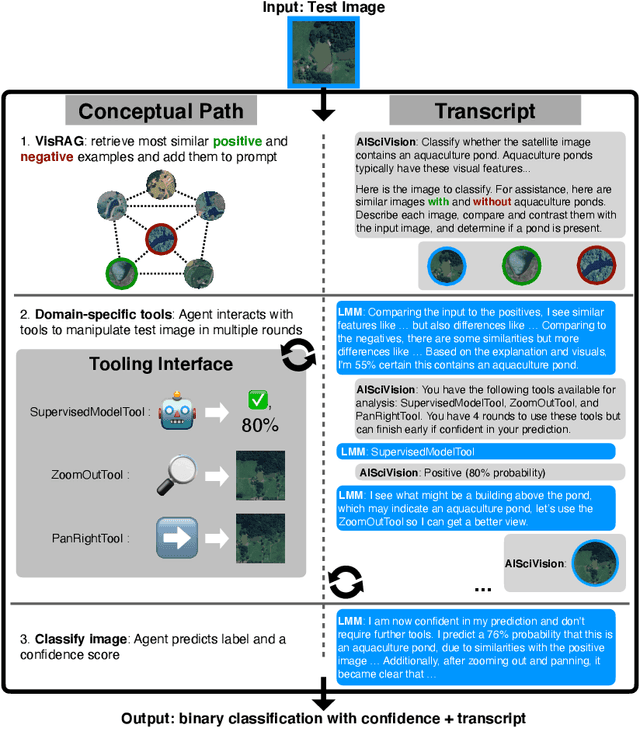



Trust and interpretability are crucial for the use of Artificial Intelligence (AI) in scientific research, but current models often operate as black boxes offering limited transparency and justifications for their outputs. We introduce AiSciVision, a framework that specializes Large Multimodal Models (LMMs) into interactive research partners and classification models for image classification tasks in niche scientific domains. Our framework uses two key components: (1) Visual Retrieval-Augmented Generation (VisRAG) and (2) domain-specific tools utilized in an agentic workflow. To classify a target image, AiSciVision first retrieves the most similar positive and negative labeled images as context for the LMM. Then the LMM agent actively selects and applies tools to manipulate and inspect the target image over multiple rounds, refining its analysis before making a final prediction. These VisRAG and tooling components are designed to mirror the processes of domain experts, as humans often compare new data to similar examples and use specialized tools to manipulate and inspect images before arriving at a conclusion. Each inference produces both a prediction and a natural language transcript detailing the reasoning and tool usage that led to the prediction. We evaluate AiSciVision on three real-world scientific image classification datasets: detecting the presence of aquaculture ponds, diseased eelgrass, and solar panels. Across these datasets, our method outperforms fully supervised models in low and full-labeled data settings. AiSciVision is actively deployed in real-world use, specifically for aquaculture research, through a dedicated web application that displays and allows the expert users to converse with the transcripts. This work represents a crucial step toward AI systems that are both interpretable and effective, advancing their use in scientific research and scientific discovery.