 Add to Chrome
 Add to Firefox
 Add to Edge
Industrial Semantics-Aware Digital Twins: A Hybrid Graph Matching Approach for Asset Administration Shells
Jan 10, 2026
Although the Asset Administration Shell (AAS) standard provides a structured and machine-readable representation of industrial assets, their semantic comparability remains a major challenge, particularly when different vocabularies and modeling practices are used. Engineering would benefit from retrieving existing AAS models that are similar to the target in order to reuse submodels, parameters, and metadata. In practice, however, heterogeneous vocabularies and divergent modeling conventions hinder automated, content-level comparison across AAS. This paper proposes a hybrid graph matching approach to enable semantics-aware comparison of Digital Twin representations. The method combines rule-based pre-filtering using SPARQL with embedding-based similarity calculation leveraging RDF2vec to capture both structural and semantic relationships between AAS models. This contribution provides a foundation for enhanced discovery, reuse, and automated configuration in Digital Twin networks.

Deep Reinforcement Learning using Cyclical Learning Rates
Jul 31, 2020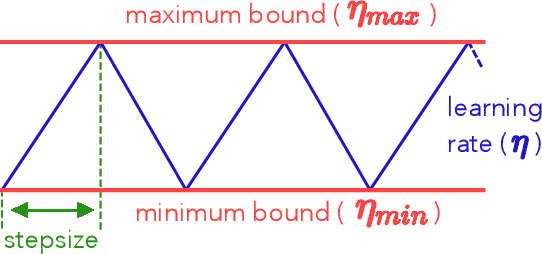
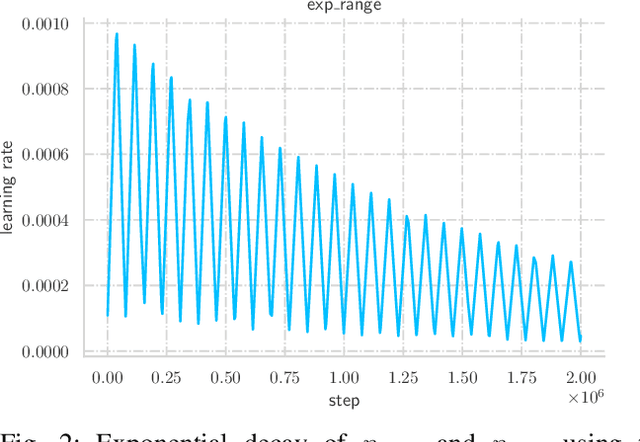
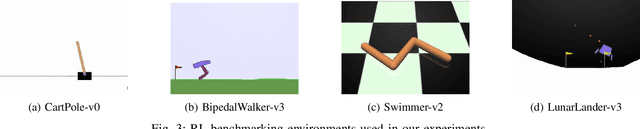
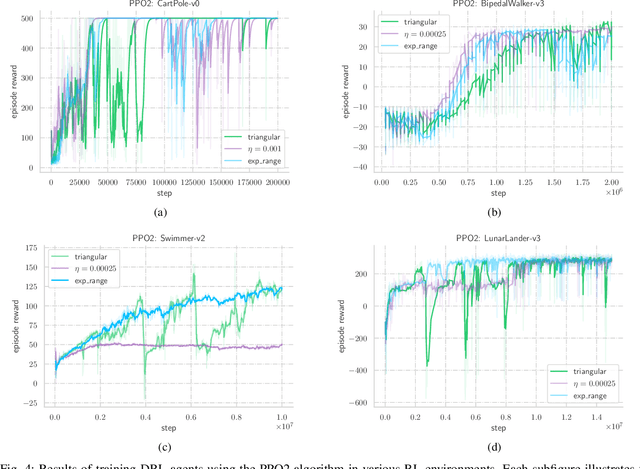
Deep Reinforcement Learning (DRL) methods often rely on the meticulous tuning of hyperparameters to successfully resolve problems. One of the most influential parameters in optimization procedures based on stochastic gradient descent (SGD) is the learning rate. We investigate cyclical learning and propose a method for defining a general cyclical learning rate for various DRL problems. In this paper we present a method for cyclical learning applied to complex DRL problems. Our experiments show that, utilizing cyclical learning achieves similar or even better results than highly tuned fixed learning rates. This paper presents the first application of cyclical learning rates in DRL settings and is a step towards overcoming manual hyperparameter tuning.
Reinforcement Learning Approach to Vibration Compensation for Dynamic Feed Drive Systems
Apr 14, 2020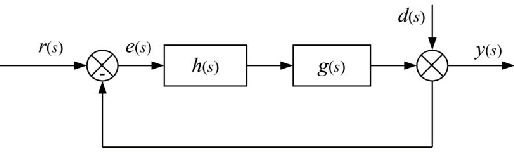
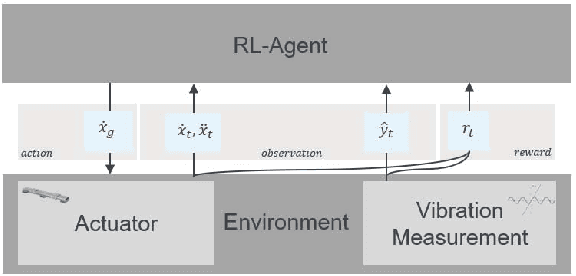
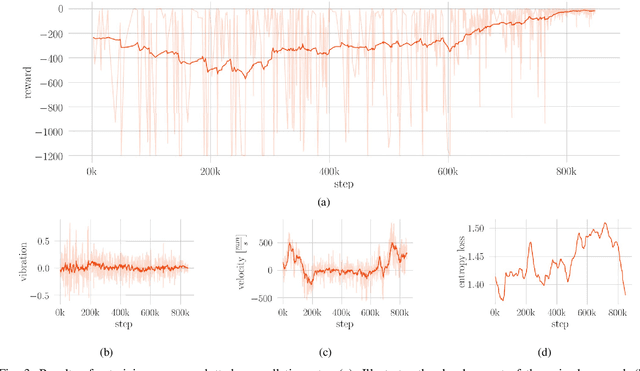
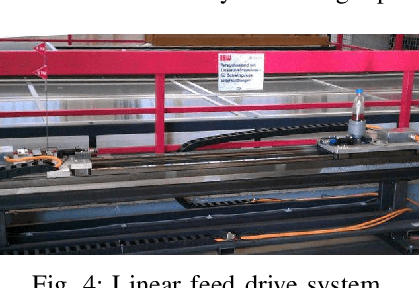
Vibration compensation is important for many domains. For the machine tool industry it translates to higher machining precision and longer component lifetime. Current methods for vibration damping have their shortcomings (e.g. need for accurate dynamic models). In this paper we present a reinforcement learning based approach to vibration compensation applied to a machine tool axis. The work describes the problem formulation, the solution, the implementation and experiments using industrial machine tool hardware and control system.