 Add to Chrome
 Add to Firefox
 Add to Edge
Intuitive Human-Robot Interaction: Development and Evaluation of a Gesture-Based User Interface for Object Selection
Apr 07, 2026
Gestures are a natural form of communication between humans and can also be leveraged for human-robot interaction. This work presents a gesture-based user interface for object selection using pointing and click gestures. An experiment with 20 participants evaluates accuracy and selection time, demonstrating the potential for efficient collaboration.
* This submission contains both an English translation and the original German version. The German version was originally published in the Proceedings of the 72nd GfA Conference (2026)

Automating Manual Tasks through Intuitive Robot Programming and Cognitive Robotics
Apr 07, 2026This paper presents a novel concept for intuitive end-user programming of robots, inspired by natural interaction between humans. Natural language and supportive gestures are translated into robot programs using large language models (LLMs) and computer vision (CV). Through equally natural system feedback in the form of clarification questions and visual representations, the generated program can be reviewed and adjusted, thereby ensuring safety, transparency, and user acceptance.
* This submission contains both an English translation and the original German version. The German version was originally published in the Proceedings of the 71st GfA Conference (2025)
Zero-Shot Parameter Learning of Robot Dynamics Using Bayesian Statistics and Prior Knowledge
Jun 24, 2025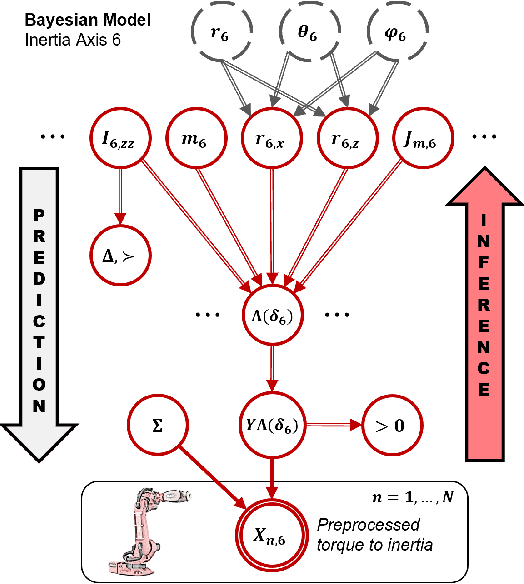
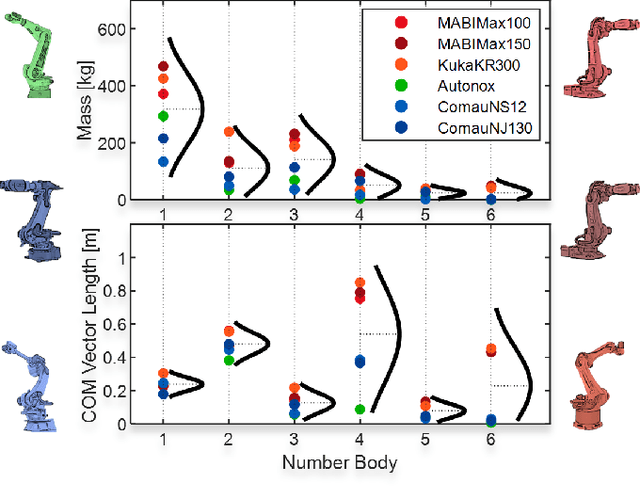
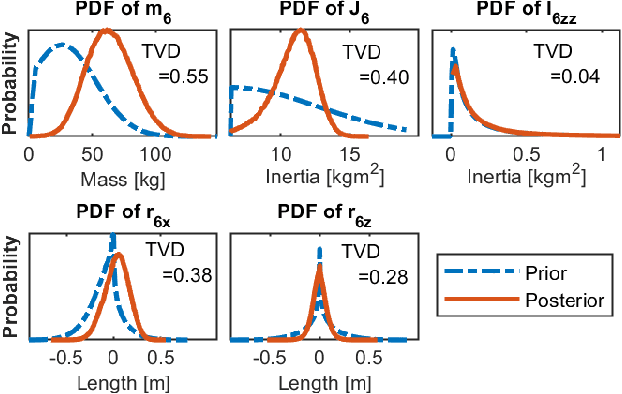

Inertial parameter identification of industrial robots is an established process, but standard methods using Least Squares or Machine Learning do not consider prior information about the robot and require extensive measurements. Inspired by Bayesian statistics, this paper presents an identification method with improved generalization that incorporates prior knowledge and is able to learn with only a few or without additional measurements (Zero-Shot Learning). Furthermore, our method is able to correctly learn not only the inertial but also the mechanical and base parameters of the MABI Max 100 robot while ensuring physical feasibility and specifying the confidence intervals of the results. We also provide different types of priors for serial robots with 6 degrees of freedom, where datasheets or CAD models are not available.
Demonstrating Data-to-Knowledge Pipelines for Connecting Production Sites in the World Wide Lab
Dec 16, 2024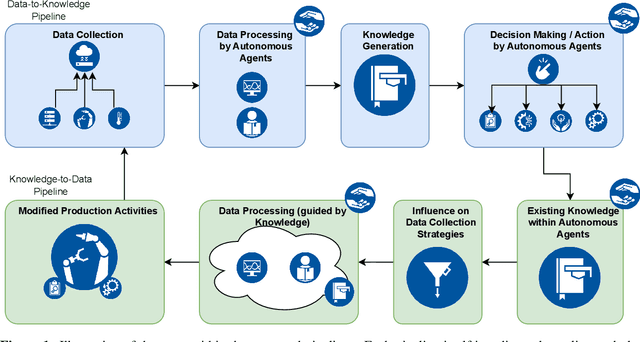
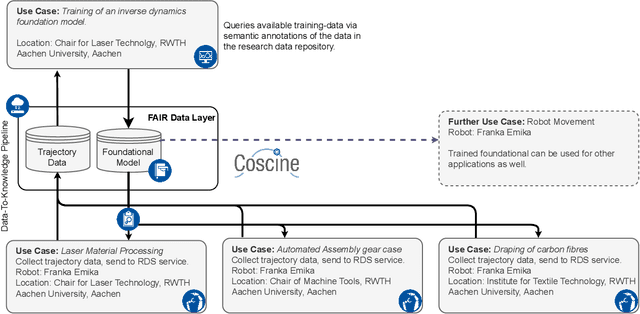

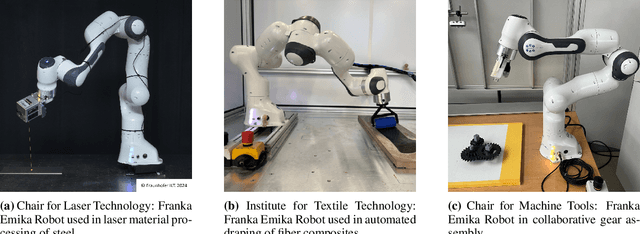
The digital transformation of production requires new methods of data integration and storage, as well as decision making and support systems that work vertically and horizontally throughout the development, production, and use cycle. In this paper, we propose Data-to-Knowledge (and Knowledge-to-Data) pipelines for production as a universal concept building on a network of Digital Shadows (a concept augmenting Digital Twins). We show a proof of concept that builds on and bridges existing infrastructure to 1) capture and semantically annotates trajectory data from multiple similar but independent robots in different organisations and use cases in a data lakehouse and 2) an independent process that dynamically queries matching data for training an inverse dynamic foundation model for robotic control. The article discusses the challenges and benefits of this approach and how Data-to-Knowledge pipelines contribute efficiency gains and industrial scalability in a World Wide Lab as a research outlook.