 Add to Chrome
 Add to Firefox
 Add to Edge
Denoising and Baseline Correction of Low-Scan FTIR Spectra: A Benchmark of Deep Learning Models Against Traditional Signal Processing
Jan 28, 2026
High-quality Fourier Transform Infrared (FTIR) imaging usually needs extensive signal averaging to reduce noise and drift which severely limits clinical speed. Deep learning can accelerate imaging by reconstructing spectra from rapid, single-scan inputs. However, separating noise and baseline drift simultaneously without ground truth is an ill-posed inverse problem. Standard black-box architectures often rely on statistical approximations that introduce spectral hallucinations or fail to generalize to unstable atmospheric conditions. To solve these issues we propose a physics-informed cascade Unet that separates denoising and baseline correction tasks using a new, deterministic Physics Bridge. This architecture forces the network to separate random noise from chemical signals using an embedded SNIP layer to enforce spectroscopic constraints instead of learning statistical approximations. We benchmarked this approach against a standard single Unet and a traditional Savitzky-Golay/SNIP workflow. We used a dataset of human hypopharyngeal carcinoma cells (FaDu). The cascade model outperformed all other methods, achieving a 51.3% reduction in RMSE compared to raw single-scan inputs, surpassing both the single Unet (40.2%) and the traditional workflow (33.7%). Peak-aware metrics show that the cascade architecture eliminates spectral hallucinations found in standard deep learning. It also preserves peak intensity with much higher fidelity than traditional smoothing. These results show that the cascade Unet is a robust solution for diagnostic-grade FTIR imaging. It enables imaging speeds 32 times faster than current methods.

RAMANMETRIX: a delightful way to analyze Raman spectra
Jan 19, 2022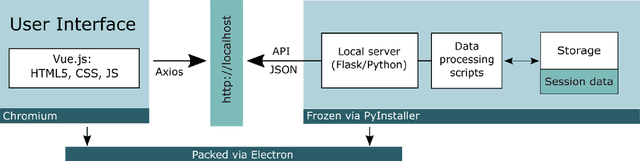
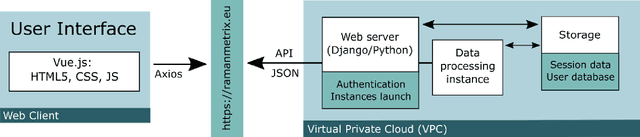
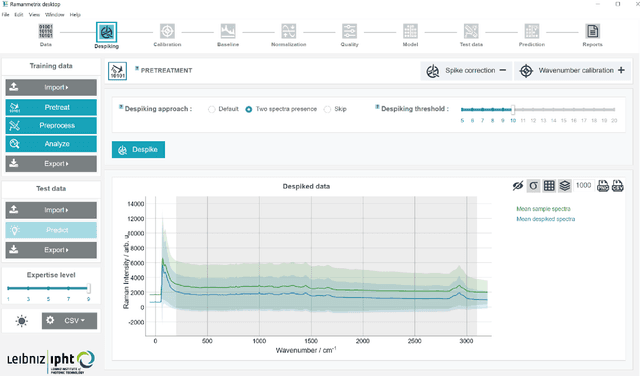
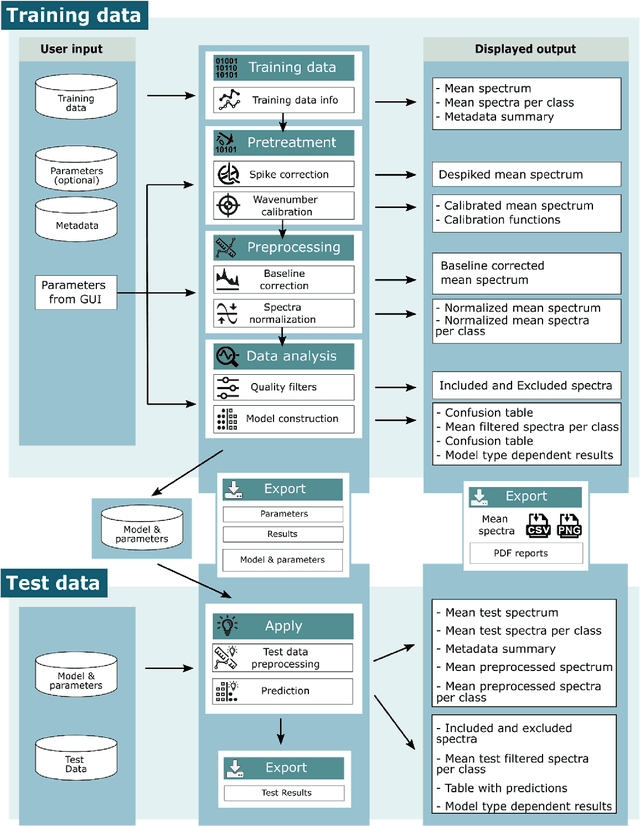
Although Raman spectroscopy is widely used for the investigation of biomedical samples and has a high potential for use in clinical applications, it is not common in clinical routines. One of the factors that obstruct the integration of Raman spectroscopic tools into clinical routines is the complexity of the data processing workflow. Software tools that simplify spectroscopic data handling may facilitate such integration by familiarizing clinical experts with the advantages of Raman spectroscopy. Here, RAMANMETRIX is introduced as a user-friendly software with an intuitive web-based graphical user interface (GUI) that incorporates a complete workflow for chemometric analysis of Raman spectra, from raw data pretreatment to a robust validation of machine learning models. The software can be used both for model training and for the application of the pretrained models onto new data sets. Users have full control of the parameters during model training, but the testing data flow is frozen and does not require additional user input. RAMANMETRIX is available in two versions: as standalone software and web application. Due to the modern software architecture, the computational backend part can be executed separately from the GUI and accessed through an application programming interface (API) for applying a preconstructed model to the measured data. This opens up possibilities for using the software as a data processing backend for the measurement devices in real-time. The models preconstructed by more experienced users can be exported and reused for easy one-click data preprocessing and prediction, which requires minimal interaction between the user and the software. The results of such prediction and graphical outputs of the different data processing steps can be exported and saved.