 Add to Chrome
 Add to Firefox
 Add to Edge
Dynamical Predictive Modelling of Cardiovascular Disease Progression Post-Myocardial Infarction via ECG-Trained Artificial Intelligence Model
May 13, 2026
Myocardial infarction (MI) is a leading cause of death, and its adverse outcomes are urgent to predict. Yet ECG-based prognostic models underperform because deep learning requires large, labelled datasets, which are scarce in medicine. Foundation models can learn from unlabelled ECGs via selfsupervision, but medically relevant training strategies remain underexplored. We propose a pretrained artificial intelligence model that combines patient-specific temporal information using contrastive learning with supervised multitask heads, then fine-tunes on post-MI outcome prediction. The proposed model outperformed a model trained from scratch (0.794 vs 0.608 AUC) showing that clinically structured ECG modelling improves classification in limited data regimes.

Neural Surrogate Forward Modelling For Electrocardiology Without Explicit Intracellular Conductivity Tensor
May 13, 2026Accurate forward modelling is essential for non-invasive cardiac electrophysiology, particularly in atrial fibrillation, where electrical activation is highly disorganised. Conventional physics-based forward models require explicit specification of intracellular conductivity tensors, which are not directly measurable in clinical practice and introduce structural modelling errors. This proof-of-concept study presents a deep learning approach that learns a direct mapping from left atrial intracellular electrical potentials to far-field ECGs without requiring explicit intracellular conductivity inputs at inference time. Despite training only on 74 subjects, the model achieved an R2 of 0.949 \pm 0.037, highlighting potential to reduce structural uncertainty and improve non-invasive AF assessment.
Towards Deep Learning Surrogate for the Forward Problem in Electrocardiology: A Scalable Alternative to Physics-Based Models
Dec 15, 2025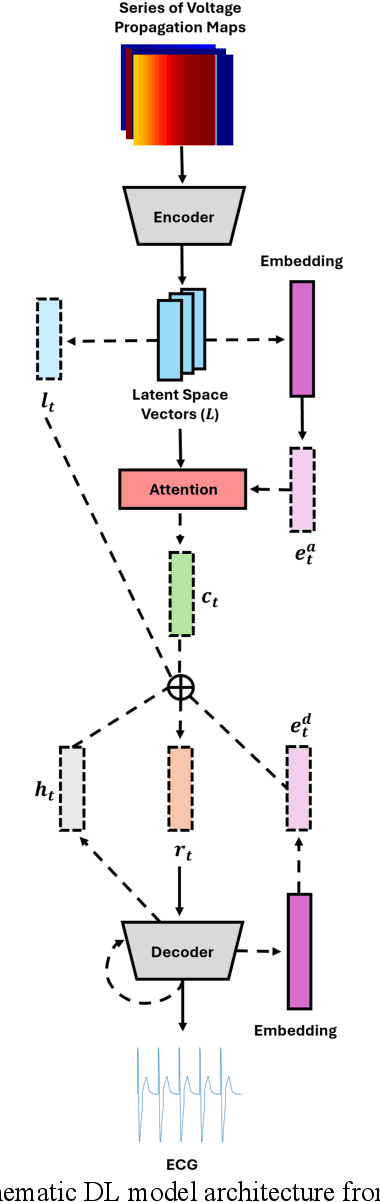

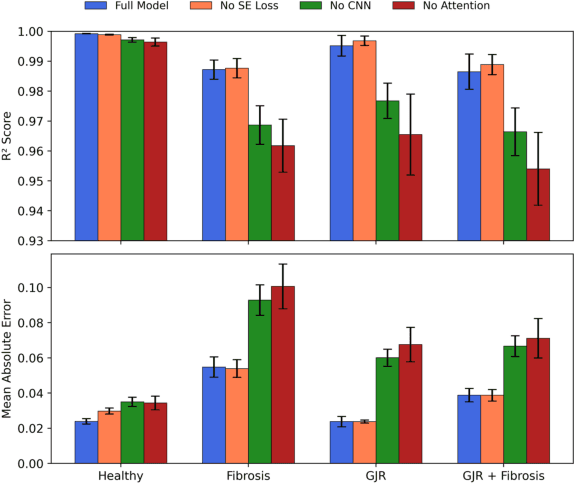
The forward problem in electrocardiology, computing body surface potentials from cardiac electrical activity, is traditionally solved using physics-based models such as the bidomain or monodomain equations. While accurate, these approaches are computationally expensive, limiting their use in real-time and large-scale clinical applications. We propose a proof-of-concept deep learning (DL) framework as an efficient surrogate for forward solvers. The model adopts a time-dependent, attention-based sequence-to-sequence architecture to predict electrocardiogram (ECG) signals from cardiac voltage propagation maps. A hybrid loss combining Huber loss with a spectral entropy term was introduced to preserve both temporal and frequency-domain fidelity. Using 2D tissue simulations incorporating healthy, fibrotic, and gap junction-remodelled conditions, the model achieved high accuracy (mean $R^2 = 0.99 \pm 0.01$). Ablation studies confirmed the contributions of convolutional encoders, time-aware attention, and spectral entropy loss. These findings highlight DL as a scalable, cost-effective alternative to physics-based solvers, with potential for clinical and digital twin applications.