 Add to Chrome
 Add to Firefox
 Add to Edge
Markovian ODE-guided scoring can assess the quality of offline reasoning traces in language models
Mar 02, 2026
Reasoning traces produced by generative language models are increasingly used for tasks ranging from mathematical problem solving to automated fact checking. However, existing evaluation methods remain largely mechanical and fail to capture human-centric notions of reasoning quality in a way that generalizes across varied and progressively degraded reasoning. We introduce MarODE, an offline evaluation framework that assigns quality scores to reasoning traces. Its effectiveness is assessed using human-centric perturbations and human judgments, which jointly evaluate the fundamental dimensions of an evaluation metric - goodness and soundness. The approach is grounded in a Markovian formulation of reasoning progression and an ordinary differential equation based characterization of trace dynamics, enabling efficient evaluation of reasoning quality. In a large-scale evaluation, MarODE outperforms existing baselines by over 250% under Somers' D correlation. Our results emphasize the value of theory-driven evaluation frameworks as reasoning traces become central to language model-based systems.

Listening Between the Lines: Decoding Podcast Narratives with Language Modeling
Nov 07, 2025
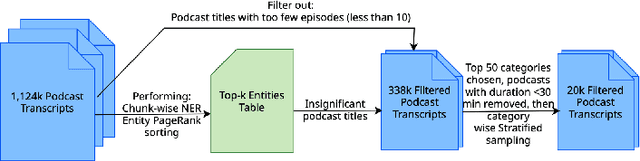
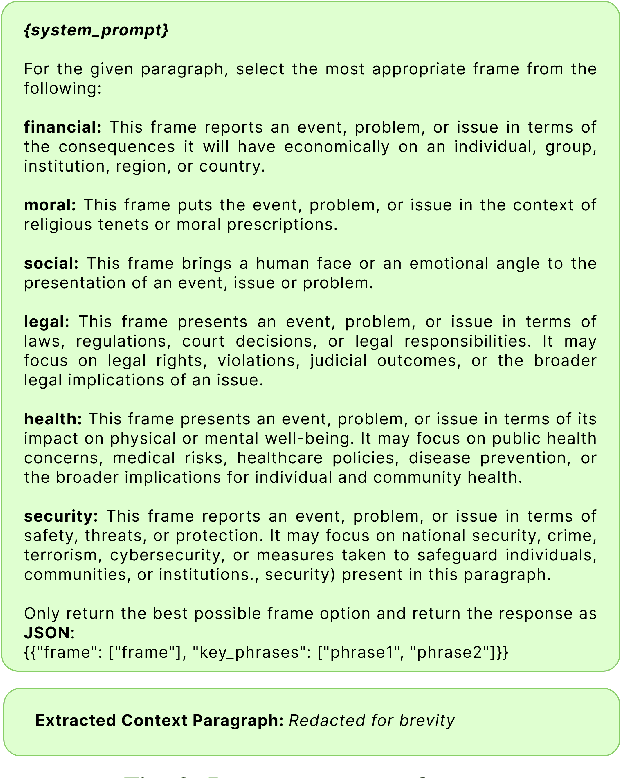
Podcasts have become a central arena for shaping public opinion, making them a vital source for understanding contemporary discourse. Their typically unscripted, multi-themed, and conversational style offers a rich but complex form of data. To analyze how podcasts persuade and inform, we must examine their narrative structures -- specifically, the narrative frames they employ. The fluid and conversational nature of podcasts presents a significant challenge for automated analysis. We show that existing large language models, typically trained on more structured text such as news articles, struggle to capture the subtle cues that human listeners rely on to identify narrative frames. As a result, current approaches fall short of accurately analyzing podcast narratives at scale. To solve this, we develop and evaluate a fine-tuned BERT model that explicitly links narrative frames to specific entities mentioned in the conversation, effectively grounding the abstract frame in concrete details. Our approach then uses these granular frame labels and correlates them with high-level topics to reveal broader discourse trends. The primary contributions of this paper are: (i) a novel frame-labeling methodology that more closely aligns with human judgment for messy, conversational data, and (ii) a new analysis that uncovers the systematic relationship between what is being discussed (the topic) and how it is being presented (the frame), offering a more robust framework for studying influence in digital media.