 Add to Chrome
 Add to Firefox
 Add to Edge
Discovering mathematical concepts through a multi-agent system
Mar 04, 2026
Mathematical concepts emerge through an interplay of processes, including experimentation, efforts at proof, and counterexamples. In this paper, we present a new multi-agent model for computational mathematical discovery based on this observation. Our system, conceived with research in mind, poses its own conjectures and then attempts to prove them, making decisions informed by this feedback and an evolving data distribution. Inspired by the history of Euler's conjecture for polyhedra and an open challenge in the literature, we benchmark with the task of autonomously recovering the concept of homology from polyhedral data and knowledge of linear algebra. Our system completes this learning problem. Most importantly, the experiments are ablations, statistically testing the value of the complete dynamic and controlling for experimental setup. They support our main claim: that the optimisation of the right combination of local processes can lead to surprisingly well-aligned notions of mathematical interestingness.

Calabi-Yau metrics through Grassmannian learning and Donaldson's algorithm
Oct 15, 2024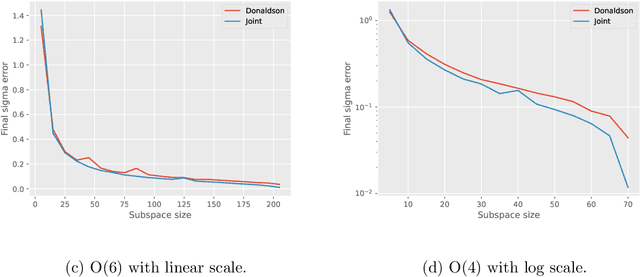
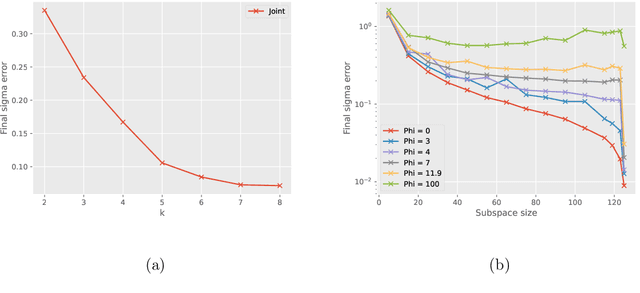
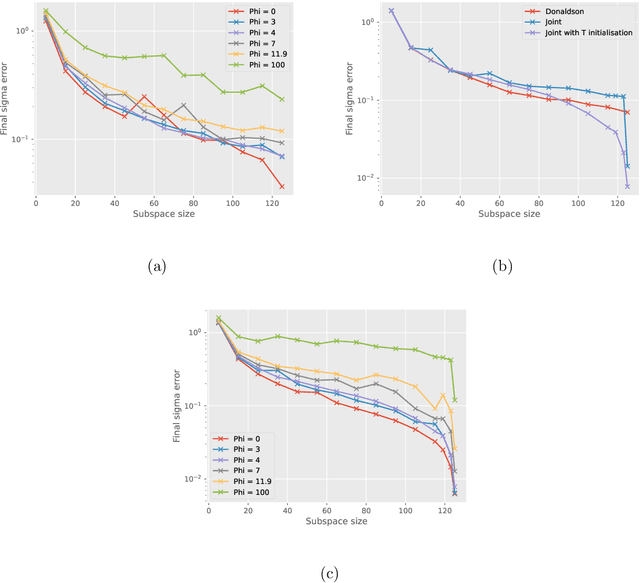
Motivated by recent progress in the problem of numerical K\"ahler metrics, we survey machine learning techniques in this area, discussing both advantages and drawbacks. We then revisit the algebraic ansatz pioneered by Donaldson. Inspired by his work, we present a novel approach to obtaining Ricci-flat approximations to K\"ahler metrics, applying machine learning within a `principled' framework. In particular, we use gradient descent on the Grassmannian manifold to identify an efficient subspace of sections for calculation of the metric. We combine this approach with both Donaldson's algorithm and learning on the $h$-matrix itself (the latter method being equivalent to gradient descent on the fibre bundle of Hermitian metrics on the tautological bundle over the Grassmannian). We implement our methods on the Dwork family of threefolds, commenting on the behaviour at different points in moduli space. In particular, we observe the emergence of nontrivial local minima as the moduli parameter is increased.