 Add to Chrome
 Add to Firefox
 Add to Edge
IndicDLP: A Foundational Dataset for Multi-Lingual and Multi-Domain Document Layout Parsing
Dec 23, 2025
Document layout analysis is essential for downstream tasks such as information retrieval, extraction, OCR, and digitization. However, existing large-scale datasets like PubLayNet and DocBank lack fine-grained region labels and multilingual diversity, making them insufficient for representing complex document layouts. In contrast, human-annotated datasets such as M6Doc and D4LA offer richer labels and greater domain diversity, but are too small to train robust models and lack adequate multilingual coverage. This gap is especially pronounced for Indic documents, which encompass diverse scripts yet remain underrepresented in current datasets, further limiting progress in this space. To address these shortcomings, we introduce IndicDLP, a large-scale foundational document layout dataset spanning 11 representative Indic languages alongside English and 12 common document domains. Additionally, we curate UED-mini, a dataset derived from DocLayNet and M6Doc, to enhance pretraining and provide a solid foundation for Indic layout models. Our experiments demonstrate that fine-tuning existing English models on IndicDLP significantly boosts performance, validating its effectiveness. Moreover, models trained on IndicDLP generalize well beyond Indic layouts, making it a valuable resource for document digitization. This work bridges gaps in scale, diversity, and annotation granularity, driving inclusive and efficient document understanding.

Can Vision-Language Models Evaluate Handwritten Math?
Jan 13, 2025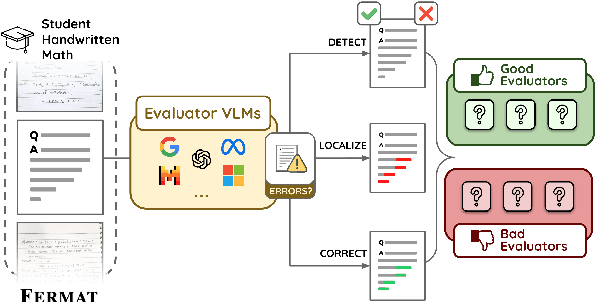
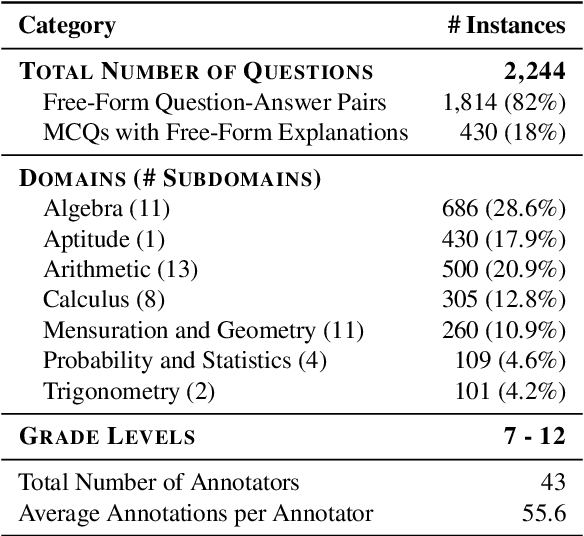
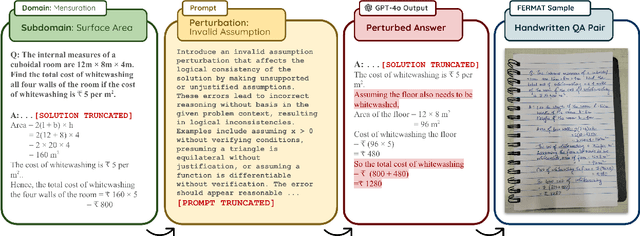
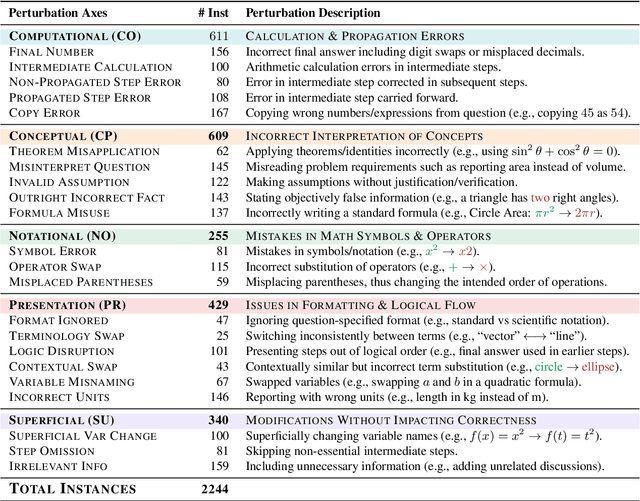
Recent advancements in Vision-Language Models (VLMs) have opened new possibilities in automatic grading of handwritten student responses, particularly in mathematics. However, a comprehensive study to test the ability of VLMs to evaluate and reason over handwritten content remains absent. To address this gap, we introduce FERMAT, a benchmark designed to assess the ability of VLMs to detect, localize and correct errors in handwritten mathematical content. FERMAT spans four key error dimensions - computational, conceptual, notational, and presentation - and comprises over 2,200 handwritten math solutions derived from 609 manually curated problems from grades 7-12 with intentionally introduced perturbations. Using FERMAT we benchmark nine VLMs across three tasks: error detection, localization, and correction. Our results reveal significant shortcomings in current VLMs in reasoning over handwritten text, with Gemini-1.5-Pro achieving the highest error correction rate (77%). We also observed that some models struggle with processing handwritten content, as their accuracy improves when handwritten inputs are replaced with printed text or images. These findings highlight the limitations of current VLMs and reveal new avenues for improvement. We release FERMAT and all the associated resources in the open-source to drive further research.