 Add to Chrome
 Add to Firefox
 Add to Edge
Gen-Fab: A Variation-Aware Generative Model for Predicting Fabrication Variations in Nanophotonic Devices
Mar 12, 2026
Silicon photonic devices often exhibit fabrication-induced variations such as over-etching, underetching, and corner rounding, which can significantly alter device performance. These variations are non-uniform and are influenced by feature size and shape. Accurate digital twins are therefore needed to predict the range of possible fabricated outcomes for a given design. In this paper, we introduce Gen-Fab, a conditional generative adversarial network (cGAN) based on Pix2Pix to predict and model uncertainty in photonic fabrication outcomes. The proposed method takes a design layout (in GDS format) as input and produces diverse high-resolution predictions similar to scanning electron microscope (SEM) images of fabricated devices, capturing the range of process variations at the nanometer scale. To enable one-to-many mapping, we inject a latent noise vector at the model bottleneck. We compare Gen-Fab against three baselines: (1) a deterministic U-Net predictor, (2) an inference-time Monte Carlo Dropout U-Net, and (3) an ensemble of varied U-Nets. Evaluations on an out-of-distribution dataset of fabricated photonic test structures demonstrate that Gen-Fab outperforms all baselines in both accuracy and uncertainty modeling. An additional distribution shift analysis further confirms its strong generalization to unseen fabrication geometries. Gen-Fab achieves the highest intersection-over-union (IoU) score of 89.8%, outperforming the deterministic U-Net (85.3%), the MC-Dropout U-Net (83.4%), and varying U-Nets (85.8%). It also better aligns with the distribution of real fabrication outcomes, achieving lower Kullback-Leibler divergence and Wasserstein distance.
* Accepted and published in Structural and Multidisciplinary Optimization (2026)

SEMU-Net: A Segmentation-based Corrector for Fabrication Process Variations of Nanophotonics with Microscopic Images
Nov 25, 2024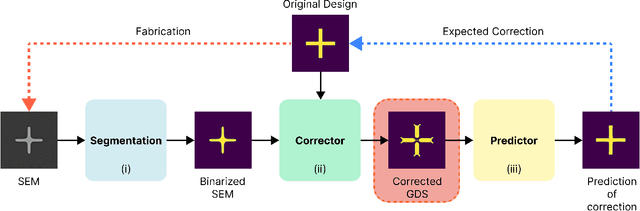
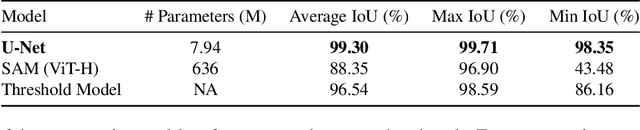
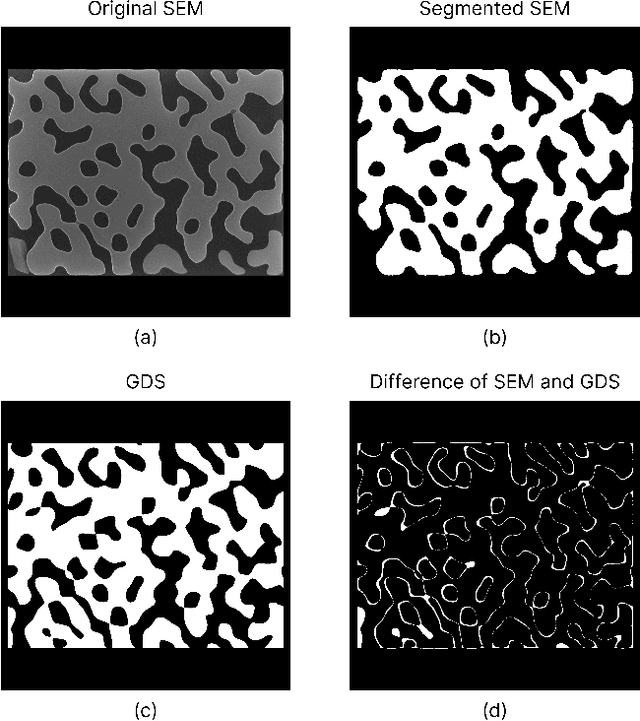
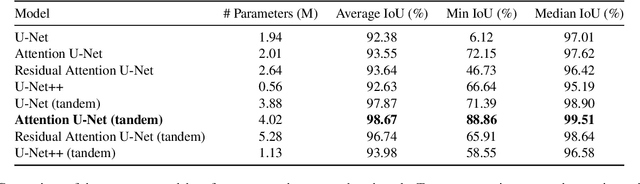
Integrated silicon photonic devices, which manipulate light to transmit and process information on a silicon-on-insulator chip, are highly sensitive to structural variations. Minor deviations during nanofabrication-the precise process of building structures at the nanometer scale-such as over- or under-etching, corner rounding, and unintended defects, can significantly impact performance. To address these challenges, we introduce SEMU-Net, a comprehensive set of methods that automatically segments scanning electron microscope images (SEM) and uses them to train two deep neural network models based on U-Net and its variants. The predictor model anticipates fabrication-induced variations, while the corrector model adjusts the design to address these issues, ensuring that the final fabricated structures closely align with the intended specifications. Experimental results show that the segmentation U-Net reaches an average IoU score of 99.30%, while the corrector attention U-Net in a tandem architecture achieves an average IoU score of 98.67%.
Improving Fabrication Fidelity of Integrated Nanophotonic Devices Using Deep Learning
Mar 21, 2023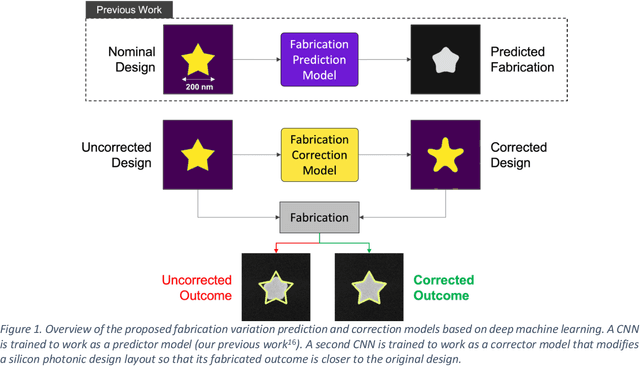
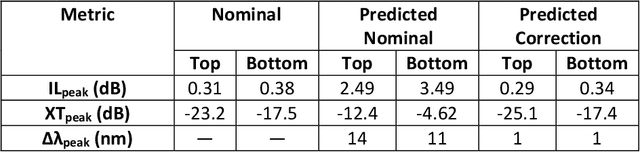

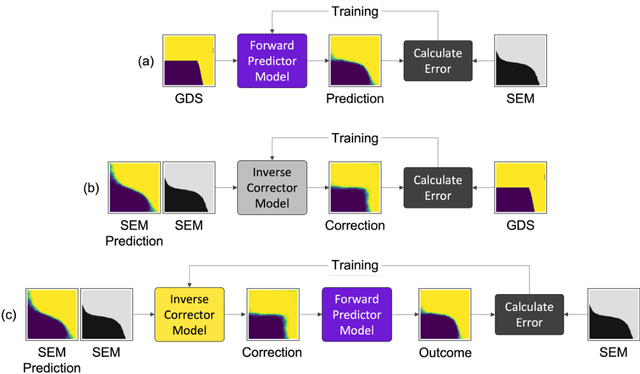
Next-generation integrated nanophotonic device designs leverage advanced optimization techniques such as inverse design and topology optimization which achieve high performance and extreme miniaturization by optimizing a massively complex design space enabled by small feature sizes. However, unless the optimization is heavily constrained, the generated small features are not reliably fabricated, leading to optical performance degradation. Even for simpler, conventional designs, fabrication-induced performance degradation still occurs. The degree of deviation from the original design not only depends on the size and shape of its features, but also on the distribution of features and the surrounding environment, presenting complex, proximity-dependent behavior. Without proprietary fabrication process specifications, design corrections can only be made after calibrating fabrication runs take place. In this work, we introduce a general deep machine learning model that automatically corrects photonic device design layouts prior to first fabrication. Only a small set of scanning electron microscopy images of engineered training features are required to create the deep learning model. With correction, the outcome of the fabricated layout is closer to what is intended, and thus so too is the performance of the design. Without modifying the nanofabrication process, adding significant computation in design, or requiring proprietary process specifications, we believe our model opens the door to new levels of reliability and performance in next-generation photonic circuits.