 Add to Chrome
 Add to Firefox
 Add to Edge
Transfer Learning of Keystroke Dynamics for Cross-Device User Authentication
Aug 17, 2026
Keystroke dynamics (typing patterns) can be used as a behavioural biometric modality for user authentication, with applications such as fraud prevention. While the modality has been shown to work well for single device authentication, its application to cross-device scenarios is more challenging. Dynamics learned on one device (eg., phone) may not be directly applicable to authentication on a secondary device with a different form factor (eg., tablet) due to changes in typing patterns that can lead to distribution drifts. To address this, we propose a cross-device user authentication system based on inductive transfer learning, where keystroke dynamics learned on one device are adapted to a secondary device. The adapted data is then combined with necessarily limited training data for the secondary device, which is used to robustly train a binary classifier. Furthermore, an extended set of keystroke features is used to better capture discriminative dynamics. Experiments on the BBMAS dataset show that proposed system achieves an equal error rate of 14.2% for the cross-device scenario, surpassing state-of-the-art methods.

DEFT: A new distance-based feature set for keystroke dynamics
Oct 06, 2023

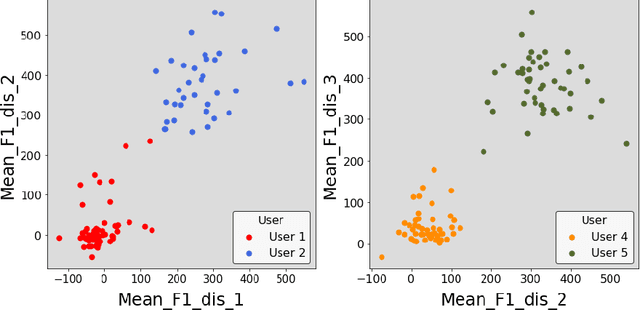
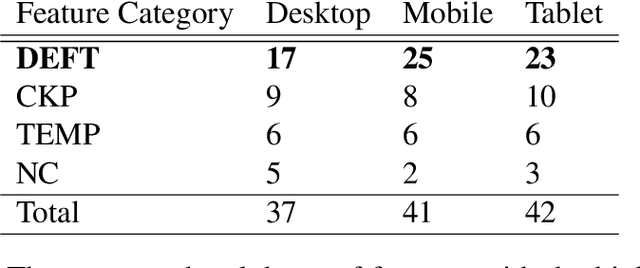
Keystroke dynamics is a behavioural biometric utilised for user identification and authentication. We propose a new set of features based on the distance between keys on the keyboard, a concept that has not been considered before in keystroke dynamics. We combine flight times, a popular metric, with the distance between keys on the keyboard and call them as Distance Enhanced Flight Time features (DEFT). This novel approach provides comprehensive insights into a person's typing behaviour, surpassing typing velocity alone. We build a DEFT model by combining DEFT features with other previously used keystroke dynamic features. The DEFT model is designed to be device-agnostic, allowing us to evaluate its effectiveness across three commonly used devices: desktop, mobile, and tablet. The DEFT model outperforms the existing state-of-the-art methods when we evaluate its effectiveness across two datasets. We obtain accuracy rates exceeding 99% and equal error rates below 10% on all three devices.