 Add to Chrome
 Add to Firefox
 Add to Edge
Site-Specific Finetuning of Neural Receivers with Real-World 5G NR Measurements
Mar 10, 2026
Finetuning wireless receivers to a specific deployment scenario can yield significant error-rate performance improvements without increasing processing complexity. However, site-specific finetuning has so far only been demonstrated on synthetic channel data and lacks real-world benchmarks. In this work, we empirically study site-specific finetuning of neural receivers using real-world 5G NR physical uplink shared channel (PUSCH) data collected with an over-the-air testbed at ETH Zurich across three scenarios: (i) a small laboratory, (ii) a large office floor, and (iii) a high-mobility outdoor environment. Our results confirm substantial error-rate performance improvements from site-specific finetuning, consistent with earlier findings based on synthetic channel data. Moreover, we demonstrate that these improvements generalize across different user-equipment hardware and deployment scenarios.

Machine Learning and Kalman Filtering for Nanomechanical Mass Spectrometry
Jun 01, 2023
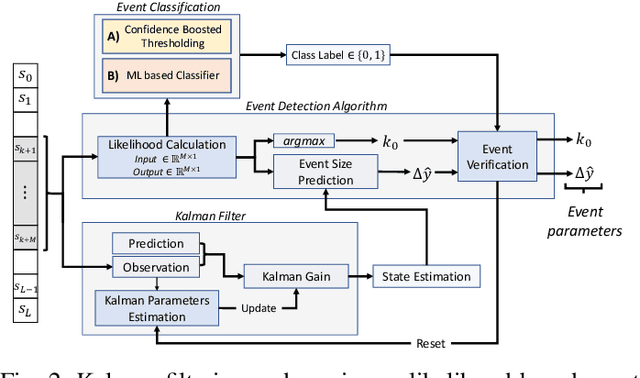


Nanomechanical resonant sensors are used in mass spectrometry via detection of resonance frequency jumps. There is a fundamental trade-off between detection speed and accuracy. Temporal and size resolution are limited by the resonator characteristics and noise. A Kalman filtering technique, augmented with maximum-likelihood estimation, was recently proposed as a Pareto optimal solution. We present enhancements and robust realizations for this technique, including a confidence boosted thresholding approach as well as machine learning for event detection. We describe learning techniques that are based on neural networks and boosted decision trees for temporal location and event size estimation. In the pure learning based approach that discards the Kalman filter, the raw data from the sensor are used in training a model for both location and size prediction. In the alternative approach that augments a Kalman filter, the event likelihood history is used in a binary classifier for event occurrence. Locations and sizes are predicted using maximum-likelihood, followed by a Kalman filter that continually improves the size estimate. We present detailed comparisons of the learning based schemes and the confidence boosted thresholding approach, and demonstrate robust performance for a practical realization.