 Add to Chrome
 Add to Firefox
 Add to Edge
Defer to Plan: Adaptive Multi-Agent Fusion for End-to-End V2X Driving
Jul 22, 2026
Vehicle-to-everything-aided autonomous driving (V2X-AD) significantly enhances driving performance through information sharing. However, existing collaborative perception methods only optimize module-level perception capabilities and fail to effectively serve the ultimate planning and control tasks. We propose an end-to-end collaborative driving system that directly optimizes planning task performance. The system employs MotionNetwork to fuse historical temporal information, utilizes attention mechanisms to efficiently compress spatial features into compact tokens, and adaptively fuses multi-agent features through an autoregressive decoder. Additionally, we introduce Mixture-of-Experts (MoE) architecture to enhance the model's representation capacity for heterogeneous features. Experiments demonstrate that our method achieves a driving score of 79.72, surpassing the state-of-the-art CoDriving baseline (77.15) by 3.33% in closed-loop evaluation while maintaining communication efficiency.

HeatV2X: Scalable Heterogeneous Collaborative Perception via Efficient Alignment and Interaction
Nov 13, 2025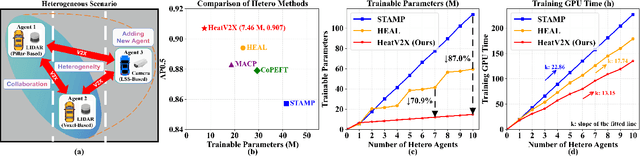
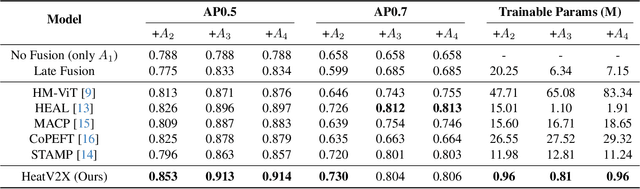
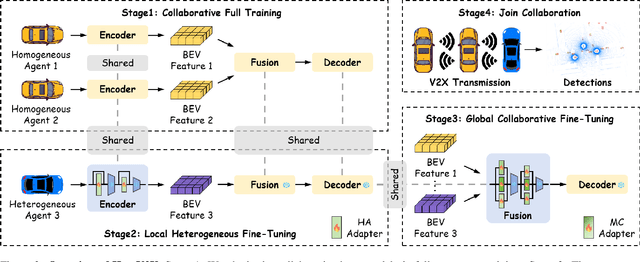
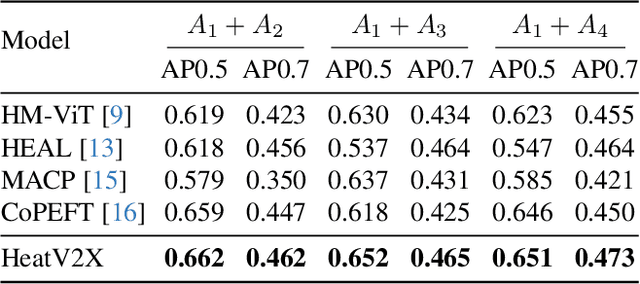
Vehicle-to-Everything (V2X) collaborative perception extends sensing beyond single vehicle limits through transmission. However, as more agents participate, existing frameworks face two key challenges: (1) the participating agents are inherently multi-modal and heterogeneous, and (2) the collaborative framework must be scalable to accommodate new agents. The former requires effective cross-agent feature alignment to mitigate heterogeneity loss, while the latter renders full-parameter training impractical, highlighting the importance of scalable adaptation. To address these issues, we propose Heterogeneous Adaptation (HeatV2X), a scalable collaborative framework. We first train a high-performance agent based on heterogeneous graph attention as the foundation for collaborative learning. Then, we design Local Heterogeneous Fine-Tuning and Global Collaborative Fine-Tuning to achieve effective alignment and interaction among heterogeneous agents. The former efficiently extracts modality-specific differences using Hetero-Aware Adapters, while the latter employs the Multi-Cognitive Adapter to enhance cross-agent collaboration and fully exploit the fusion potential. These designs enable substantial performance improvement of the collaborative framework with minimal training cost. We evaluate our approach on the OPV2V-H and DAIR-V2X datasets. Experimental results demonstrate that our method achieves superior perception performance with significantly reduced training overhead, outperforming existing state-of-the-art approaches. Our implementation will be released soon.