 Add to Chrome
 Add to Firefox
 Add to Edge
Specification-Guided Synthesis of Deadlock-Free Communication Protocol Refinements with Large Language Models
Jul 30, 2026
Ensuring behavioural correctness in communication protocols is a central challenge in distributed software systems, as subtle inconsistencies can lead to deadlocks. In such settings, protocol refinement - the safe substitution of a protocol that preserves correctness and compatibility with other components - is essential. Large language models (LLMs) have demonstrated strong capabilities in code generation and program synthesis, yet lack mechanisms to reliably produce outputs with correct behaviour. Formal specification approaches, such as multiparty session types (MPST), offer rigorous guarantees, including deadlock freedom, but provide limited support for automatically constructing protocol refinements. In this paper, we present Syntropy, a framework for synthesising protocol refinements guided by MPST specifications and LLMs. It incorporates refinement constraints directly into the generation process, ensuring the generated variants satisfy these guarantees. Our comprehensive evaluation indicates that Syntropy achieves 95.6%-99.5% validity while maintaining high syntactic correctness, and produces diverse, non-trivial refinements across multiple LLMs.

Multiparty Motion Coordination: From Choreographies to Robotics Programs
Oct 12, 2020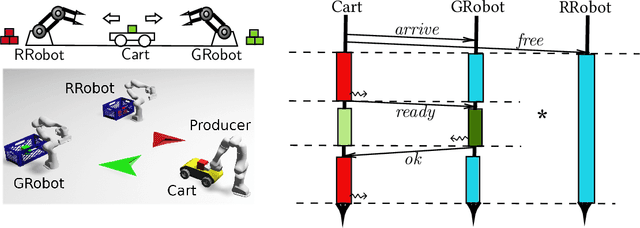
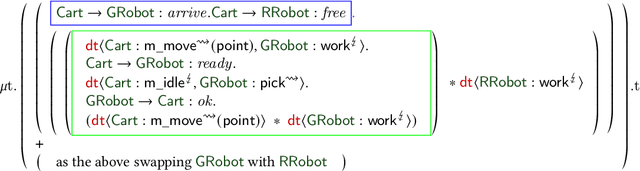
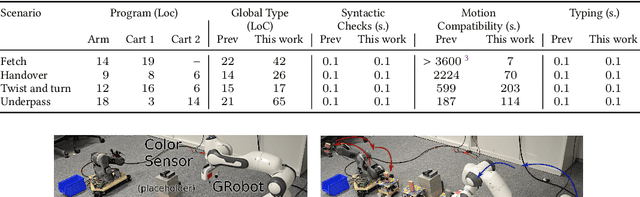
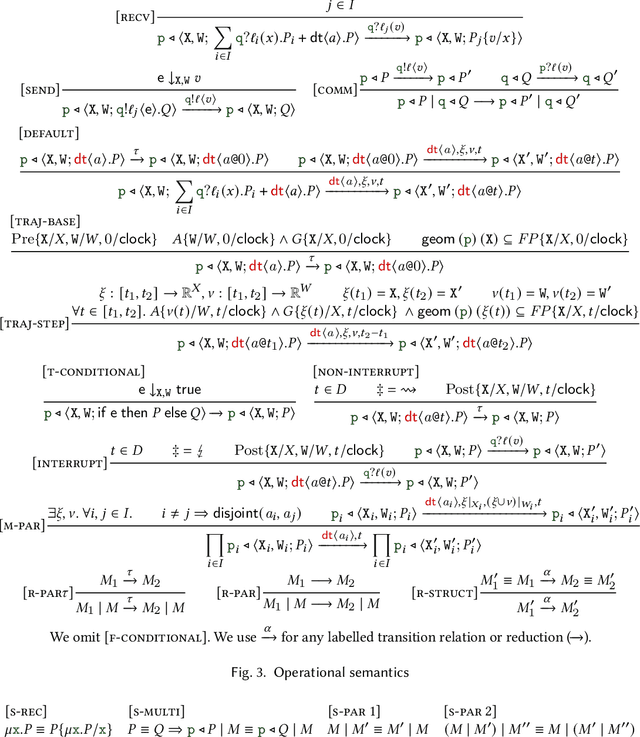
We present a programming model and typing discipline for complex multi-robot coordination programming. Our model encompasses both synchronisation through message passing and continuous-time dynamic motion primitives in physical space. We specify \emph{continuous-time motion primitives} in an assume-guarantee logic that ensures compatibility of motion primitives as well as collision freedom. We specify global behaviour of programs in a \emph{choreographic} type system that extends multiparty session types with jointly executed motion primitives, predicated refinements, as well as a \emph{separating conjunction} that allows reasoning about subsets of interacting robots. We describe a notion of \emph{well-formedness} for global types that ensures motion and communication can be correctly synchronised and provide algorithms for checking well-formedness, projecting a type, and local type checking. A well-typed program is \emph{communication safe}, \emph{motion compatible}, and \emph{collision free}. Our type system provides a compositional approach to ensuring these properties. We have implemented our model on top of the ROS framework. This allows us to program multi-robot coordination scenarios on top of commercial and custom robotics hardware platforms. We show through case studies that we can model and statically verify quite complex manoeuvres involving multiple manipulators and mobile robots---such examples are beyond the scope of previous approaches.